QUESTION IMAGE
Question
name
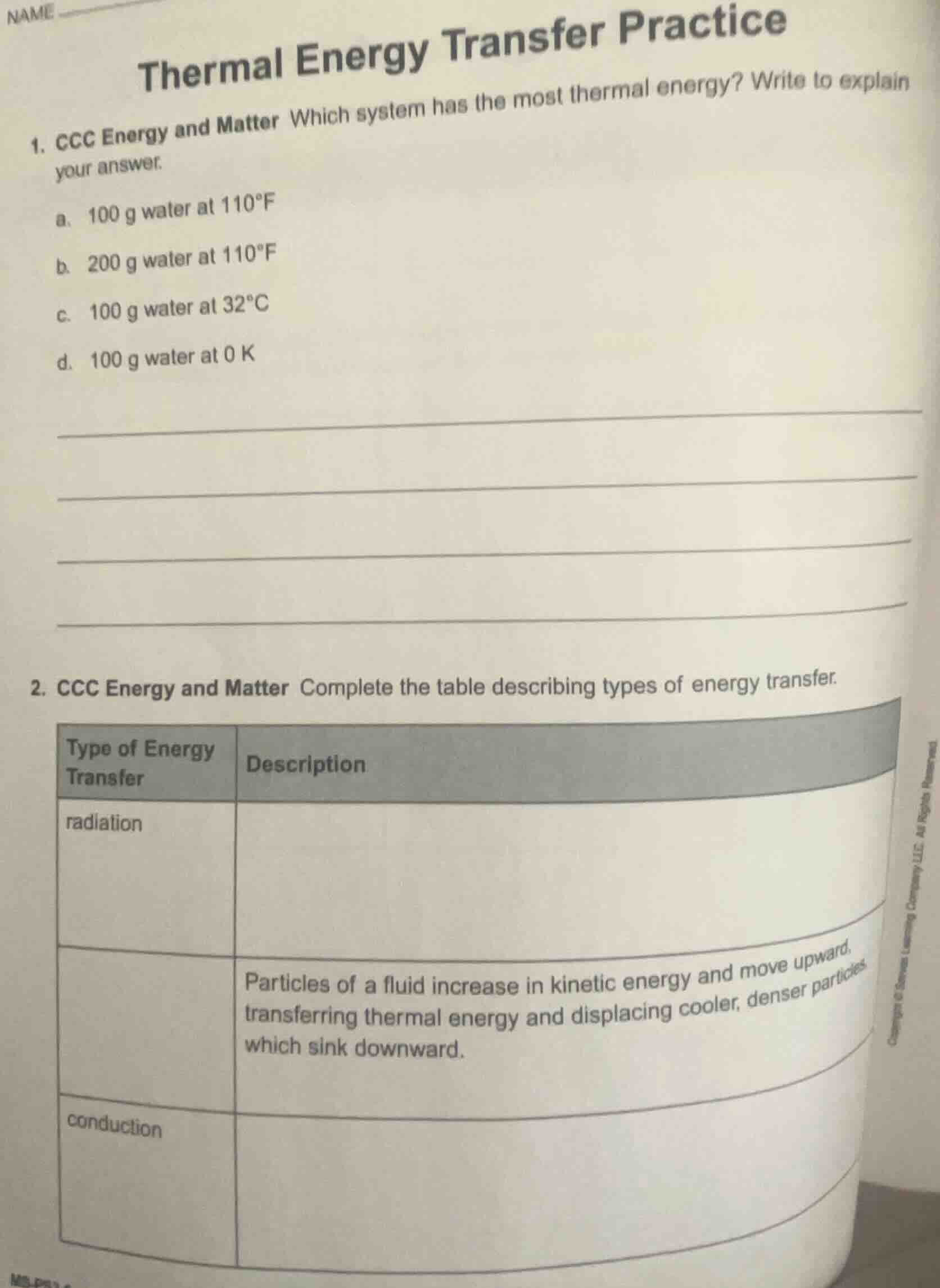
thermal energy transfer practice
- ccc energy and matter which system has the most thermal energy? write to explain your answer.
a. 100 g water at 110°f
b. 200 g water at 110°f
c. 100 g water at 32°c
d. 100 g water at 0 k
- ccc energy and matter complete the table describing types of energy transfer.
type of energy transfer | description
radiation |
| particles of a fluid increase in kinetic energy and move upward, transferring thermal energy and displacing cooler, denser particles which sink downward.
conduction |
Step1: Convert temps to same scale
First, convert $32^\circ\text{C}$ to °F: $^\circ\text{F} = (^\circ\text{C} \times \frac{9}{5}) + 32 = (32 \times \frac{9}{5}) + 32 = 89.6^\circ\text{F}$. 0 K is absolute zero, so thermal energy is 0.
Step2: Compare thermal energy
Thermal energy depends on mass and temperature. For same temp, more mass = more energy. 200 g at 110°F has more mass than 100 g at same temp, and 110°F > 89.6°F > 0 K.
Step3: Define radiation
Radiation uses EM waves, no medium required.
Step4: Identify convection
The given description matches fluid movement in convection.
Step5: Define conduction
Conduction is direct particle contact energy transfer.

Snap & solve any problem in the app
Get step-by-step solutions on Sovi AI
Photo-based solutions with guided steps
Explore more problems and detailed explanations
- b. 200 g water at 110°F
2.
| Type of Energy Transfer | Description |
|---|---|
| convection | Particles of a fluid increase in kinetic energy and move upward, transferring thermal energy and displacing cooler, denser particles which sink downward. |
| conduction | Transfer of thermal energy through direct contact of particles. |