QUESTION IMAGE
Question
name
venus
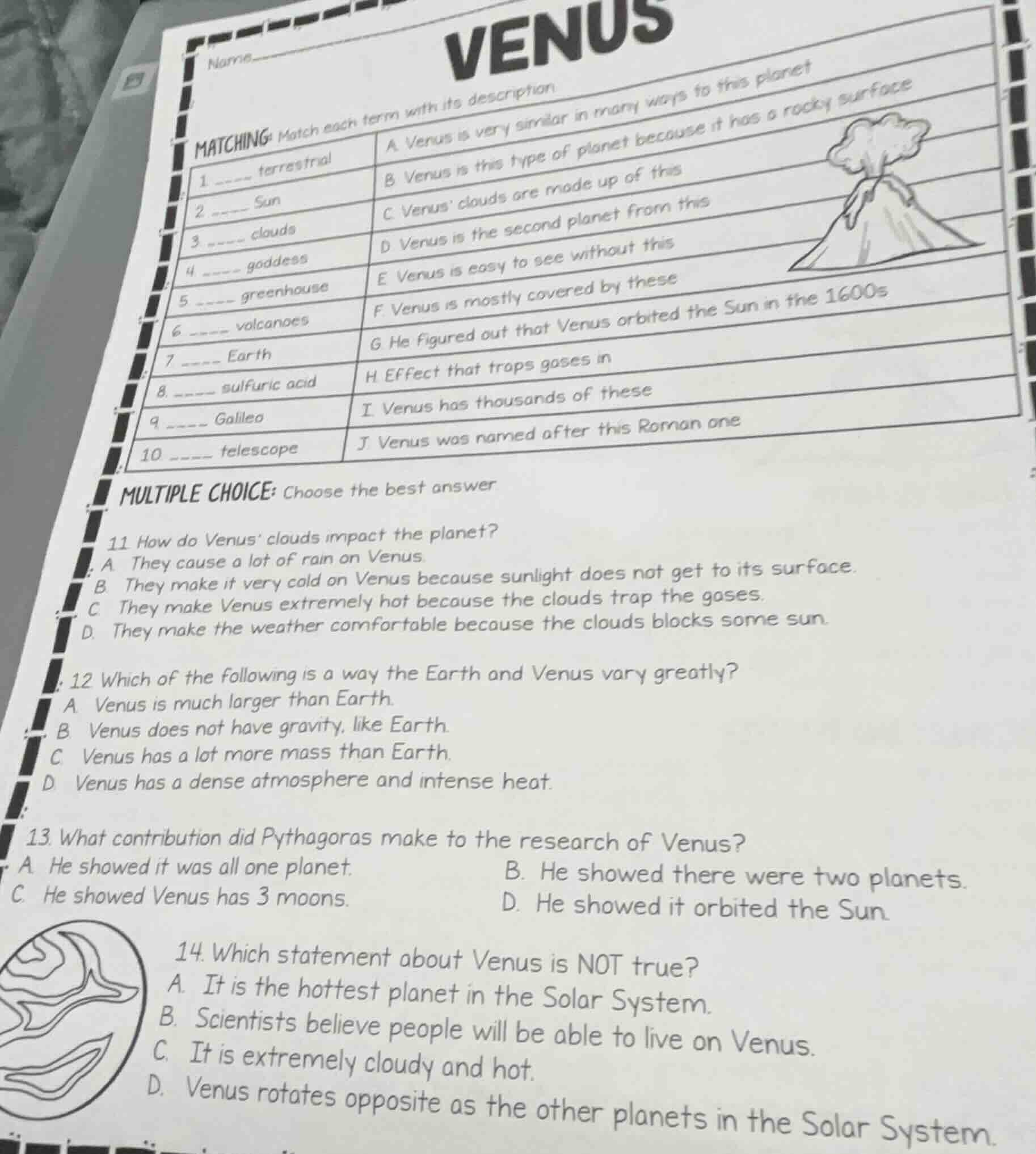
matching: match each term with its description
1 ------ terrestrial a. venus is very similar in many ways to this planet
2 ------ sun b. venus is this type of planet because it has a rocky surface
3 ------ clouds c. venus clouds are made up of this
4 ------ goddess d. venus is the second planet from this
5 ------ greenhouse e. venus is easy to see without this
6 ------ volcanoes f. venus is mostly covered by these
7 ------ earth g. he figured out that venus orbited the sun in the 1600s
8 ------ sulfuric acid h. effect that traps gases in
9 ------ galileo i. venus has thousands of these
10 ------ telescope j. venus was named after this roman one
multiple choice: choose the best answer
- how do venus clouds impact the planet?
a. they cause a lot of rain on venus.
b. they make it very cold on venus because sunlight does not get to its surface.
c. they make venus extremely hot because the clouds trap the gases.
d. they make the weather comfortable because the clouds blocks some sun.
12 which of the following is a way the earth and venus vary greatly?
a. venus is much larger than earth.
b. venus does not have gravity, like earth.
c. venus has a lot more mass than earth.
d. venus has a dense atmosphere and intense heat.
- what contribution did pythagoras make to the research of venus?
a. he showed it was all one planet. b. he showed there were two planets.
c. he showed venus has 3 moons. d. he showed it orbited the sun.
- which statement about venus is not true?
a. it is the hottest planet in the solar system.
b. scientists believe people will be able to live on venus.
c. it is extremely cloudy and hot.
d. venus rotates opposite as the other planets in the solar system.
Step1: Match terms to descriptions
- terrestrial → B. Venus is this type of planet because it has a rocky surface
- Sun → D. Venus is the second planet from this
- clouds → F. Venus is mostly covered by these
- goddess → J. Venus was named after this Roman one
- greenhouse → H. Effect that traps gases in
- volcanoes → I. Venus has thousands of these
- Earth → A. Venus is very similar in many ways to this planet
- sulfuric acid → C. Venus' clouds are made up of this
- Galileo → G. He figured out that Venus orbited the Sun in the 1600s
- telescope → E. Venus is easy to see without this
Step2: Answer multiple choice questions
- Select correct cloud impact: Venus' clouds cause extreme heat via trapping gases.
- Select key Earth-Venus difference: Venus has dense atmosphere/intense heat.
- Select Pythagoras' Venus contribution: He thought it was two separate objects.
- Select false Venus statement: Venus is uninhabitable for humans.

Snap & solve any problem in the app
Get step-by-step solutions on Sovi AI
Photo-based solutions with guided steps
Explore more problems and detailed explanations
Matching Answers:
- B. Venus is this type of planet because it has a rocky surface
- D. Venus is the second planet from this
- F. Venus is mostly covered by these
- J. Venus was named after this Roman one
- H. Effect that traps gases in
- I. Venus has thousands of these
- A. Venus is very similar in many ways to this planet
- C. Venus' clouds are made up of this
- G. He figured out that Venus orbited the Sun in the 1600s
- E. Venus is easy to see without this
Multiple Choice Answers:
- C. They make Venus extremely hot because the clouds trap the gases.
- D. Venus has a dense atmosphere and intense heat.
- B. He showed there were two planets.
- B. Scientists believe people will be able to live on Venus.