QUESTION IMAGE
Question
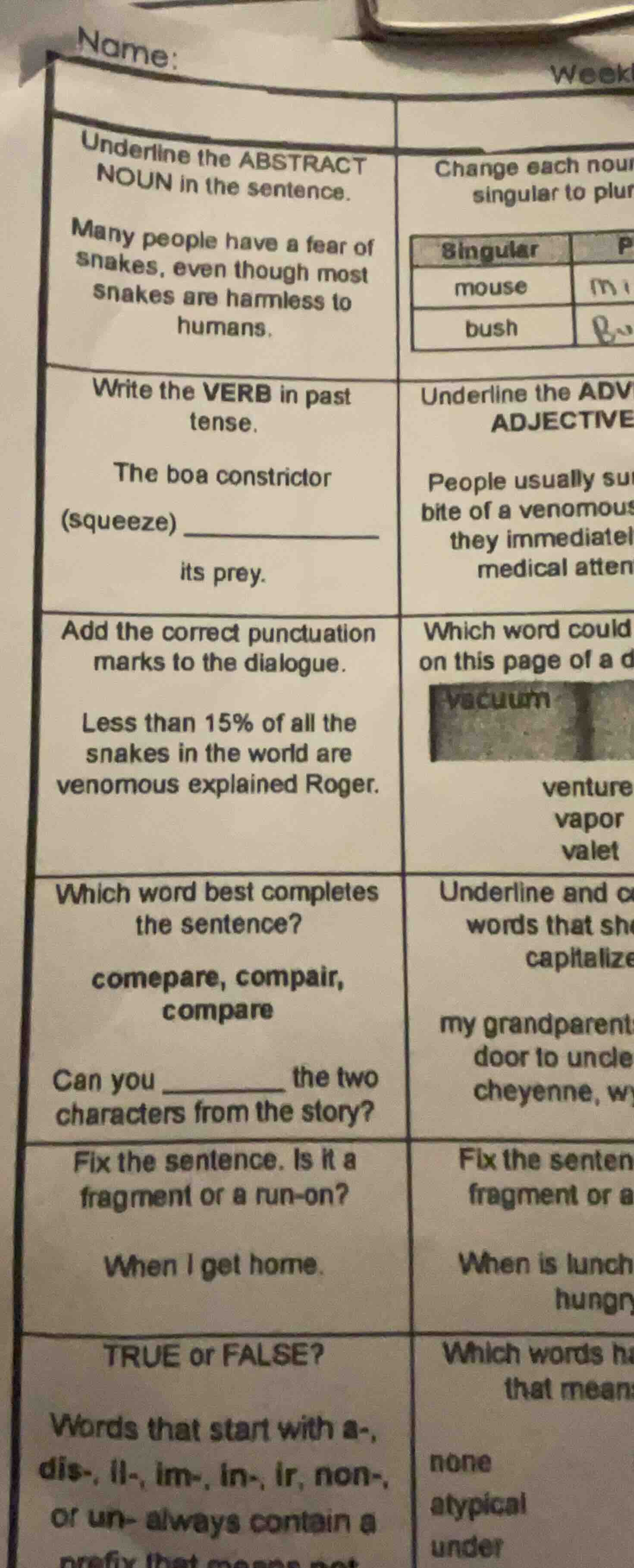
name: week underline the abstract noun in the sentence. many people have a fear of snakes, even though most snakes are harmless to humans. change each noun singular to plur singular p mouse bush write the verb in past tense. the boa constrictor (squeeze) ______ its prey. underline the adv adjective people usually su bite of a venomous they immediatel medical atten add the correct punctuation marks to the dialogue. less than 15% of all the snakes in the world are venomous explained roger. which word could on this page of a d vacuum venture vapor valet which word best completes the sentence? comepare, compair, compare can you ____ the two characters from the story? underline and o words that sh capitalize my grandparent door to uncle cheyenne, wy fix the sentence. is it a fragment or a run - on? when i get home. fix the senten fragment or a when is lunch hungr true or false? words that start with a -, dis -, il -, im -, in -, ir, non -, or un - always contain a prefix that means not none atypical under
1. Underline the ABSTRACT NOUN in the sentence.
- Sentence: Many people have a fear of snakes, even though most snakes are harmless to humans.
- Abstract noun: fear (Abstract nouns refer to ideas, feelings, concepts, etc., and "fear" is a feeling. "People", "snakes", "humans" are concrete nouns as they refer to physical beings.)
- Underlined: $\underline{\text{fear}}$
2. Write the VERB in past tense.
- Verb: squeeze
- Past tense of "squeeze" (a regular verb? No, "squeeze" is a regular verb? Wait, "squeeze" has the past tense "squeezed" (for regular verbs ending in -eeze, we usually add -d, but actually, "squeeze" is a regular verb, so past tense is "squeezed". Wait, no, wait: the base form is "squeeze", past tense is "squeezed" (because for verbs ending in -eeze, we add -d? Wait, no, "squeeze" is a regular verb, so past tense is "squeezed". Wait, actually, "squeeze" is a regular verb, so past tense is "squeezed". Wait, no, let's check: the rule for regular verbs is add -ed, but if the verb ends with -e, we add -d. "Squeeze" ends with -e, so past tense is "squeezed".
- Answer: squeezed
3. Add the correct punctuation marks to the dialogue.
- Sentence: Less than 15% of all the snakes in the world are venomous explained Roger.
- We need to add quotation marks for the dialogue (since Roger is explaining, so the statement "Less than 15% of all the snakes in the world are venomous" is what Roger said, and then "explained Roger" at the end. So: "Less than 15% of all the snakes in the world are venomous," explained Roger.
- Answer: "Less than 15% of all the snakes in the world are venomous," explained Roger.
4. Which word best completes the sentence?
- Sentence: Can you ______ the two characters from the story?
- Options: comepare, compair, compare
- Correct spelling: "compare" (the other two are misspellings: "comepare" has an extra "e", "compair" is incorrect; the correct spelling is "compare" which means to examine the similarities and differences between two or more things.)
- Answer: compare
5. Fix the sentence. Is it a fragment or a run - on?
- Sentence: When I get home.
- This is a fragment because it is a dependent clause (starts with "when") and does not express a complete thought. To fix it, we can add an independent clause, e.g., "When I get home, I will do my homework."
- Fragment or run - on: fragment
- Fixed sentence: When I get home, (add an independent clause, e.g., "When I get home, I will rest.")
6. TRUE or FALSE?
- Statement: Words that start with a -, dis -, il -, im -, in -, ir, non -, or un - always contain a prefix that means not.
- Let's analyze:
- "a -": in some cases, "a -" can mean "not" (e.g., "asymmetrical" = not symmetrical), but "a -" can also mean "on" (e.g., "a - bed" (archaic) meaning on bed? Wait, no, more common: "a -" in "asleep" means "in a state of", not "not". Wait, "asleep" means in a state of sleep, not "not sleep". Wait, maybe the statement is not entirely accurate. Wait, "dis -": "dislike" = not like; "il -": "illegal" = not legal; "im -": "impossible" = not possible; "in -": "inactive" = not active; "ir -": "irregular" = not regular; "non -": "non - stop" = not stop; "un -": "unhappy" = not happy. But "a -" in "asleep" does not mean "not", it means "in a state of". So the statement says "always", but there are exceptions. So the answer is FALSE.
- Answer: FALSE
7. (The "Change each noun singular to plural" part: for "mouse", the plural is "mice"; for "bush", the plural is "bushes".)
- Mouse: mice
- Bush: bushes
8. (The "Underline the ADVERB/ADJECTIVE" part…

Snap & solve any problem in the app
Get step-by-step solutions on Sovi AI
Photo-based solutions with guided steps
Explore more problems and detailed explanations
1. Underline the ABSTRACT NOUN in the sentence.
- Sentence: Many people have a fear of snakes, even though most snakes are harmless to humans.
- Abstract noun: fear (Abstract nouns refer to ideas, feelings, concepts, etc., and "fear" is a feeling. "People", "snakes", "humans" are concrete nouns as they refer to physical beings.)
- Underlined: $\underline{\text{fear}}$
2. Write the VERB in past tense.
- Verb: squeeze
- Past tense of "squeeze" (a regular verb? No, "squeeze" is a regular verb? Wait, "squeeze" has the past tense "squeezed" (for regular verbs ending in -eeze, we usually add -d, but actually, "squeeze" is a regular verb, so past tense is "squeezed". Wait, no, wait: the base form is "squeeze", past tense is "squeezed" (because for verbs ending in -eeze, we add -d? Wait, no, "squeeze" is a regular verb, so past tense is "squeezed". Wait, actually, "squeeze" is a regular verb, so past tense is "squeezed". Wait, no, let's check: the rule for regular verbs is add -ed, but if the verb ends with -e, we add -d. "Squeeze" ends with -e, so past tense is "squeezed".
- Answer: squeezed
3. Add the correct punctuation marks to the dialogue.
- Sentence: Less than 15% of all the snakes in the world are venomous explained Roger.
- We need to add quotation marks for the dialogue (since Roger is explaining, so the statement "Less than 15% of all the snakes in the world are venomous" is what Roger said, and then "explained Roger" at the end. So: "Less than 15% of all the snakes in the world are venomous," explained Roger.
- Answer: "Less than 15% of all the snakes in the world are venomous," explained Roger.
4. Which word best completes the sentence?
- Sentence: Can you ______ the two characters from the story?
- Options: comepare, compair, compare
- Correct spelling: "compare" (the other two are misspellings: "comepare" has an extra "e", "compair" is incorrect; the correct spelling is "compare" which means to examine the similarities and differences between two or more things.)
- Answer: compare
5. Fix the sentence. Is it a fragment or a run - on?
- Sentence: When I get home.
- This is a fragment because it is a dependent clause (starts with "when") and does not express a complete thought. To fix it, we can add an independent clause, e.g., "When I get home, I will do my homework."
- Fragment or run - on: fragment
- Fixed sentence: When I get home, (add an independent clause, e.g., "When I get home, I will rest.")
6. TRUE or FALSE?
- Statement: Words that start with a -, dis -, il -, im -, in -, ir, non -, or un - always contain a prefix that means not.
- Let's analyze:
- "a -": in some cases, "a -" can mean "not" (e.g., "asymmetrical" = not symmetrical), but "a -" can also mean "on" (e.g., "a - bed" (archaic) meaning on bed? Wait, no, more common: "a -" in "asleep" means "in a state of", not "not". Wait, "asleep" means in a state of sleep, not "not sleep". Wait, maybe the statement is not entirely accurate. Wait, "dis -": "dislike" = not like; "il -": "illegal" = not legal; "im -": "impossible" = not possible; "in -": "inactive" = not active; "ir -": "irregular" = not regular; "non -": "non - stop" = not stop; "un -": "unhappy" = not happy. But "a -" in "asleep" does not mean "not", it means "in a state of". So the statement says "always", but there are exceptions. So the answer is FALSE.
- Answer: FALSE
7. (The "Change each noun singular to plural" part: for "mouse", the plural is "mice"; for "bush", the plural is "bushes".)
- Mouse: mice
- Bush: bushes