QUESTION IMAGE
Question
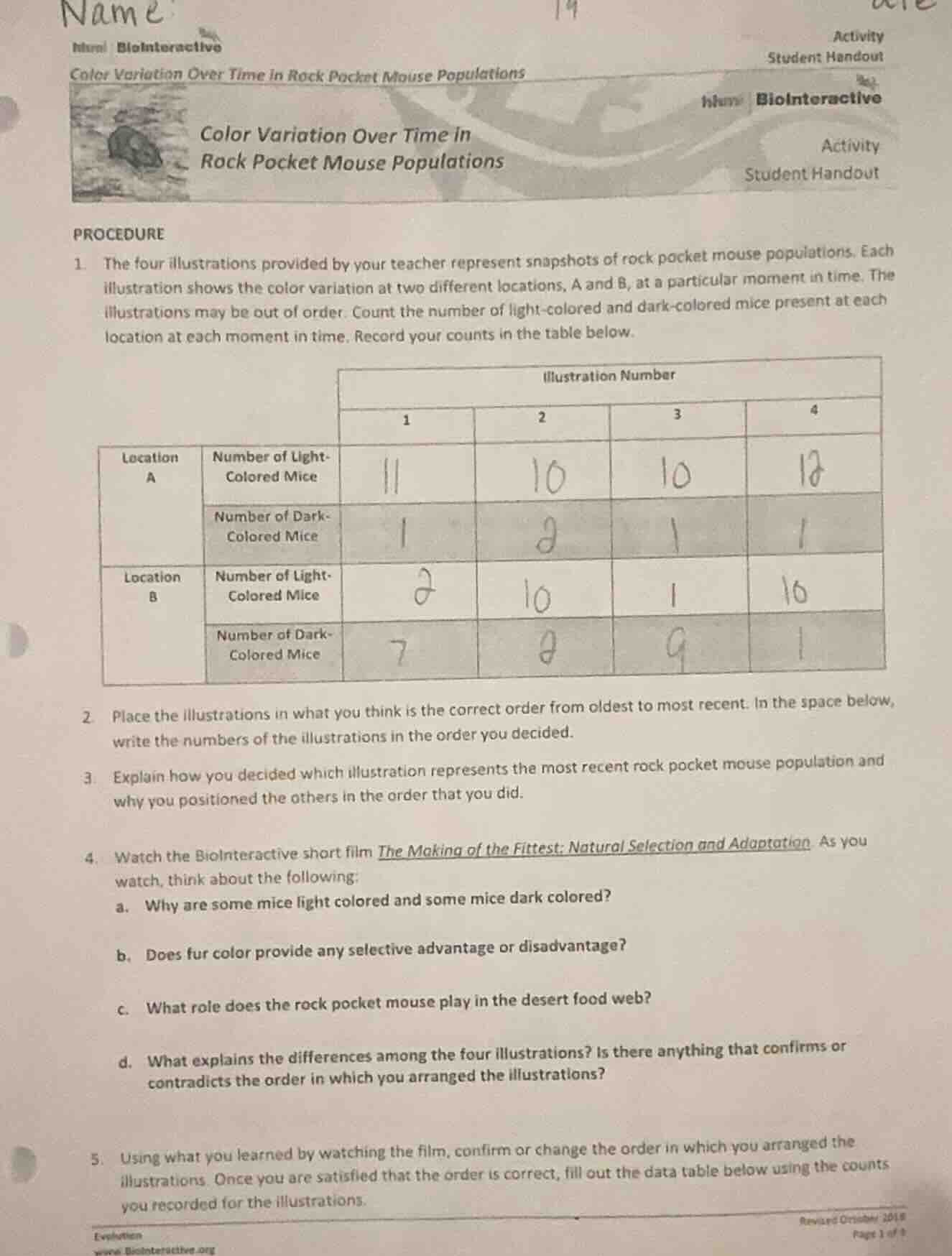
namehhmi biointeractivecolor variation over time in rock pocket mouse populationsactivitystudent handouthhmi biointeractivecolor variation over time inrock pocket mouse populationsactivitystudent handoutprocedure1. the four illustrations provided by your teacher represent snapshots of rock pocket mouse populations. each illustration shows the color variation at two different locations, a and b, at a particular moment in time. the illustrations may be out of order. count the number of light-colored and dark-colored mice present at each location at each moment in time. record your counts in the table below.| location | | illustration number | | | || ---- | ---- | ---- | ---- | ---- | ---- || | | 1 | 2 | 3 | 4 || location a | number of light-colored mice | 11 | 10 | 10 | 12 || | number of dark-colored mice | 1 | 2 | 1 | 1 || location b | number of light-colored mice | 2 | 10 | 1 | 10 || | number of dark-colored mice | 7 | 2 | 9 | 1 |2. place the illustrations in what you think is the correct order from oldest to most recent. in the space below, write the numbers of the illustrations in the order you decided.3. explain how you decided which illustration represents the most recent rock pocket mouse population and why you positioned the others in the order that you did.4. watch the biointeractive short film the making of the fittest: natural selection and adaptation. as you watch, think about the following:a. why are some mice light colored and some mice dark colored?b. does fur color provide any selective advantage or disadvantage?c. what role does the rock pocket mouse play in the desert food web?d. what explains the differences among the four illustrations? is there anything that confirms or contradicts the order in which you arranged the illustrations?5. using what you learned by watching the film, confirm or change the order in which you arranged the illustrations. once you are satisfied that the order is correct, fill out the data table below using the counts you recorded for the illustrations.
For Question 2:
This activity is based on natural selection in rock pocket mice, where light mice are favored on light-colored rocks (Location A) and dark mice on dark volcanic rocks (Location B). We order the illustrations by tracking the shift in mouse populations to match their environment:
- Start with the state before volcanic rock covered Location B: Location A has mostly light mice, Location B has mostly light mice (Illustration 4: A:12 light/1 dark; B:10 light/1 dark).
- Next, volcanic rock forms at Location B, dark mice start to increase there (Illustration 2: A:10 light/2 dark; B:10 light/2 dark).
- Then, dark mice become dominant at Location B as natural selection acts (Illustration 1: A:11 light/1 dark; B:2 light/7 dark).
- Finally, dark mice are fully dominant at Location B, light mice remain dominant at Location A (Illustration 3: A:10 light/1 dark; B:1 light/9 dark).
For Question 3:
The most recent illustration is 3 because it shows the population best adapted to their environments: nearly all dark mice on dark rocks (Location B) and nearly all light mice on light rocks (Location A), which is the end result of natural selection. The order 4 → 2 → 1 → 3 follows the progression of environmental change (volcanic rock formation at B) and natural selection: starting with all light populations, then dark mice appearing at B, then dark mice becoming more common at B, and finally dark mice being dominant at B.
For Question 4:
a. Mice have different fur colors due to genetic mutations; some mutations produce dark fur pigment, while the wild-type gene produces light fur.
b. Yes: light fur is an advantage on light-colored rocks (camouflages mice from predators), while dark fur is an advantage on dark volcanic rocks. The opposite fur color is a disadvantage, as it makes mice more visible to predators.
c. Rock pocket mice are primary consumers: they eat desert seeds, and they are prey for predators like owls, snakes, and foxes, so they transfer energy from plants to higher trophic levels in the desert food web.
d. The differences are explained by natural selection: changes in the environment (dark volcanic rock at Location B) led to differential survival of mice with fur colors matching their habitat. This confirms the order 4 → 2 → 1 → 3, as it follows the gradual adaptation of the population to the new environment.
For Question 5:
The confirmed correct order from oldest to most recent is 4, 2, 1, 3. The data table aligned to this order is:
| Location | Group | Oldest (4) | 2 | 1 | Most Recent (3) |
|---|---|---|---|---|---|
| A | Dark-colored Mice | 1 | 2 | 1 | 1 |
| B | Light-colored Mice | 10 | 10 | 2 | 1 |
| B | Dark-colored Mice | 1 | 2 | 7 | 9 |

Snap & solve any problem in the app
Get step-by-step solutions on Sovi AI
Photo-based solutions with guided steps
Explore more problems and detailed explanations
- 4, 2, 1, 3
- Most recent: 3. Order follows natural selection: starts with all light populations, dark mice appear at B, become more common, then dominate B.
- a. Genetic mutations cause fur color differences.
b. Yes: fur color matches habitat for camouflage.
c. They are seed-eating prey for desert predators.
d. Natural selection; confirms the ordered progression.
- Confirmed order: 4, 2, 1, 3. Aligned data table as shown above.