QUESTION IMAGE
Question
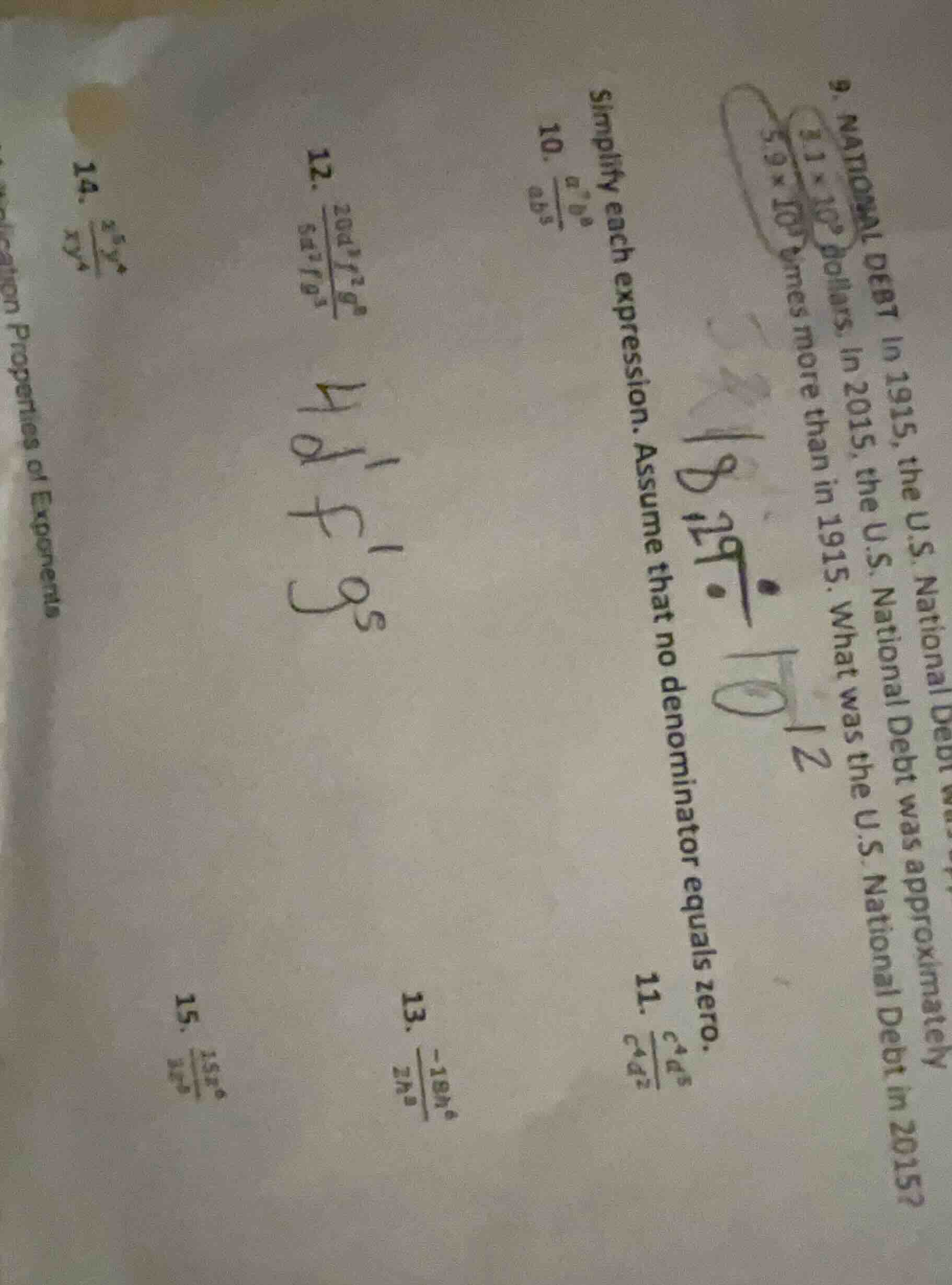
- national debt in 1915, the u.s. national debt was approximately 3.1×10² dollars. in 2015, the u.s. national debt was 5.9×10⁹ times more than in 1915. what was the u.s. national debt in 2015? simplify each expression. assume that no denominator equals zero. 10. \\(\frac{a^7b^9}{ab^3}\\) 11. \\(\frac{c^4d^5}{c^4d^2}\\) 12. \\(\frac{20a^4f^3g^2}{5a^3fg^3}\\) 13. \\(\frac{-18h^4}{2h^3}\\) 14. \\(\frac{5y^4}{xy^4}\\) 15. \\(\frac{15k^6}{3k^5}\\)
Problem 10: Simplify \(\boldsymbol{\frac{a^7b^9}{ab^3}}\)
Step 1: Apply Quotient Rule for Exponents (\( \frac{x^m}{x^n} = x^{m - n} \)) to \(a\) terms.
For the \(a\) terms: \(\frac{a^7}{a^1}=a^{7 - 1}=a^6\)
Step 2: Apply Quotient Rule for Exponents to \(b\) terms.
For the \(b\) terms: \(\frac{b^9}{b^3}=b^{9 - 3}=b^6\)
Step 3: Combine the results.
Multiply the simplified \(a\) and \(b\) terms: \(a^6 \cdot b^6 = a^6b^6\)
Step 1: Apply Quotient Rule for Exponents to \(c\) terms.
For the \(c\) terms: \(\frac{c^4}{c^4}=c^{4 - 4}=c^0 = 1\) (since \(x^0 = 1\) for \(x
eq0\))
Step 2: Apply Quotient Rule for Exponents to \(d\) terms.
For the \(d\) terms: \(\frac{d^5}{d^2}=d^{5 - 2}=d^3\)
Step 3: Combine the results.
Multiply the simplified \(c\) and \(d\) terms: \(1 \cdot d^3 = d^3\)
Step 1: Simplify the coefficient.
\(\frac{20}{5}=4\)
Step 2: Apply Quotient Rule for Exponents to \(a\) terms.
\(\frac{a^4}{a^2}=a^{4 - 2}=a^2\)
Step 3: Apply Quotient Rule for Exponents to \(f\) terms.
\(\frac{f^3}{f^1}=f^{3 - 1}=f^2\)
Step 4: Apply Quotient Rule for Exponents to \(g\) terms.
\(\frac{g^2}{g^3}=g^{2 - 3}=g^{-1}=\frac{1}{g}\) (since \(x^{-n}=\frac{1}{x^n}\))
Step 5: Combine the results.
Multiply the simplified coefficient, \(a\), \(f\), and \(g\) terms: \(4 \cdot a^2 \cdot f^2 \cdot \frac{1}{g}=\frac{4a^2f^2}{g}\)

Snap & solve any problem in the app
Get step-by-step solutions on Sovi AI
Photo-based solutions with guided steps
Explore more problems and detailed explanations
\(a^6b^6\)