QUESTION IMAGE
Question
nations promise not to use child soldiers
just for me: international cooperation
paris, french. african, asian, and south
american nations where child fighters have
been sent into battle endorsed a new
international agreement that commits them
to stopping the practice. it also commits
them to punishing those who recruit child
soldiers. the so-called \paris
commitments\ include the support of sierra
leone, congo, colombia, sudan, and
somalia, as well as all 27 nations of the
european union.
the united nations claims that at least 250,000 boys and girls are currently
fighting in about a dozen conflicts around the world. they are used as
soldiers, messengers, and spies. the paris commitments document requires
its backers to \spare no effort\ to end the use of soldiers younger than 18
years old. it requires that its backers remove all currently underage soldiers
from battle. the document also states that anyone who has recruited child
soldiers will be denied requests for political protection.
many involved in the agreement are hopeful about its potential impact.
french foreign minister philippe douste-blazy insisted the document is more
than just \good words.\ ivory coasts foreign minister, youssouf bakayoko,
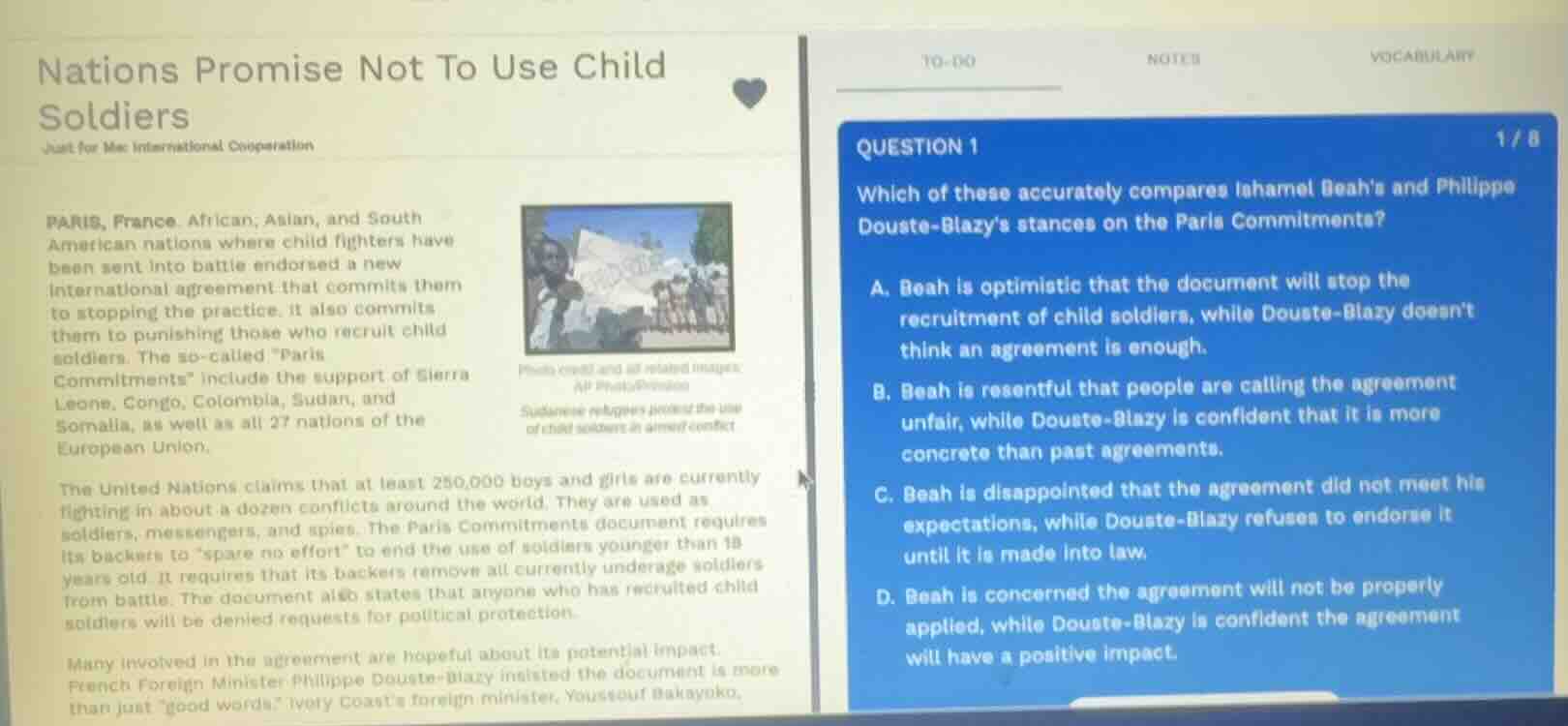
photo credit: all related images
ap photo/shirley
sudanese refugees protest the use
of child soldiers in armed conflict
to-do
notes
vocabulary
question 1 1/8
which of these accurately compares ishamel beahs and philippe
douste-blazys stances on the paris commitments?
a. beah is optimistic that the document will stop the
recruitment of child soldiers, while douste-blazy doesnt
think an agreement is enough.
b. beah is resentful that people are calling the agreement
unfair, while douste-blazy is confident that it is more
concrete than past agreements.
c. beah is disappointed that the agreement did not meet his
expectations, while douste-blazy refuses to endorse it
until it is made into law.
d. beah is concerned the agreement will not be properly
applied, while douste-blazy is confident the agreement
will have a positive impact.
First, identify the stances from the text: Philippe Douste-Blazy states the document is "more than just 'good words'", showing confidence in its positive impact. While the text does not explicitly state Ishmael Beah's stance, we can eliminate incorrect options:
- Option A is wrong because Douste-Blazy does express confidence in the agreement, not that it's insufficient.
- Option B is wrong as there is no mention of Beah being resentful about the agreement being called unfair.
- Option C is wrong because Douste-Blazy endorses the agreement, and there's no mention of him refusing to do so until it's law.
- Option D aligns with the context: Beah, a former child soldier, would logically have concerns about proper implementation, while Douste-Blazy's quote confirms his confidence in the agreement's positive impact.

Snap & solve any problem in the app
Get step-by-step solutions on Sovi AI
Photo-based solutions with guided steps
Explore more problems and detailed explanations
D. Beah is concerned the agreement will not be properly applied, while Douste-Blazy is confident the agreement will have a positive impact.