QUESTION IMAGE
Question
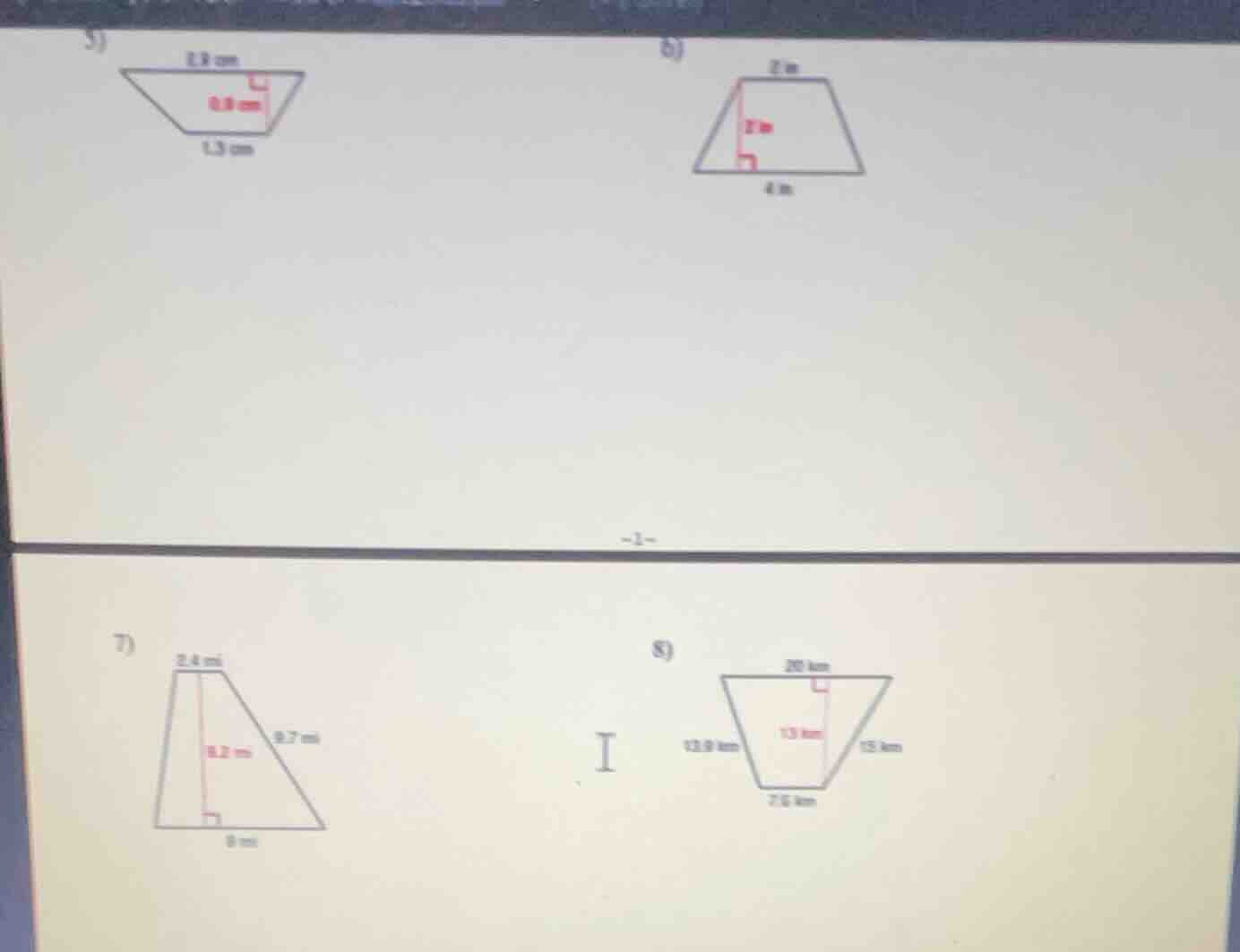
5)
6)
7)
8)
To solve for the area of a trapezoid, we use the formula for the area of a trapezoid: \( A = \frac{1}{2}(b_1 + b_2)h \), where \( b_1 \) and \( b_2 \) are the lengths of the two parallel sides (bases) and \( h \) is the height (the perpendicular distance between the bases). Let's solve each problem one by one:
Problem 5:
Given:
- \( b_1 = 1.8 \, \text{cm} \)
- \( b_2 = 1.3 \, \text{cm} \)
- \( h = 0.8 \, \text{cm} \)
Step 1: Apply the trapezoid area formula
\( A = \frac{1}{2}(b_1 + b_2)h \)
Step 2: Substitute the values
\( A = \frac{1}{2}(1.8 + 1.3)(0.8) \)
Step 3: Simplify inside the parentheses
\( 1.8 + 1.3 = 3.1 \)
Step 4: Multiply by \( \frac{1}{2} \) and \( 0.8 \)
\( A = \frac{1}{2}(3.1)(0.8) = 1.55 \times 0.8 = 1.24 \, \text{cm}^2 \)
Problem 6:
Given:
- \( b_1 = 2 \, \text{m} \)
- \( b_2 = 4 \, \text{m} \)
- \( h = 2 \, \text{m} \)
Step 1: Apply the trapezoid area formula
\( A = \frac{1}{2}(b_1 + b_2)h \)
Step 2: Substitute the values
\( A = \frac{1}{2}(2 + 4)(2) \)
Step 3: Simplify inside the parentheses
\( 2 + 4 = 6 \)
Step 4: Multiply by \( \frac{1}{2} \) and \( 2 \)
\( A = \frac{1}{2}(6)(2) = 3 \times 2 = 6 \, \text{m}^2 \)
Problem 7:
Given:
- \( b_1 = 2.4 \, \text{cm} \)
- \( b_2 = 6 \, \text{cm} \)
- \( h = 3.2 \, \text{cm} \)
Step 1: Apply the trapezoid area formula
\( A = \frac{1}{2}(b_1 + b_2)h \)
Step 2: Substitute the values
\( A = \frac{1}{2}(2.4 + 6)(3.2) \)
Step 3: Simplify inside the parentheses
\( 2.4 + 6 = 8.4 \)
Step 4: Multiply by \( \frac{1}{2} \) and \( 3.2 \)
\( A = \frac{1}{2}(8.4)(3.2) = 4.2 \times 3.2 = 13.44 \, \text{cm}^2 \)
Problem 8:
Given:
- \( b_1 = 20 \, \text{km} \)
- \( b_2 = 7.5 \, \text{km} \)
- \( h = 13 \, \text{km} \)
Step 1: Apply the trapezoid area formula
\( A = \frac{1}{2}(b_1 + b_2)h \)
Step 2: Substitute the values
\( A = \frac{1}{2}(20 + 7.5)(13) \)
Step 3: Simplify inside the parentheses
\( 20 + 7.5 = 27.5 \)
Step 4: Multiply by \( \frac{1}{2} \) and \( 13 \)
\( A = \frac{1}{2}(27.5)(13) = 13.75 \times 13 = 178.75 \, \text{km}^2 \)
Final Answers:
- \( \boldsymbol{1.24 \, \text{cm}^2} \)
- \( \boldsymbol{6 \, \text{m}^2} \)
- \( \boldsymbol{13.44 \, \text{cm}^2} \)
- \( \boldsymbol{178.75 \, \text{km}^2} \)

Snap & solve any problem in the app
Get step-by-step solutions on Sovi AI
Photo-based solutions with guided steps
Explore more problems and detailed explanations
To solve for the area of a trapezoid, we use the formula for the area of a trapezoid: \( A = \frac{1}{2}(b_1 + b_2)h \), where \( b_1 \) and \( b_2 \) are the lengths of the two parallel sides (bases) and \( h \) is the height (the perpendicular distance between the bases). Let's solve each problem one by one:
Problem 5:
Given:
- \( b_1 = 1.8 \, \text{cm} \)
- \( b_2 = 1.3 \, \text{cm} \)
- \( h = 0.8 \, \text{cm} \)
Step 1: Apply the trapezoid area formula
\( A = \frac{1}{2}(b_1 + b_2)h \)
Step 2: Substitute the values
\( A = \frac{1}{2}(1.8 + 1.3)(0.8) \)
Step 3: Simplify inside the parentheses
\( 1.8 + 1.3 = 3.1 \)
Step 4: Multiply by \( \frac{1}{2} \) and \( 0.8 \)
\( A = \frac{1}{2}(3.1)(0.8) = 1.55 \times 0.8 = 1.24 \, \text{cm}^2 \)
Problem 6:
Given:
- \( b_1 = 2 \, \text{m} \)
- \( b_2 = 4 \, \text{m} \)
- \( h = 2 \, \text{m} \)
Step 1: Apply the trapezoid area formula
\( A = \frac{1}{2}(b_1 + b_2)h \)
Step 2: Substitute the values
\( A = \frac{1}{2}(2 + 4)(2) \)
Step 3: Simplify inside the parentheses
\( 2 + 4 = 6 \)
Step 4: Multiply by \( \frac{1}{2} \) and \( 2 \)
\( A = \frac{1}{2}(6)(2) = 3 \times 2 = 6 \, \text{m}^2 \)
Problem 7:
Given:
- \( b_1 = 2.4 \, \text{cm} \)
- \( b_2 = 6 \, \text{cm} \)
- \( h = 3.2 \, \text{cm} \)
Step 1: Apply the trapezoid area formula
\( A = \frac{1}{2}(b_1 + b_2)h \)
Step 2: Substitute the values
\( A = \frac{1}{2}(2.4 + 6)(3.2) \)
Step 3: Simplify inside the parentheses
\( 2.4 + 6 = 8.4 \)
Step 4: Multiply by \( \frac{1}{2} \) and \( 3.2 \)
\( A = \frac{1}{2}(8.4)(3.2) = 4.2 \times 3.2 = 13.44 \, \text{cm}^2 \)
Problem 8:
Given:
- \( b_1 = 20 \, \text{km} \)
- \( b_2 = 7.5 \, \text{km} \)
- \( h = 13 \, \text{km} \)
Step 1: Apply the trapezoid area formula
\( A = \frac{1}{2}(b_1 + b_2)h \)
Step 2: Substitute the values
\( A = \frac{1}{2}(20 + 7.5)(13) \)
Step 3: Simplify inside the parentheses
\( 20 + 7.5 = 27.5 \)
Step 4: Multiply by \( \frac{1}{2} \) and \( 13 \)
\( A = \frac{1}{2}(27.5)(13) = 13.75 \times 13 = 178.75 \, \text{km}^2 \)
Final Answers:
- \( \boldsymbol{1.24 \, \text{cm}^2} \)
- \( \boldsymbol{6 \, \text{m}^2} \)
- \( \boldsymbol{13.44 \, \text{cm}^2} \)
- \( \boldsymbol{178.75 \, \text{km}^2} \)