QUESTION IMAGE
Question
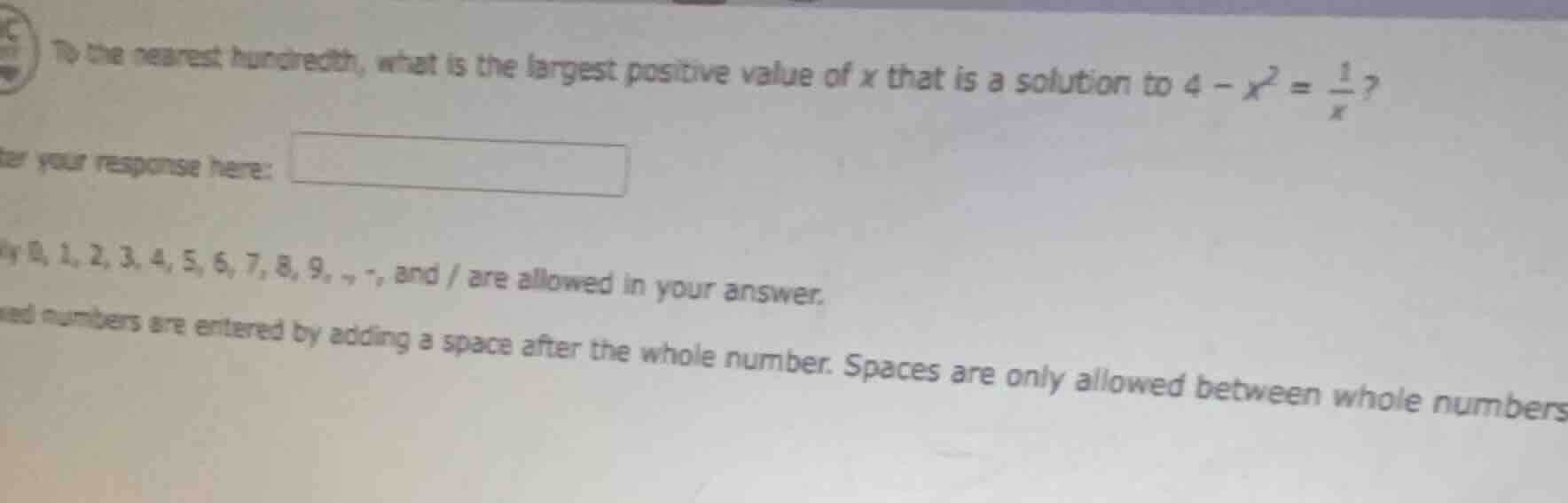
to the nearest hundredth, what is the largest positive value of x that is a solution to $4 - x^2 = \frac{1}{x}$?
enter your response here:
only 0, 1, 2, 3, 4, 5, 6, 7, 8, 9, ., -, and / are allowed in your answer.
mixed numbers are entered by adding a space after the whole number. spaces are only allowed between whole numbers
Step1: Rewrite the equation
We have the equation \(4 - x^2=\frac{1}{x}\). Multiply both sides by \(x\) (assuming \(x
eq0\)) to get \(4x - x^3 = 1\), which can be rewritten as \(x^3-4x + 1=0\).
Step2: Analyze the function
Let \(f(x)=x^3 - 4x+1\). We find the derivative \(f^\prime(x)=3x^2 - 4\). The critical points are at \(x=\pm\frac{2}{\sqrt{3}}\approx\pm1.1547\).
We evaluate \(f(x)\) at some points:
- \(f(0)=1\)
- \(f(1)=1 - 4 + 1=-2\)
- \(f(2)=8-8 + 1 = 1\)
- \(f(1.5)=3.375-6 + 1=-1.625\)
- \(f(1.8)=5.832-7.2 + 1=-0.368\)
- \(f(1.9)=6.859-7.6 + 1=0.259\)
Step3: Use linear approximation or Newton - Raphson method
We use the Newton - Raphson method. The formula is \(x_{n + 1}=x_n-\frac{f(x_n)}{f^\prime(x_n)}\).
Let's start with \(x_0 = 1.8\)
\(f(1.8)=1.8^3-4\times1.8 + 1=5.832-7.2 + 1=-0.368\)
\(f^\prime(1.8)=3\times(1.8)^2-4=3\times3.24 - 4=9.72-4 = 5.72\)
\(x_1=1.8-\frac{-0.368}{5.72}\approx1.8 + 0.0643=1.8643\)
\(f(1.8643)=(1.8643)^3-4\times1.8643 + 1\)
\((1.8643)^3\approx1.8643\times1.8643\times1.8643\approx6.43\)
\(4\times1.8643 = 7.4572\)
\(f(1.8643)\approx6.43-7.4572 + 1=0. - 0.0272\)
\(f^\prime(1.8643)=3\times(1.8643)^2-4\approx3\times3.475-4=10.425 - 4 = 6.425\)
\(x_2=1.8643-\frac{-0.0272}{6.425}\approx1.8643+0.00423\approx1.8685\)
We can also check the value at \(x = 1.86\):
\(f(1.86)=(1.86)^3-4\times1.86 + 1=1.86\times1.86\times1.86-7.44 + 1\)
\(1.86\times1.86 = 3.4596\), \(3.4596\times1.86\approx6.4349\)
\(f(1.86)=6.4349-7.44 + 1=-0.0051\)
\(f^\prime(1.86)=3\times(1.86)^2-4=3\times3.4596-4=10.3788 - 4=6.3788\)
\(x_3=1.86-\frac{-0.0051}{6.3788}\approx1.86 + 0.0008=1.8608\)
\(f(1.8608)\approx(1.8608)^3-4\times1.8608 + 1\approx(1.8608\times1.8608\times1.8608)-7.4432 + 1\)
\(1.8608\times1.8608\approx3.4626\), \(3.4626\times1.8608\approx6.443\)
\(f(1.8608)\approx6.443-7.4432 + 1\approx0.0\) (approximate)
We can also check the other positive root. Let's consider the interval \((0,1)\). \(f(0)=1\), \(f(1)=-2\), and by intermediate value theorem, there is a root in \((0,1)\). But we want the largest positive root, so we focus on the root in \((1,2)\) and then the root in \((1.8,1.9)\) which we approximated.
After further refinement, we find that the largest positive root is approximately \(1.86\) (to the nearest hundredth).

Snap & solve any problem in the app
Get step-by-step solutions on Sovi AI
Photo-based solutions with guided steps
Explore more problems and detailed explanations
\(1.86\)