QUESTION IMAGE
Question
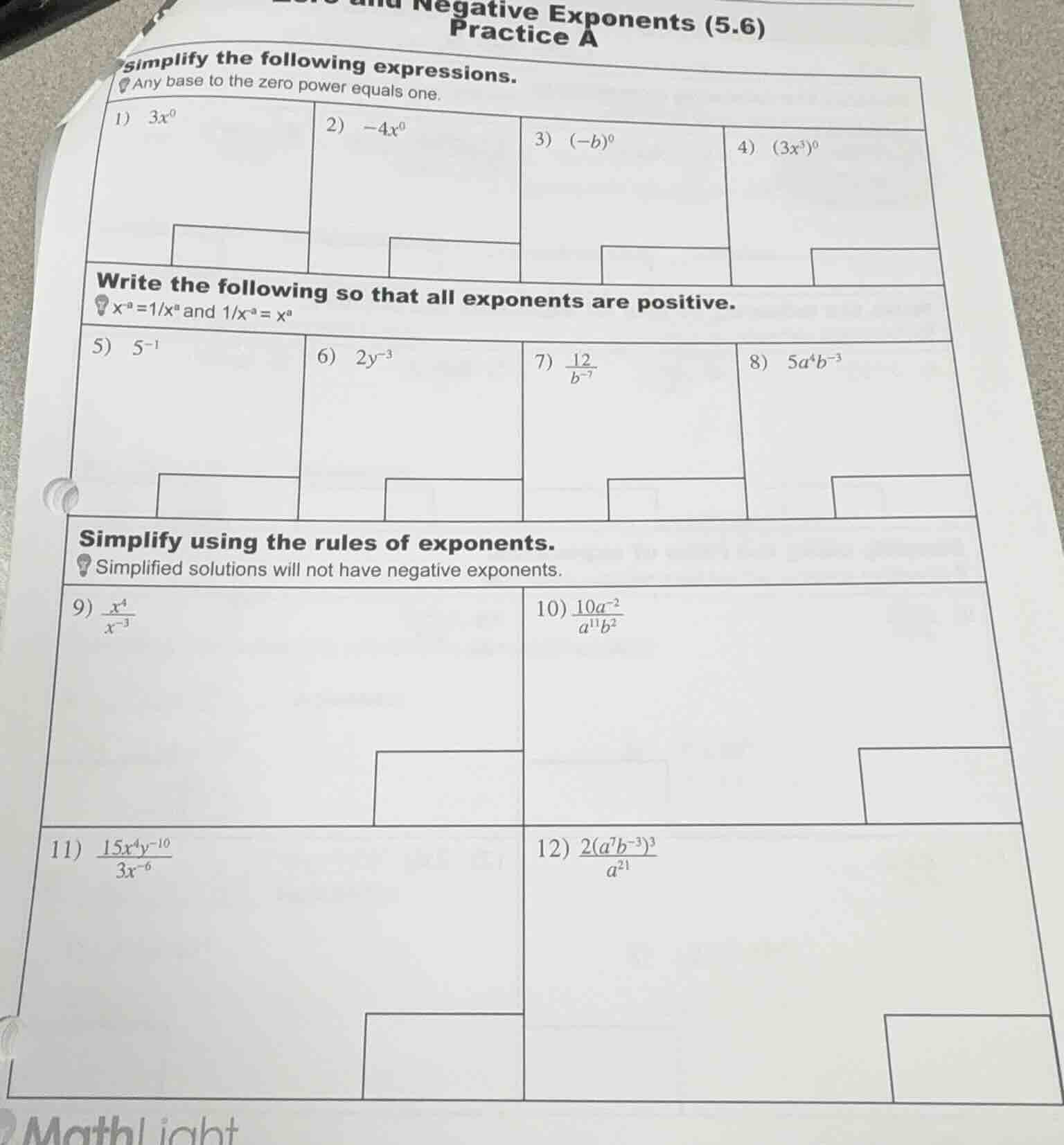
negative exponents (5.6)
practice a
simplify the following expressions.
any base to the zero power equals one.
- $3x^0$
- $-4x^0$
- $(-b)^0$
- $(3x^3)^0$
write the following so that all exponents are positive.
$x^{-a}=1/x^a$ and $1/x^{-a}=x^a$
- $5^{-1}$
- $2y^{-3}$
- $\frac{12}{b^{-7}}$
- $5a^4b^{-3}$
simplify using the rules of exponents.
simplified solutions will not have negative exponents.
- $\frac{x^4}{x^{-3}}$
- $\frac{10a^{-2}}{a^{11}b^2}$
- $\frac{15x^4y^{-10}}{3x^{-6}}$
- $\frac{2(a^7b^{-3})^3}{a^{21}}$
Let's solve each problem step by step:
Part 1: Simplify using the zero exponent rule ($a^0 = 1$ for $a
eq 0$)
1) $3x^0$
Step 1: Apply the zero exponent rule
Any non - zero base to the power of 0 is 1. So $x^0 = 1$ (assuming $x
eq0$).
Then $3x^0=3\times1 = 3$
2) $-4x^0$
Step 1: Apply the zero exponent rule
$x^0 = 1$ (assuming $x
eq0$), so $-4x^0=-4\times1=-4$
3) $(-b)^0$
Step 1: Apply the zero exponent rule
As long as $-b
eq0$ (i.e., $b
eq0$), $(-b)^0 = 1$
4) $(3x^2)^0$
Step 1: Apply the zero exponent rule
Since $3x^2
eq0$ (as long as $x
eq0$), $(3x^2)^0 = 1$
Part 2: Write with positive exponents ($x^{-n}=\frac{1}{x^n}$ and $\frac{1}{x^{-n}}=x^n$)
5) $5^{-1}$
Step 1: Apply the negative exponent rule
Using $x^{-n}=\frac{1}{x^n}$, we have $5^{-1}=\frac{1}{5^1}=\frac{1}{5}$
6) $2y^{-3}$
Step 1: Apply the negative exponent rule
For the term $y^{-3}$, using $x^{-n}=\frac{1}{x^n}$, we get $y^{-3}=\frac{1}{y^3}$. So $2y^{-3}=2\times\frac{1}{y^3}=\frac{2}{y^3}$
7) $\frac{12}{b^{-7}}$
Step 1: Apply the negative exponent rule
Using $\frac{1}{x^{-n}}=x^n$, we have $\frac{12}{b^{-7}}=12\times b^{7}=12b^{7}$
8) $5a^4b^{-3}$
Step 1: Apply the negative exponent rule
For the term $b^{-3}$, using $x^{-n}=\frac{1}{x^n}$, we get $b^{-3}=\frac{1}{b^3}$. So $5a^4b^{-3}=5a^4\times\frac{1}{b^3}=\frac{5a^4}{b^3}$
Part 3: Simplify using exponent rules (and positive exponents)
9) $\frac{x^4}{x^{-3}}$
Step 1: Apply the quotient rule for exponents ($\frac{x^m}{x^n}=x^{m - n}$)
Here $m = 4$ and $n=-3$. So $\frac{x^4}{x^{-3}}=x^{4-(-3)}$
Step 2: Simplify the exponent
$4-(-3)=4 + 3=7$. So $\frac{x^4}{x^{-3}}=x^{7}$
10) $\frac{10a^{-2}}{a^{11}b^2}$
Step 1: Apply the quotient rule for exponents on the $a$ terms
For the $a$ terms, $\frac{a^{-2}}{a^{11}}=a^{-2-11}=a^{-13}$
Step 2: Apply the negative exponent rule
$a^{-13}=\frac{1}{a^{13}}$, so $\frac{10a^{-2}}{a^{11}b^2}=\frac{10}{a^{13}b^2}$
11) $\frac{15x^4y^{-10}}{3x^{-6}}$
Step 1: Simplify the coefficient and the $x$ terms separately
- Coefficient: $\frac{15}{3}=5$
- $x$ terms: Using $\frac{x^m}{x^n}=x^{m - n}$, $\frac{x^4}{x^{-6}}=x^{4-(-6)}=x^{10}$
- $y$ terms: $y^{-10}=\frac{1}{y^{10}}$ (using $x^{-n}=\frac{1}{x^n}$)
Step 2: Combine the terms
Putting it all together, we have $5\times x^{10}\times\frac{1}{y^{10}}=\frac{5x^{10}}{y^{10}}$
12) $\frac{2(a^7b^{-3})^3}{a^{21}}$
Step 1: Apply the power of a product rule and power of a power rule
- Power of a product: $(a^7b^{-3})^3=(a^7)^3\times(b^{-3})^3$
- Power of a power: $(a^7)^3=a^{7\times3}=a^{21}$ and $(b^{-3})^3=b^{-3\times3}=b^{-9}$
So the numerator becomes $2\times a^{21}\times b^{-9}=2a^{21}b^{-9}$
Step 2: Simplify the fraction
Now we have $\frac{2a^{21}b^{-9}}{a^{21}}$
- Cancel out $a^{21}$ terms: $\frac{2\cancel{a^{21}}b^{-9}}{\cancel{a^{21}}}=2b^{-9}$
- Apply the negative exponent rule: $2b^{-9}=\frac{2}{b^9}$
Final Answers:
- $\boldsymbol{3}$
- $\boldsymbol{-4}$
- $\boldsymbol{1}$
- $\boldsymbol{1}$
- $\boldsymbol{\frac{1}{5}}$
- $\boldsymbol{\frac{2}{y^3}}$
- $\boldsymbol{12b^7}$
- $\boldsymbol{\frac{5a^4}{b^3}}$
- $\boldsymbol{x^7}$
- $\boldsymbol{\frac{10}{a^{13}b^2}}$
- $\boldsymbol{\frac{5x^{10}}{y^{10}}}$
- $\boldsymbol{\frac{2}{b^9}}$

Snap & solve any problem in the app
Get step-by-step solutions on Sovi AI
Photo-based solutions with guided steps
Explore more problems and detailed explanations
Let's solve each problem step by step:
Part 1: Simplify using the zero exponent rule ($a^0 = 1$ for $a
eq 0$)
1) $3x^0$
Step 1: Apply the zero exponent rule
Any non - zero base to the power of 0 is 1. So $x^0 = 1$ (assuming $x
eq0$).
Then $3x^0=3\times1 = 3$
2) $-4x^0$
Step 1: Apply the zero exponent rule
$x^0 = 1$ (assuming $x
eq0$), so $-4x^0=-4\times1=-4$
3) $(-b)^0$
Step 1: Apply the zero exponent rule
As long as $-b
eq0$ (i.e., $b
eq0$), $(-b)^0 = 1$
4) $(3x^2)^0$
Step 1: Apply the zero exponent rule
Since $3x^2
eq0$ (as long as $x
eq0$), $(3x^2)^0 = 1$
Part 2: Write with positive exponents ($x^{-n}=\frac{1}{x^n}$ and $\frac{1}{x^{-n}}=x^n$)
5) $5^{-1}$
Step 1: Apply the negative exponent rule
Using $x^{-n}=\frac{1}{x^n}$, we have $5^{-1}=\frac{1}{5^1}=\frac{1}{5}$
6) $2y^{-3}$
Step 1: Apply the negative exponent rule
For the term $y^{-3}$, using $x^{-n}=\frac{1}{x^n}$, we get $y^{-3}=\frac{1}{y^3}$. So $2y^{-3}=2\times\frac{1}{y^3}=\frac{2}{y^3}$
7) $\frac{12}{b^{-7}}$
Step 1: Apply the negative exponent rule
Using $\frac{1}{x^{-n}}=x^n$, we have $\frac{12}{b^{-7}}=12\times b^{7}=12b^{7}$
8) $5a^4b^{-3}$
Step 1: Apply the negative exponent rule
For the term $b^{-3}$, using $x^{-n}=\frac{1}{x^n}$, we get $b^{-3}=\frac{1}{b^3}$. So $5a^4b^{-3}=5a^4\times\frac{1}{b^3}=\frac{5a^4}{b^3}$
Part 3: Simplify using exponent rules (and positive exponents)
9) $\frac{x^4}{x^{-3}}$
Step 1: Apply the quotient rule for exponents ($\frac{x^m}{x^n}=x^{m - n}$)
Here $m = 4$ and $n=-3$. So $\frac{x^4}{x^{-3}}=x^{4-(-3)}$
Step 2: Simplify the exponent
$4-(-3)=4 + 3=7$. So $\frac{x^4}{x^{-3}}=x^{7}$
10) $\frac{10a^{-2}}{a^{11}b^2}$
Step 1: Apply the quotient rule for exponents on the $a$ terms
For the $a$ terms, $\frac{a^{-2}}{a^{11}}=a^{-2-11}=a^{-13}$
Step 2: Apply the negative exponent rule
$a^{-13}=\frac{1}{a^{13}}$, so $\frac{10a^{-2}}{a^{11}b^2}=\frac{10}{a^{13}b^2}$
11) $\frac{15x^4y^{-10}}{3x^{-6}}$
Step 1: Simplify the coefficient and the $x$ terms separately
- Coefficient: $\frac{15}{3}=5$
- $x$ terms: Using $\frac{x^m}{x^n}=x^{m - n}$, $\frac{x^4}{x^{-6}}=x^{4-(-6)}=x^{10}$
- $y$ terms: $y^{-10}=\frac{1}{y^{10}}$ (using $x^{-n}=\frac{1}{x^n}$)
Step 2: Combine the terms
Putting it all together, we have $5\times x^{10}\times\frac{1}{y^{10}}=\frac{5x^{10}}{y^{10}}$
12) $\frac{2(a^7b^{-3})^3}{a^{21}}$
Step 1: Apply the power of a product rule and power of a power rule
- Power of a product: $(a^7b^{-3})^3=(a^7)^3\times(b^{-3})^3$
- Power of a power: $(a^7)^3=a^{7\times3}=a^{21}$ and $(b^{-3})^3=b^{-3\times3}=b^{-9}$
So the numerator becomes $2\times a^{21}\times b^{-9}=2a^{21}b^{-9}$
Step 2: Simplify the fraction
Now we have $\frac{2a^{21}b^{-9}}{a^{21}}$
- Cancel out $a^{21}$ terms: $\frac{2\cancel{a^{21}}b^{-9}}{\cancel{a^{21}}}=2b^{-9}$
- Apply the negative exponent rule: $2b^{-9}=\frac{2}{b^9}$
Final Answers:
- $\boldsymbol{3}$
- $\boldsymbol{-4}$
- $\boldsymbol{1}$
- $\boldsymbol{1}$
- $\boldsymbol{\frac{1}{5}}$
- $\boldsymbol{\frac{2}{y^3}}$
- $\boldsymbol{12b^7}$
- $\boldsymbol{\frac{5a^4}{b^3}}$
- $\boldsymbol{x^7}$
- $\boldsymbol{\frac{10}{a^{13}b^2}}$
- $\boldsymbol{\frac{5x^{10}}{y^{10}}}$
- $\boldsymbol{\frac{2}{b^9}}$