QUESTION IMAGE
Question
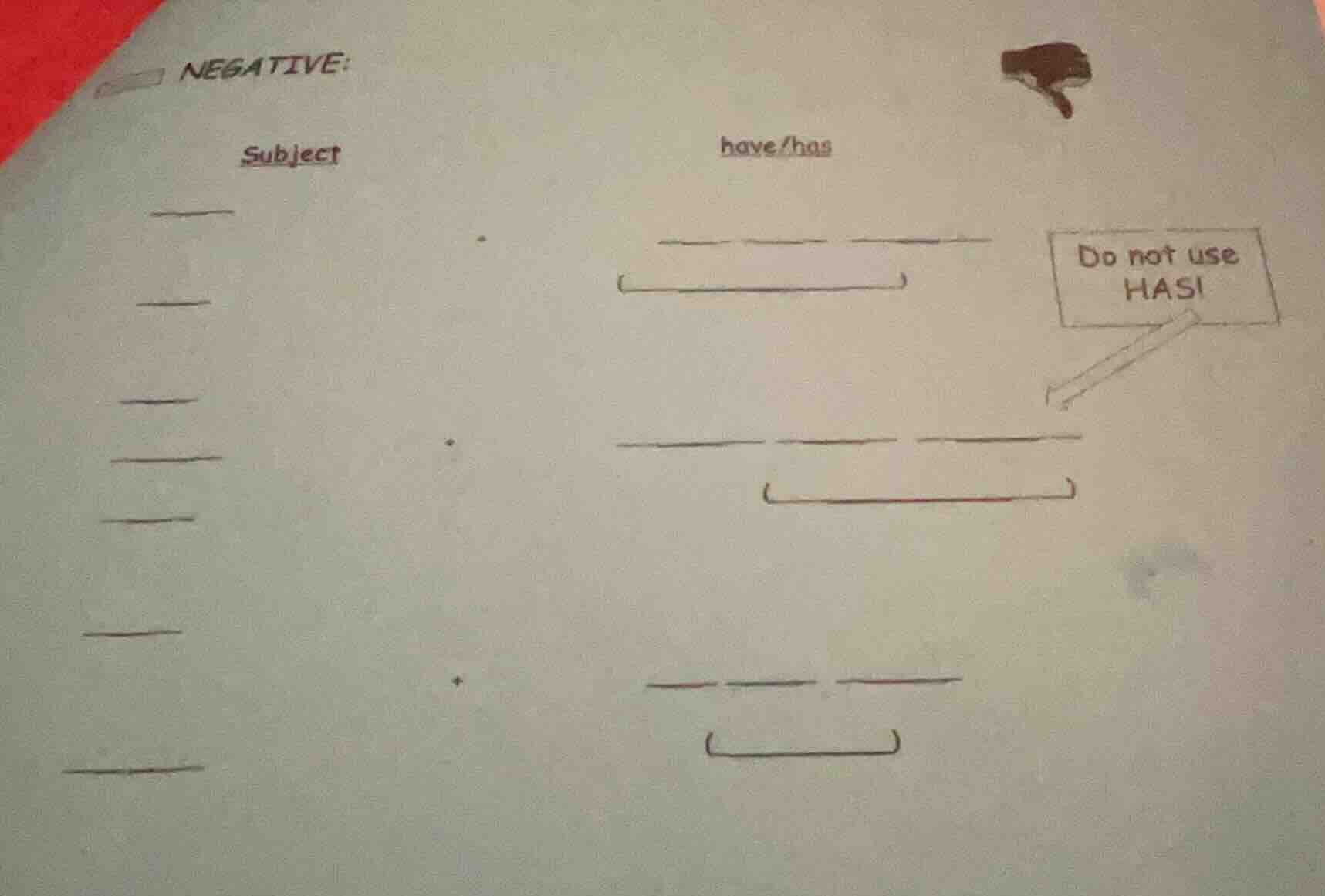
negative:
subject have/has
do not use has!
To solve this exercise on forming negative sentences with "have/has" (avoiding "has" as per the note, so we'll use "have" appropriately for subjects that take "have" or adjust for "has" - but the note says "Do not use HAS!", so we focus on subjects with "have" in negative), we follow these steps:
Step 1: Identify Subjects and Verb Form
First, recall that the negative form of "have" (for most subjects except third - person singular like he/she/it, but since we can't use "has", we'll work with subjects that take "have") is "do not have" (contracted as "don't have"). For example:
- Subject: I
The negative form of "have" for "I" is formed by using "do not" (or "don't") before "have". So, "I don't have".
- Subject: You
Similarly, for "you", the negative is "You don't have".
- Subject: We
For the subject "we", the negative sentence is "We don't have".
- Subject: They
For "they", it is "They don't have".
Step 2: Fill in the Blanks
Let's take a few common subjects and fill in the "Subject" and "have/has" (negative) columns:
| Subject | have/has (Negative) |
|---|---|
| You | don't have |
| We | don't have |
| They | don't have |
If we consider a subject like "he" (but the note says "Do not use HAS!", so we might need to re - evaluate. Wait, the note says "Do not use HAS!", so maybe the exercise expects us to use "have" - based negatives even for third - person singular? But grammatically, "he" should take "has", but since we can't use "has", maybe the exercise has a typo or wants us to use "don't have" incorrectly for third - person singular (but that's non - standard). However, following the note strictly, we use "don't have" for all subjects here.
Final Answers (Examples)
- Subject: I; have/has (Negative): don't have
- Subject: You; have/has (Negative): don't have
- Subject: We; have/has (Negative): don't have
- Subject: They; have/has (Negative): don't have
(You can fill in the blanks in the worksheet with these subject - negative verb pairs as per the number of blanks provided. For example, if there are 4 blanks for subjects, you can use the above - mentioned subjects and their corresponding negative verb forms.)

Snap & solve any problem in the app
Get step-by-step solutions on Sovi AI
Photo-based solutions with guided steps
Explore more problems and detailed explanations
To solve this exercise on forming negative sentences with "have/has" (avoiding "has" as per the note, so we'll use "have" appropriately for subjects that take "have" or adjust for "has" - but the note says "Do not use HAS!", so we focus on subjects with "have" in negative), we follow these steps:
Step 1: Identify Subjects and Verb Form
First, recall that the negative form of "have" (for most subjects except third - person singular like he/she/it, but since we can't use "has", we'll work with subjects that take "have") is "do not have" (contracted as "don't have"). For example:
- Subject: I
The negative form of "have" for "I" is formed by using "do not" (or "don't") before "have". So, "I don't have".
- Subject: You
Similarly, for "you", the negative is "You don't have".
- Subject: We
For the subject "we", the negative sentence is "We don't have".
- Subject: They
For "they", it is "They don't have".
Step 2: Fill in the Blanks
Let's take a few common subjects and fill in the "Subject" and "have/has" (negative) columns:
| Subject | have/has (Negative) |
|---|---|
| You | don't have |
| We | don't have |
| They | don't have |
If we consider a subject like "he" (but the note says "Do not use HAS!", so we might need to re - evaluate. Wait, the note says "Do not use HAS!", so maybe the exercise expects us to use "have" - based negatives even for third - person singular? But grammatically, "he" should take "has", but since we can't use "has", maybe the exercise has a typo or wants us to use "don't have" incorrectly for third - person singular (but that's non - standard). However, following the note strictly, we use "don't have" for all subjects here.
Final Answers (Examples)
- Subject: I; have/has (Negative): don't have
- Subject: You; have/has (Negative): don't have
- Subject: We; have/has (Negative): don't have
- Subject: They; have/has (Negative): don't have
(You can fill in the blanks in the worksheet with these subject - negative verb pairs as per the number of blanks provided. For example, if there are 4 blanks for subjects, you can use the above - mentioned subjects and their corresponding negative verb forms.)