QUESTION IMAGE
Question
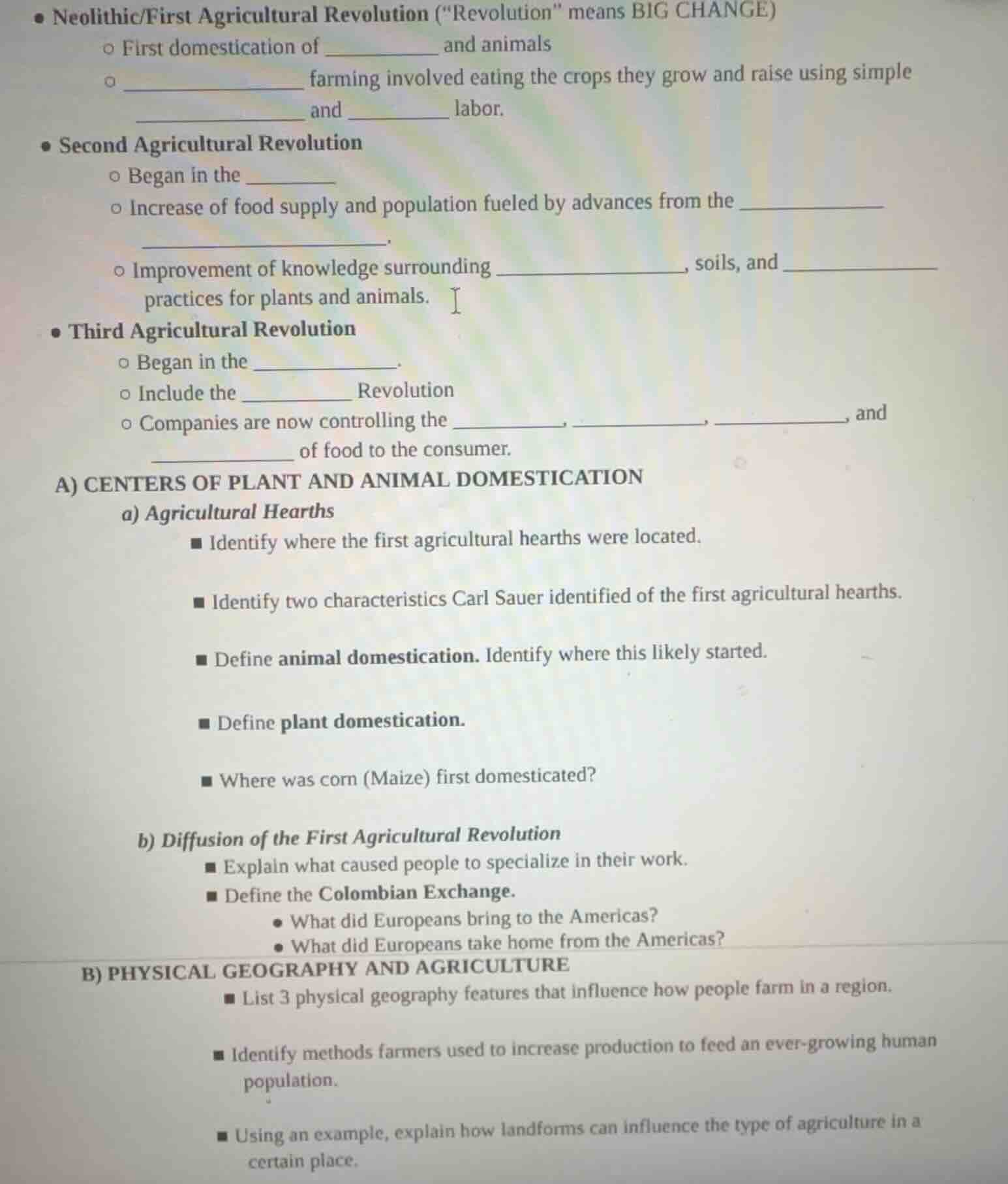
● neolithic/first agricultural revolution (
evolution\ means big change)
○ first domestication of _______ and animals
○ ____________ farming involved eating the crops they grow and raise using simple
___________ and _____ labor.
● second agricultural revolution
○ began in the _______
○ increase of food supply and population fueled by advances from the ____________
____________________.
○ improvement of knowledge surrounding ___________, soils, and __________
practices for plants and animals.
● third agricultural revolution
○ began in the ___________.
○ include the ________ revolution
○ companies are now controlling the ______, _______, _________, and
____________ of food to the consumer.
a) centers of plant and animal domestication
a) agricultural hearths
■ identify where the first agricultural hearths were located.
■ identify two characteristics carl sauer identified of the first agricultural hearths.
■ define animal domestication. identify where this likely started.
■ define plant domestication.
■ where was corn (maize) first domesticated?
b) diffusion of the first agricultural revolution
■ explain what caused people to specialize in their work.
■ define the colombian exchange.
● what did europeans bring to the americas?
● what did europeans take home from the americas?
b) physical geography and agriculture
■ list 3 physical geography features that influence how people farm in a region.
■ identify methods farmers used to increase production to feed an ever - growing human
population.
■ using an example, explain how landforms can influence the type of agriculture in a
certain place.

Snap & solve any problem in the app
Get step-by-step solutions on Sovi AI
Photo-based solutions with guided steps
Explore more problems and detailed explanations
- plants; Subsistence; tools; human
- 1700s (Great Britain); Industrial Revolution; crop rotation; breeding
- 1900s; Green; production; processing; distribution
- Southwest Asia (Fertile Crescent), East Asia, South Asia, Africa, and the Americas.
- High biodiversity and vegetative planting.
- The process of taming animals for human use; Southwest Asia.
- The process of adapting wild plants for human use.
- Central Mexico.
- Food surpluses allowed for labor diversification.
- The exchange of plants, animals, and diseases between the Old and New Worlds.
- Horses, cattle, wheat, and smallpox.
- Corn, potatoes, tomatoes, and tobacco.
- Climate, soil quality, and topography.
- Irrigation, terrace farming, and fertilizers.
- Terracing on mountainsides allows for rice cultivation in steep terrain.