QUESTION IMAGE
Question
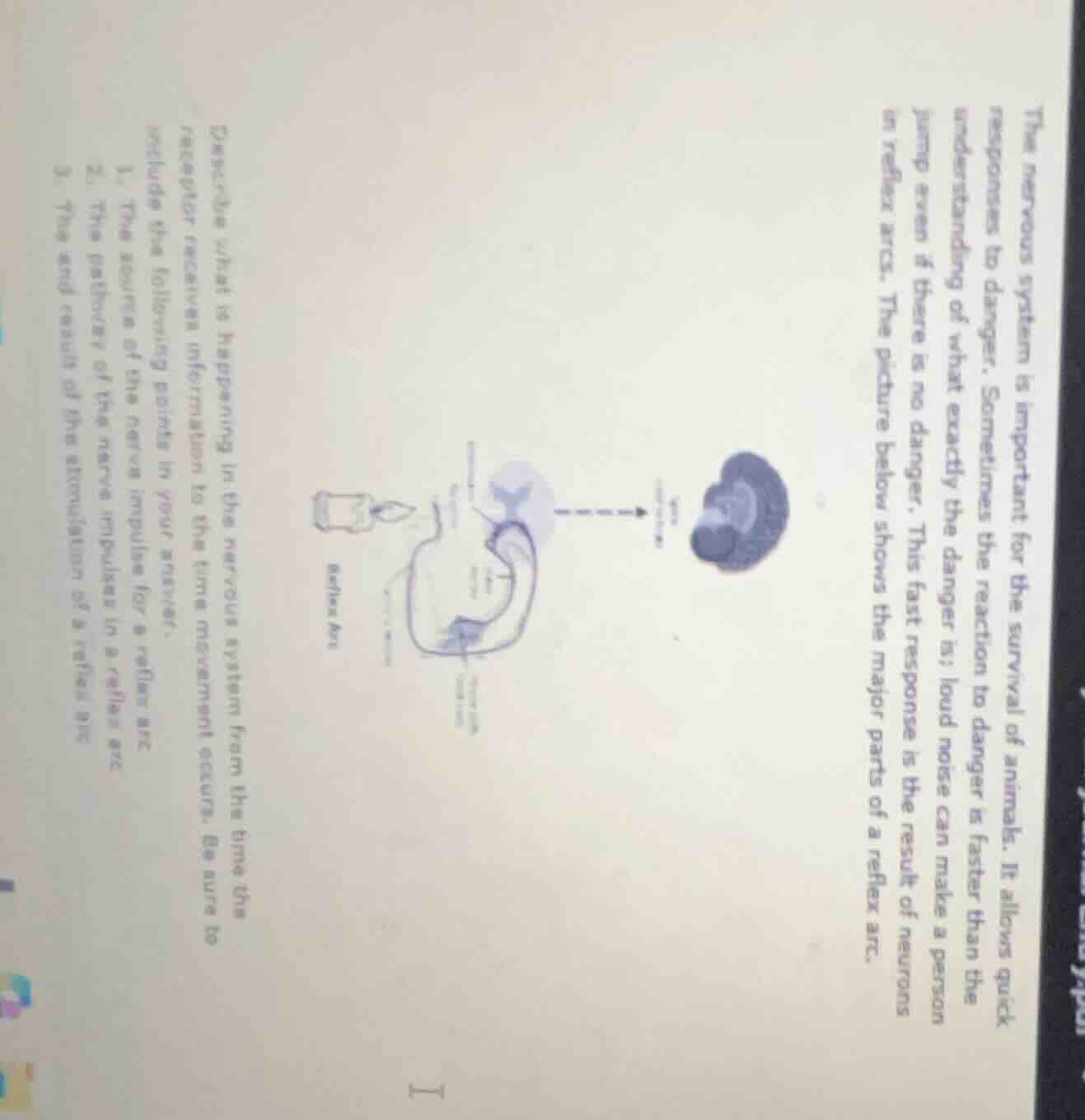
the nervous system is important for the survival of animals. it allows quick responses to danger. sometimes the reaction to danger is faster than the understanding of what exactly the danger is; loud noise can make a person jump even if there is no danger. this fast response is the result of neurons in reflex arcs. the picture below shows the major parts of a reflex arc.
describe what is happening in the nervous system from the time the receptor receives information to the time movement occurs. be sure to include the following points in your answer.
- the sequence of the nerves in a reflex arc.
- the pathway of the nerve impulse in a reflex arc.
- the end result of the activation of a reflex arc.
Brief Explanations
- Source of nerve impulse: The stimulus (like heat from the candle touching the hand) activates sensory receptors in the skin. This triggers a nerve impulse.
- Pathway of nerve impulse: The impulse travels via a sensory neuron to the spinal cord (central nervous system). In the spinal cord, it synapses with an interneuron, then immediately passes to a motor neuron (bypassing the brain first for speed). The motor neuron carries the impulse to the muscle effector.
- End result of stimulation: The muscle contracts, causing the hand to quickly pull away from the harmful stimulus, preventing further injury. The impulse is also sent to the brain after the reflex occurs to register the sensation.

Snap & solve any problem in the app
Get step-by-step solutions on Sovi AI
Photo-based solutions with guided steps
Explore more problems and detailed explanations
- The nerve impulse starts when a stimulus (e.g., heat from the candle) activates sensory receptors in the body (the hand in the diagram).
- The impulse travels along a sensory neuron to the spinal cord, where it synapses with an interneuron, then immediately moves to a motor neuron, which carries the signal to the muscle effector.
- The muscle contracts, producing an immediate reflex movement (pulling the hand away from the stimulus) to avoid harm, and the brain later receives the signal to process the sensation.