QUESTION IMAGE
Question
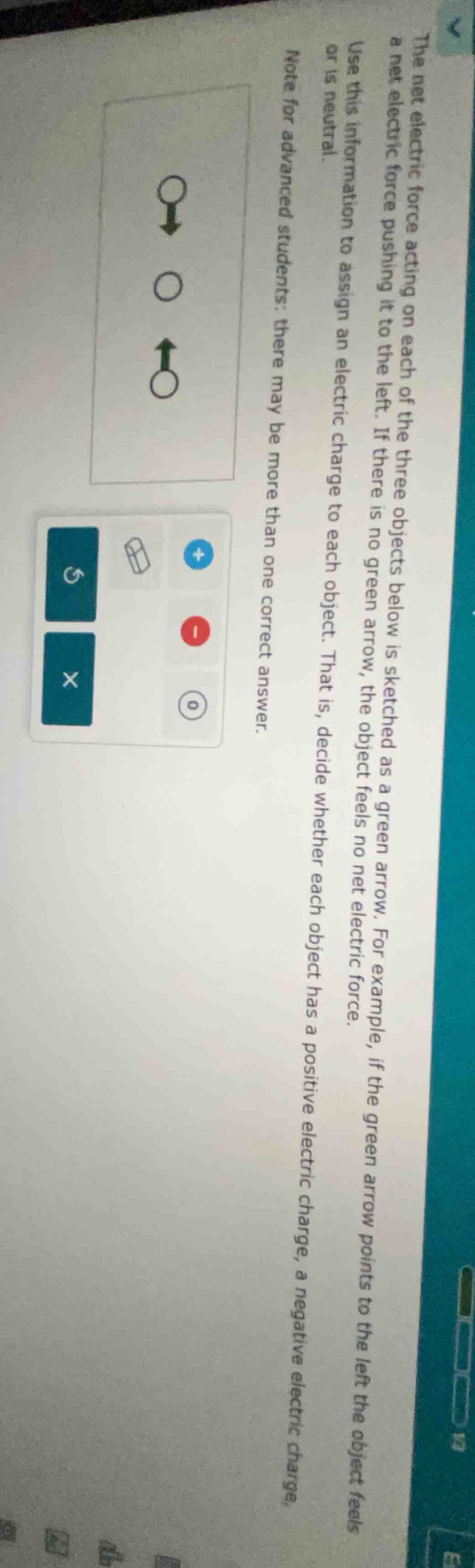
the net electric force acting on each of the three objects below is sketched as a green arrow. for example, if the green arrow points to the left the object feels a net electric force pushing it to the left. if there is no green arrow, the object feels no net electric force.
use this information to assign an electric charge to each object. that is, decide whether each object has a positive electric charge, a negative electric charge, or is neutral.
note for advanced students: there may be more than one correct answer.
To solve this, we analyze the electric forces (green arrows) and use the rules of electric charges (like charges repel, opposite attract):
Top Object (arrow down):
The force is downward. Let's assume interactions with the middle and bottom objects. If the top object has a charge, the force direction depends on neighboring charges. Suppose the middle object’s charge and bottom object’s charge influence it. If the top force is down, maybe it’s repelled by a like charge below or attracted by opposite above? Wait, better: electric force on a charge \( q \) is \( \vec{F} = q\vec{E} \), so force direction relates to charge sign and electric field. But simpler: use charge interactions.
Middle Object (no arrow):
No net force, so it’s neutral (\( 0 \)) or forces cancel. But since it’s between two charged objects, maybe neutral (no charge) or equal and opposite forces. But likely neutral here.
Bottom Object (arrow up):
Force is upward. So if force is up, and using \( \vec{F} \propto q\vec{E} \), if the electric field (from top/middle) is down, a negative charge would have force up (since \( q \) is negative, \( \vec{F} = (-) \vec{E} \), so opposite to \( \vec{E} \)). Or if repelled by a like charge above, but force is up, so maybe bottom is positive? Wait, no—let's re-express:
- Top Object: Force down. If the bottom object is positive, and middle is neutral, top could be positive (repelled by bottom? No, repel would be away. Wait, maybe top is negative, bottom is positive: opposite charges attract, so top (negative) is attracted to bottom (positive), force down? Wait, no—force on top: if bottom is positive, top negative would have force up (toward bottom). Wait, I’m mixing force direction (on the object). The green arrow is the force on the object. So:
- Bottom object: Force up (arrow up). So the force on bottom is up. If the middle is neutral, top is a charge. Let's assign:
- Bottom: positive (\( + \))? No, force up—if top is negative, bottom positive: force on bottom is up (attracted to top? No, top negative, bottom positive: force on bottom is up (toward top? No, top is above, so force on bottom up would be repulsion from below, but there’s no below. Wait, maybe the middle is neutral, top is negative, bottom is positive. Then force on top: attracted to bottom (positive), so force down (toward bottom). Force on bottom: attracted to top (negative), so force up (toward top). Middle: neutral (no force).
Yes! That works:
- Top: negative (\( - \)) (force down, attracted to positive bottom).
- Middle: neutral (\( 0 \)) (no net force).
- Bottom: positive (\( + \)) (force up, attracted to negative top).
Final Assignment:
- Top: \( - \) (negative)
- Middle: \( 0 \) (neutral)
- Bottom: \( + \) (positive)
(Note: The middle object has no arrow, so it’s neutral. Top force down (negative charge, attracted to positive bottom), bottom force up (positive charge, attracted to negative top).)

Snap & solve any problem in the app
Get step-by-step solutions on Sovi AI
Photo-based solutions with guided steps
Explore more problems and detailed explanations
- Top: \( - \) (negative)
- Middle: \( 0 \) (neutral)
- Bottom: \( + \) (positive)