QUESTION IMAGE
Question
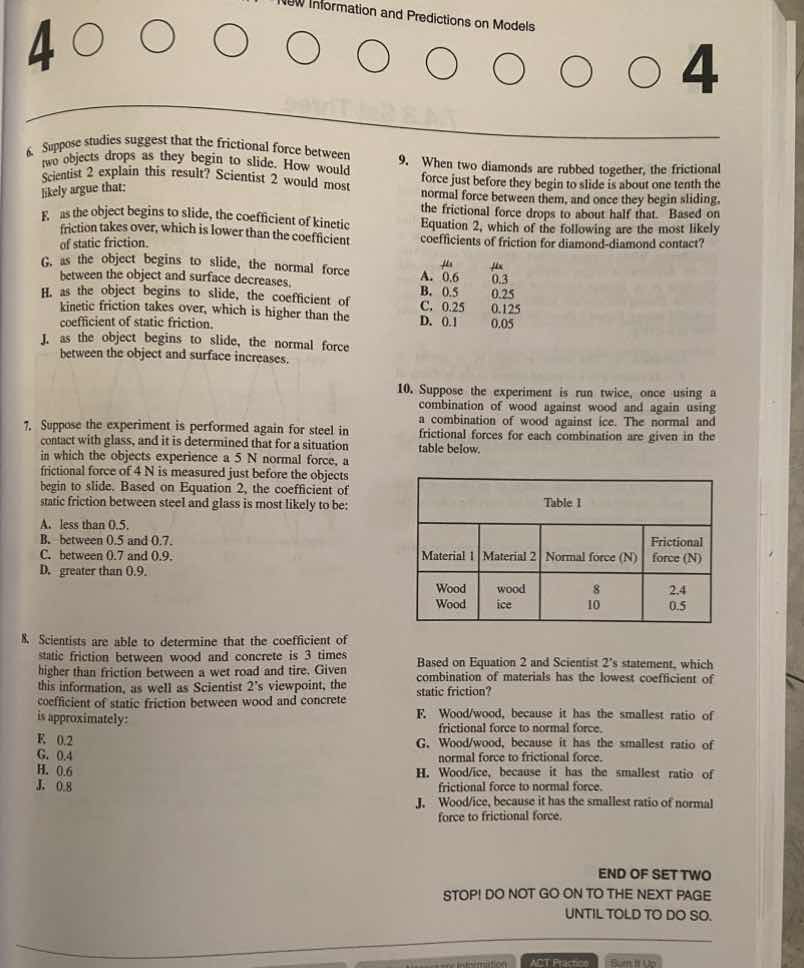
new information and predictions on models6. suppose studies suggest that the frictional force between two objects drops as they begin to slide. how would scientist 2 explain this result? scientist 2 would most likely argue that:f. as the object begins to slide, the coefficient of kinetic friction takes over, which is lower than the coefficient of static friction.g. as the object begins to slide, the normal force between the object and surface decreases.h. as the object begins to slide, the coefficient of kinetic friction takes over, which is higher than the coefficient of static friction.j. as the object begins to slide, the normal force between the object and surface increases.7. suppose the experiment is performed again for steel in contact with glass, and it is determined that for a situation in which the objects experience a 5 n normal force, a frictional force of 4 n is measured just before the objects begin to slide. based on equation 2, the coefficient of static friction between steel and glass is most likely to be:a. less than 0.5.b. between 0.5 and 0.7.c. between 0.7 and 0.9.d. greater than 0.9.8. scientists are able to determine that the coefficient of static friction between wood and concrete is 3 times higher than friction between a wet road and tire. given this information, as well as scientist 2s viewpoint, the coefficient of static friction between wood and concrete is approximately:f. 0.2g. 0.4h. 0.6j. 0.89. when two diamonds are rubbed together, the frictional force just before they begin to slide is about one tenth the normal force between them, and once they begin sliding, the frictional force drops to about half that. based on equation 2, which of the following are the most likely coefficients of friction for diamond-diamond contact?$mu_s$ $mu_k$f. 0.6 0.3g. 0.5 0.25h. 0.25 0.125j. 0.1 0.0510. suppose the experiment is run twice, once using a combination of wood against wood and again using a combination of wood against ice. the normal and frictional forces for each combination are given in the table below.table 1| material 1 | material 2 | normal force (n) | frictional force (n) || ---- | ---- | ---- | ---- || wood | wood | 8 | 2.4 || wood | ice | 10 | 0.5 |based on equation 2 and scientist 2s statement, which combination of materials has the lowest coefficient of static friction?f. wood/wood, because it has the smallest ratio of frictional force to normal force.g. wood/wood, because it has the smallest ratio of normal force to frictional force.h. wood/ice, because it has the smallest ratio of frictional force to normal force.j. wood/ice, because it has the smallest ratio of normal force to frictional force.end of set twostop! do not go on to the next page until told to do so.
Question 6
Step1: Recall friction coefficient properties
Kinetic friction coefficient < static friction coefficient.
Step2: Match to Scientist 2's logic
When sliding starts, kinetic friction replaces static friction (lower coefficient), so friction drops.
Step1: Define static friction formula
Static friction $f_s = \mu_s N$, so $\mu_s = \frac{f_s}{N}$
Step2: Substitute given values
$f_s=4\ \text{N}$, $N=5\ \text{N}$. $\mu_s = \frac{4}{5}=0.8$
Step1: Set up ratio relationship
Let $\mu_{\text{wood-concrete}} = 3\mu_{\text{wet road-tire}}$. Standard $\mu_{\text{wet road-tire}}\approx0.2$.
Step2: Calculate target coefficient
$\mu_{\text{wood-concrete}}=3\times0.2=0.6$

Snap & solve any problem in the app
Get step-by-step solutions on Sovi AI
Photo-based solutions with guided steps
Explore more problems and detailed explanations
F. as the object begins to slide, the coefficient of kinetic friction takes over, which is lower than the coefficient of static friction.
---