QUESTION IMAGE
Question
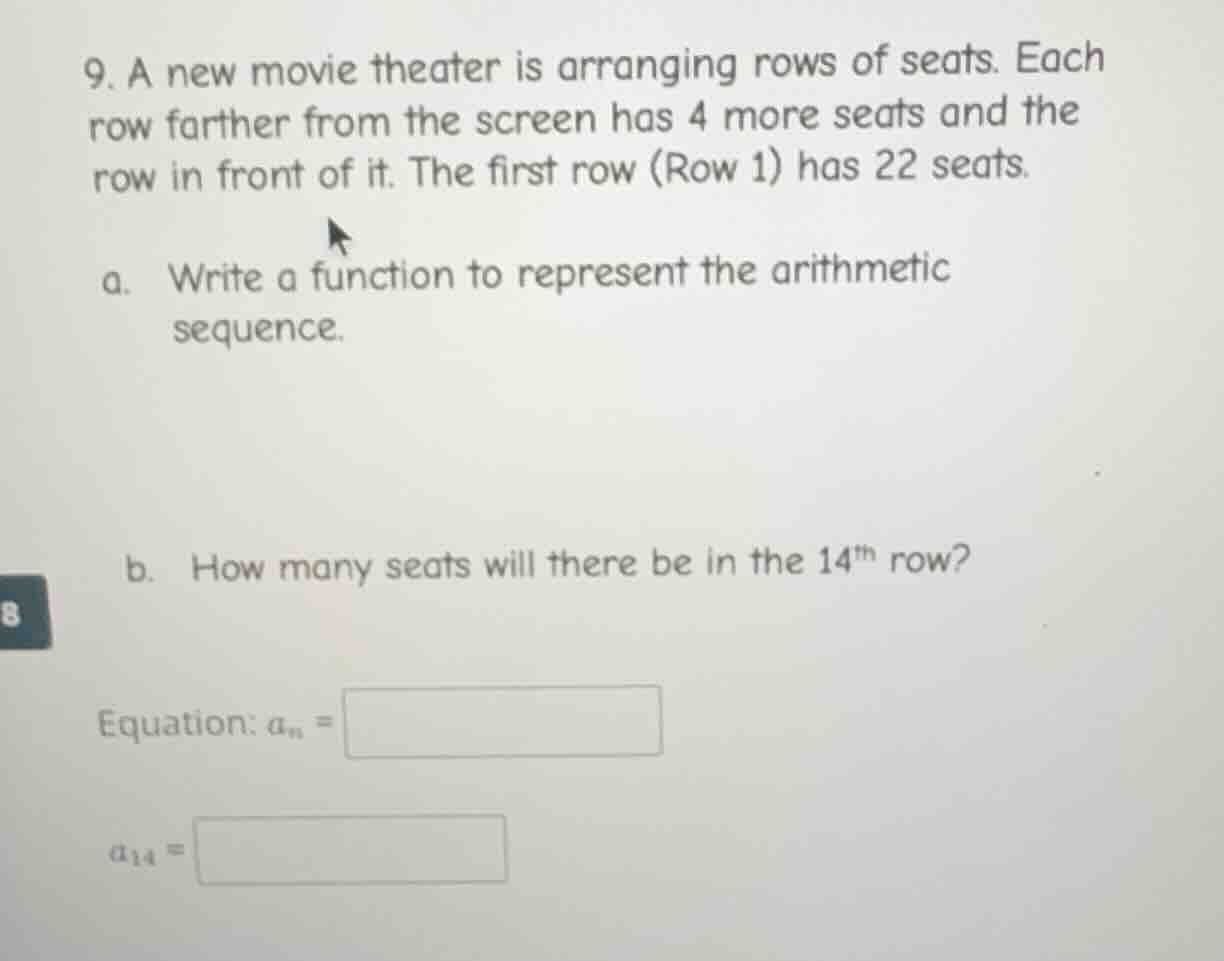
- a new movie theater is arranging rows of seats. each row farther from the screen has 4 more seats and the row in front of it. the first row (row 1) has 22 seats.
a. write a function to represent the arithmetic sequence.
b. how many seats will there be in the 14th row?
equation: $a_n = \square$
$a_{14} = \square$
Part a: Write the arithmetic sequence function
Step 1: Recall arithmetic sequence formula
The formula for the \( n \)-th term of an arithmetic sequence is \( a_n = a_1 + (n - 1)d \), where \( a_1 \) is the first term and \( d \) is the common difference.
Step 2: Identify \( a_1 \) and \( d \)
Here, \( a_1 = 22 \) (seats in the first row) and \( d = 4 \) (each row has 4 more seats than the previous).
Step 3: Substitute into the formula
Substitute \( a_1 = 22 \) and \( d = 4 \) into \( a_n = a_1 + (n - 1)d \):
\[
\]
Part b: Find the number of seats in the 14th row
Step 1: Use the arithmetic sequence function
We have the function \( a_n = 4n + 18 \). To find \( a_{14} \), substitute \( n = 14 \) into the function.
Step 2: Calculate \( a_{14} \)
\[
\]

Snap & solve any problem in the app
Get step-by-step solutions on Sovi AI
Photo-based solutions with guided steps
Explore more problems and detailed explanations
- For part a, the function is \( a_n = 4n + 18 \) (or \( a_n = 22 + (n - 1) \times 4 \)).
- For part b, \( a_{14} = 74 \).
So, the equation for \( a_n \) is \( \boldsymbol{4n + 18} \) (or \( \boldsymbol{22 + 4(n - 1)} \)) and \( a_{14} = \boldsymbol{74} \).