QUESTION IMAGE
Question
new world networks 1200-1490s
directions: click the title above to access the article on the oer website. choose a lexile (reading) level that is best for you. remember to use the read write toolbar skills we learned in unit 0. answer the questions below.
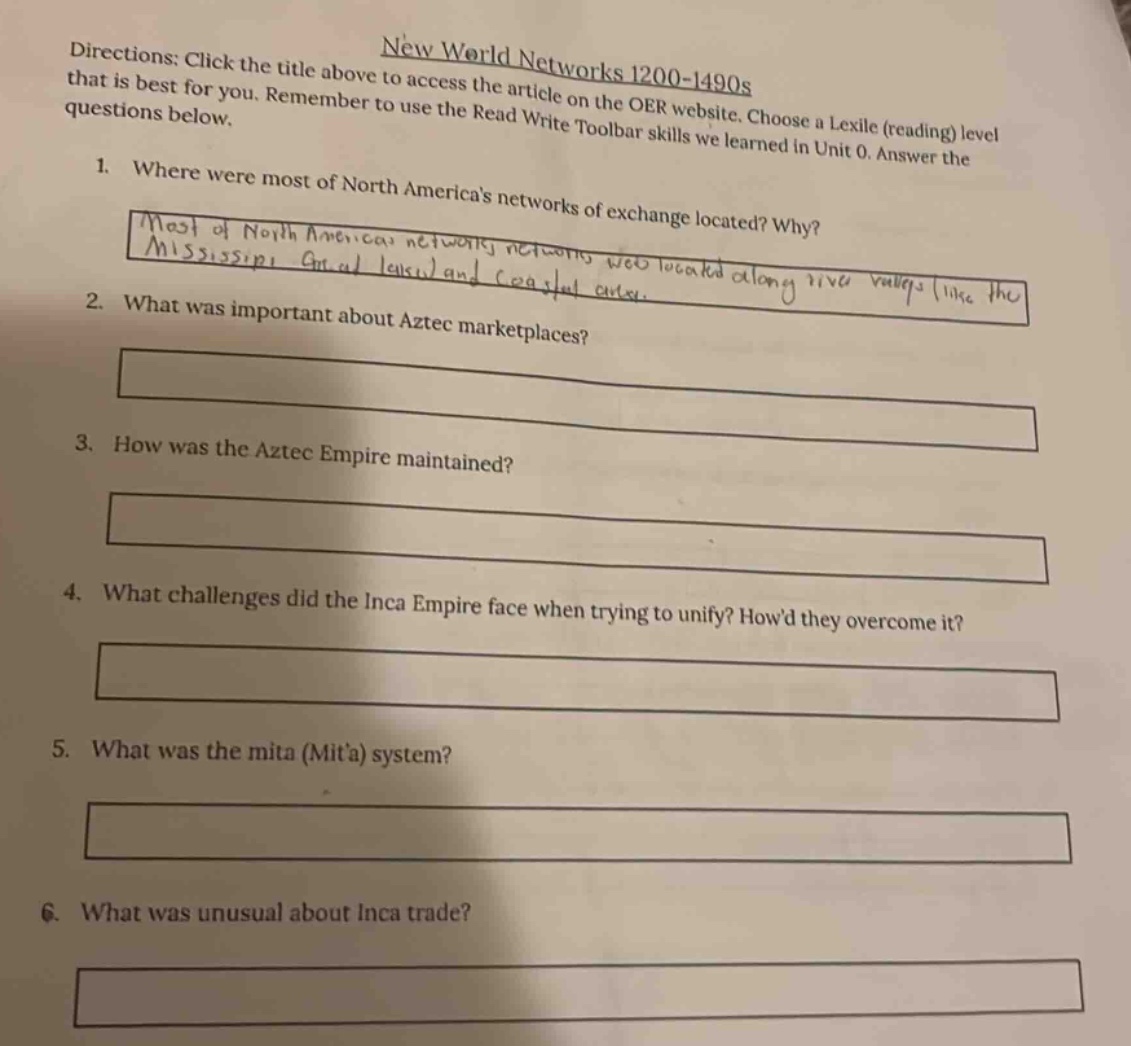
- where were most of north americas networks of exchange located? why?
most of north american networks of exchange were located along river valleys (like the mississippi, great lakes) and coastal areas.
- what was important about aztec marketplaces?
- how was the aztec empire maintained?
- what challenges did the inca empire face when trying to unify? howd they overcome it?
- what was the mita (mita) system?
- what was unusual about inca trade?
Brief Explanations
- For question 1, we first confirm the location of North America's exchange networks, then explain that waterways supported transport, agriculture, and dense populations enabling trade.
- For question 2, Aztec marketplaces were central economic, social, and administrative hubs with regulated, large-scale trade.
- For question 3, the Aztec Empire relied on military conquest, tribute systems, and religious integration.
- For question 4, the Inca faced geographic and cultural diversity; they used road networks, mit'a, and cultural assimilation.
- For question 5, the mit'a system was an Inca labor obligation for public works.
- For question 6, Inca trade lacked a formal currency and relied on state-managed exchange and barter.

Snap & solve any problem in the app
Get step-by-step solutions on Sovi AI
Photo-based solutions with guided steps
Explore more problems and detailed explanations
- Most of North America's exchange networks were located along river valleys (like the Mississippi River) and coastal areas. These locations provided easy water transport for goods, supported fertile land for agriculture (creating surplus goods to trade), and were home to denser populations that drove demand for exchange.
- Aztec marketplaces (like the one at Tenochtitlan's Tlatelolco) were critical large-scale hubs that centralized regional trade, offered a vast range of goods (food, crafts, luxury items), and were regulated by officials to ensure fair trade. They also served as social gathering spaces and centers for distributing tribute goods.
- The Aztec Empire was maintained through a system of military conquest to subjugate neighboring city-states, a regular tribute system that extracted goods and labor from conquered peoples, and the integration of local elites into Aztec governance and religious practices to reduce rebellion.
- The Inca Empire faced challenges like rugged, diverse geography (mountains, deserts, rainforests) that separated communities, and cultural/language diversity across conquered groups. They overcame these by building an extensive, 40,000-kilometer road system to connect regions, imposing Quechua as a universal language, using the mit'a labor system for infrastructure, and relocating loyal populations to restive areas.
- The mit'a (Mit'a) system was a mandatory public labor obligation in the Inca Empire. All able-bodied commoners (men aged 15-50) were required to work a set number of days per year on state projects like roads, agricultural terraces, mines, or construction, in exchange for state support (food, supplies) during their service.
- Inca trade was unusual because there was no formal, standardized currency. Most exchange was either managed directly by the state (redistributing surplus goods across the empire) or done through barter of local products. Long-distance trade of luxury goods was controlled by the imperial elite, not private merchants.