QUESTION IMAGE
Question
(b)
nice work!
linear function, of the form f(x) = mx + b
cubic function, of the form f(x) = ax³ + bx² + cx + d
exponential function, of the form f(x) = a·bˣ + c
reciprocal function, of the form f(x) = \frac{a}{x}
root function, of the form f(x) = a√(bx) + c
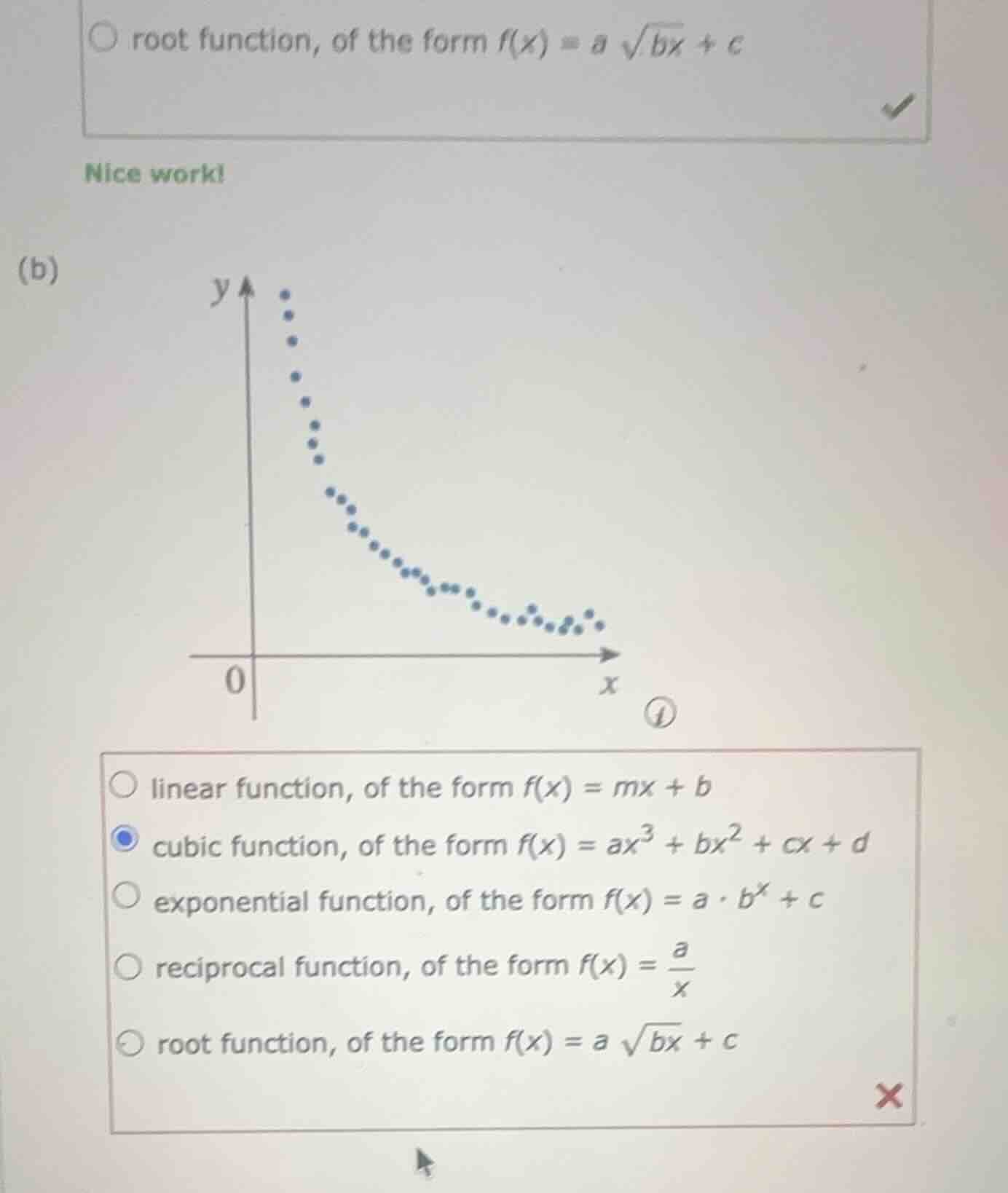
The plotted data shows a curve that decreases rapidly at first, then the rate of decrease slows and the curve approaches a horizontal asymptote, which matches the shape of a decreasing exponential function. Linear functions form straight lines, cubic functions have an S-shaped curve with two turning points, reciprocal functions have hyperbolic shapes with asymptotes at axes, and root functions increase/decrease with a gentle, consistent curve that does not approach a horizontal asymptote in this manner.

Snap & solve any problem in the app
Get step-by-step solutions on Sovi AI
Photo-based solutions with guided steps
Explore more problems and detailed explanations
exponential function, of the form $f(x) = a \cdot b^x + c$