QUESTION IMAGE
Question
no additional details were added for this assignment.
view submission
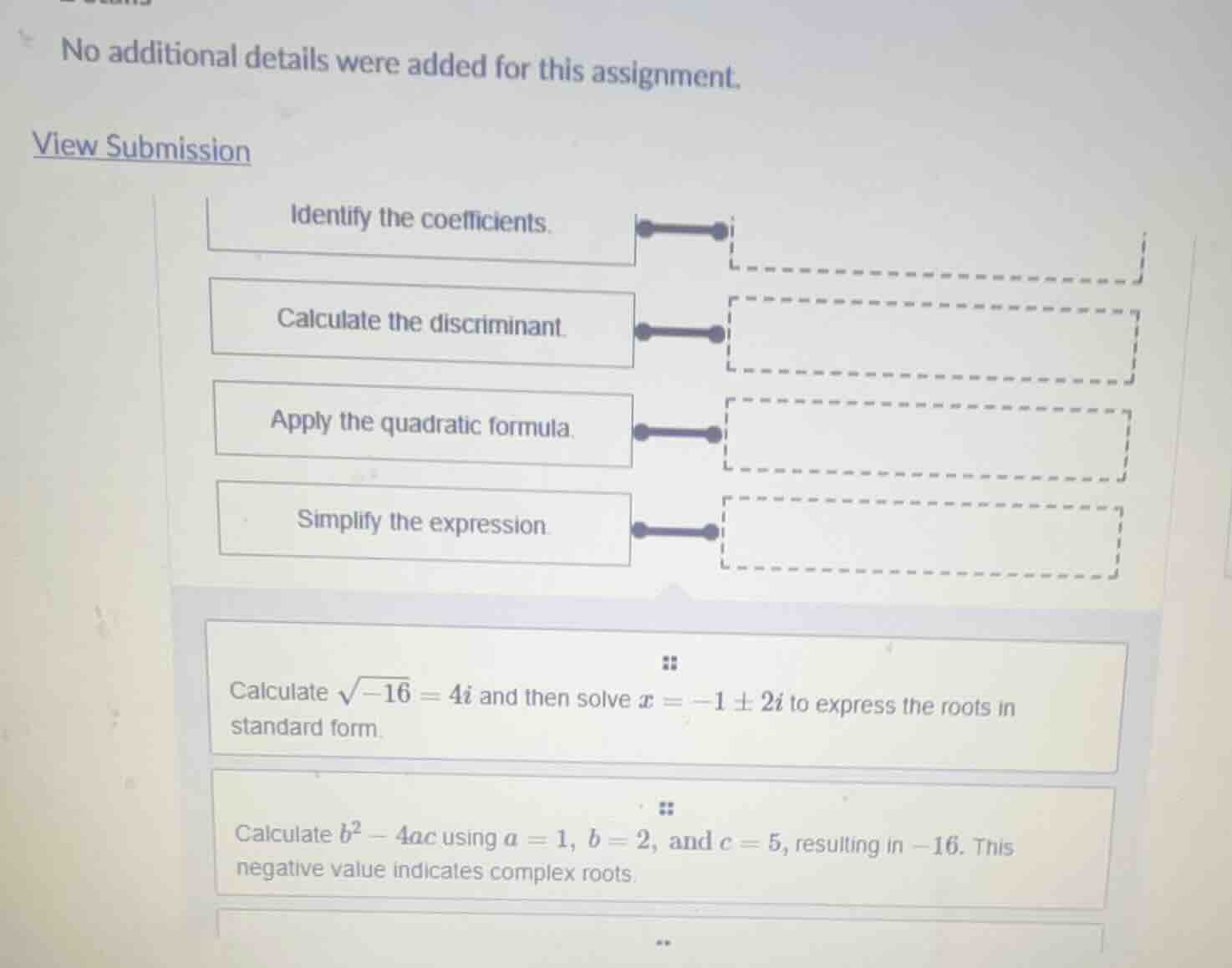
identify the coefficients.
calculate the discriminant.
apply the quadratic formula.
simplify the expression.
calculate \\(\sqrt{-16} = 4i\\) and then solve \\(x = -1 \pm 2i\\) to express the roots in standard form.
calculate \\(b^2 - 4ac\\) using \\(a = 1\\), \\(b = 2\\), and \\(c = 5\\), resulting in \\(-16\\). this negative value indicates complex roots.
Step1: Match Identify coefficients
For quadratic $ax^2+bx+c=0$, use $a=1,b=2,c=5$.
Step2: Match Calculate discriminant
Compute $b^2-4ac = 2^2-4(1)(5)=-16$.
Step3: Match Apply quadratic formula
Substitute into $x=\frac{-b\pm\sqrt{b^2-4ac}}{2a}$.
Step4: Match Simplify expression
Calculate $\sqrt{-16}=4i$, get $x=-1\pm2i$.

Snap & solve any problem in the app
Get step-by-step solutions on Sovi AI
Photo-based solutions with guided steps
Explore more problems and detailed explanations
- Identify the coefficients. → [Corresponding blank: State $a=1$, $b=2$, $c=5$ for the quadratic equation]
- Calculate the discriminant. → Calculate $b^2 - 4ac$ using $a = 1$, $b = 2$, and $c = 5$, resulting in $-16$. This negative value indicates complex roots.
- Apply the quadratic formula. → [Corresponding blank: Substitute values into $x=\frac{-2\pm\sqrt{-16}}{2(1)}$]
- Simplify the expression. → Calculate $\sqrt{-16}=4i$ and then solve $x=-1\pm2i$ to express the roots in standard form.