QUESTION IMAGE
Question
no calculator is allowed on this question.
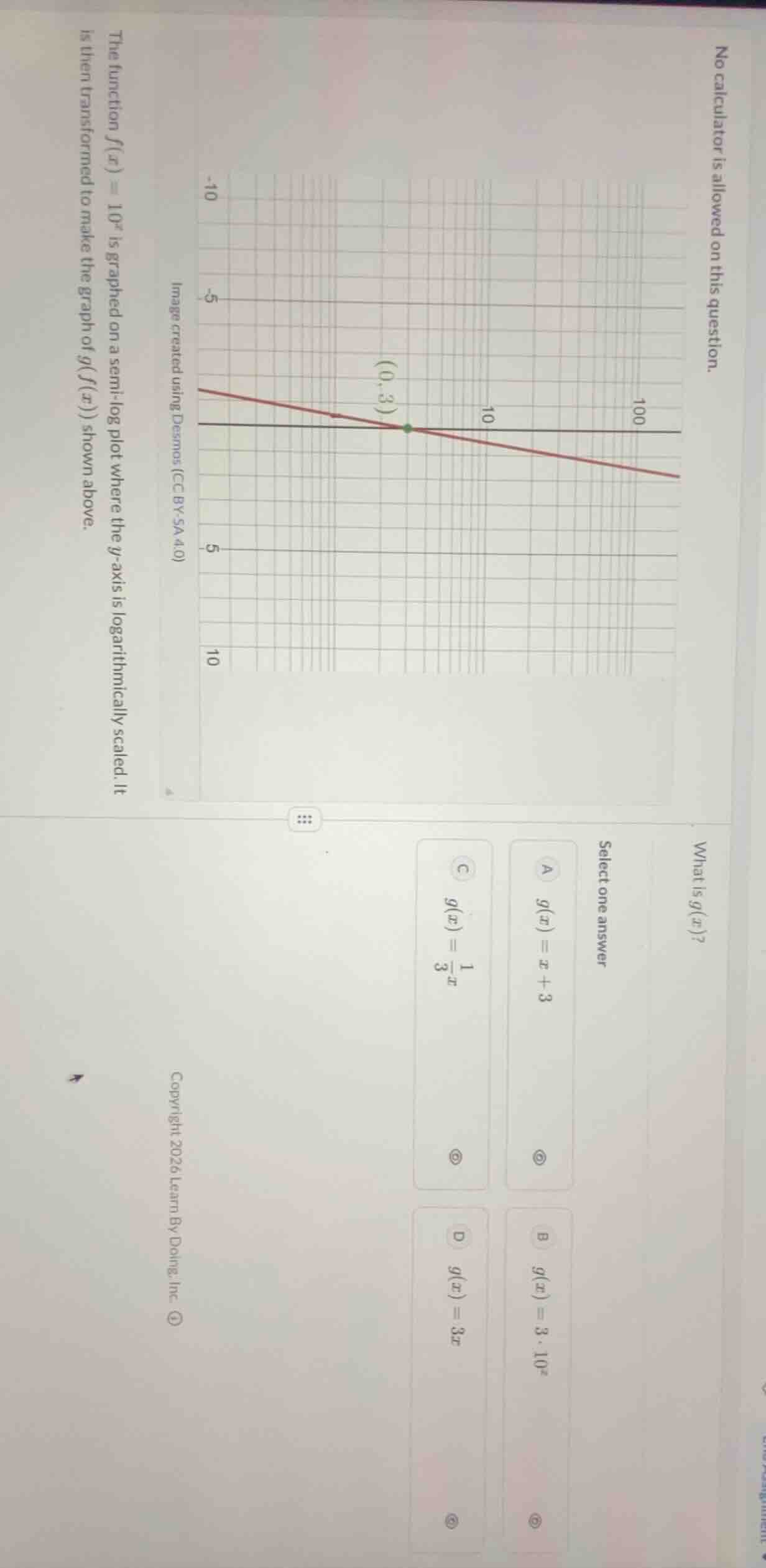
the function $f(x) = 10^x$ is graphed on a semi - log plot where the $y$-axis is logarithmically scaled. it is then transformed to make the graph of $g(f(x))$ shown above.
what is $g(x)$?
select one answer
a $g(x)=x + 3$
c $g(x)=\frac{1}{3}x$
b $g(x)=3cdot10^x$
d $g(x)=3x$
image created using desmos (cc by - sa 4.0)
copyright 2026 learn by doing, inc.
Step1: Analyze the semi - log plot
In a semi - log plot where the \(y\) - axis is logarithmically scaled, if \(y = f(x)=10^{x}\), and we have \(y = g(f(x))\) graphed. Let's first recall the properties of logarithmic scales. If we take the logarithm (base 10) of \(y = 10^{x}\), we get \(\log_{10}y=x\).
Step2: Use the point on the graph
We know that the point \((0,3)\) is on the graph of \(y = g(f(x))\). First, find \(f(0)\): since \(f(x)=10^{x}\), then \(f(0) = 10^{0}=1\).
Now, we know that when \(x = 0\), \(g(f(0))=g(1) = 3\)? Wait, no, wait. Wait, in the semi - log plot, the \(y\) - axis is the logarithm of the function value? Wait, no, the problem says "the function \(f(x)=10^{x}\) is graphed on a semi - log plot where the \(y\) - axis is logarithmically scaled. It is then transformed to make the graph of \(g(f(x))\) shown above."
Wait, let's re - express. Let's consider the general form. If we have a function \(y = g(f(x))\) on a semi - log plot (log - y plot), then \(\log_{10}y=\log_{10}(g(f(x)))\). But \(f(x)=10^{x}\), so let's substitute \(f(x)\) into \(g\).
Let's test each option:
- Option A: \(g(x)=x + 3\). Then \(g(f(x))=g(10^{x})=10^{x}+3\). When \(x = 0\), \(g(f(0))=g(1)=1 + 3=4
eq3\). So A is wrong.
- Option B: \(g(x)=3\cdot10^{x}\). Then \(g(f(x))=g(10^{x})=3\cdot10^{10^{x}}\). When \(x = 0\), \(g(f(0))=3\cdot10^{1}=30
eq3\). So B is wrong.
- Option C: \(g(x)=\frac{1}{3}x\). Then \(g(f(x))=g(10^{x})=\frac{1}{3}\times10^{x}\). When \(x = 0\), \(g(f(0))=\frac{1}{3}\times1 = \frac{1}{3}
eq3\). So C is wrong.
- Option D: \(g(x)=3x\). Then \(g(f(x))=g(10^{x})=3\times10^{x}\)? Wait, no, wait, \(f(x)=10^{x}\), so \(g(f(x))=3\times f(x)=3\times10^{x}\)? Wait, no, wait, no. Wait, \(g(x)=3x\), so \(g(f(x))=3\times f(x)=3\times10^{x}\)? But when \(x = 0\), \(3\times10^{0}=3\), which matches the point \((0,3)\) on the graph. Wait, maybe I made a mistake in the earlier analysis. Wait, let's re - think.
Wait, in the semi - log plot (log - y axis), the \(y\) - coordinate is \(\log_{10}(g(f(x)))\)? No, the problem says "the function \(f(x)=10^{x}\) is graphed on a semi - log plot where the \(y\) - axis is logarithmically scaled". So for \(f(x)=10^{x}\), when we graph it on a log - y plot, the \(y\) - value is \(\log_{10}(10^{x})=x\). Then, after transformation to \(g(f(x))\), the graph is a line. Let's find the equation of the line.
The line passes through \((0,3)\) (in terms of the log - y plot? Wait, no, the point is \((0,3)\) on the graph of \(g(f(x))\). Let's consider the slope. Let's take another point. Wait, when \(x = 1\), \(f(1)=10^{1}=10\). Let's see what \(g(f(1))\) would be.
Wait, if \(g(x)=3x\), then \(g(f(x))=3\times10^{x}\). When \(x = 0\), \(3\times10^{0}=3\) (matches the point \((0,3)\)). When \(x = 1\), \(3\times10^{1}=30\), and \(\log_{10}(30)\approx1.477\), but maybe we are not taking the log of \(g(f(x))\) here. Wait, the problem says "the function \(f(x)=10^{x}\) is graphed on a semi - log plot where the \(y\) - axis is logarithmically scaled. It is then transformed to make the graph of \(g(f(x))\) shown above." So the \(y\) - axis is the value of \(g(f(x))\) with a logarithmic scale. Wait, no, a semi - log plot (log - y) means that the \(y\) - axis is scaled logarithmically, so the actual function value \(y = g(f(x))\) has its logarithm (base 10) represented on the \(y\) - axis? No, no. In a log - y plot, the \(y\) - axis tick marks are at \(1,10,100,\cdots\) and the distance between \(1\) and \(10\) is the same as between \(10\) and \(100\) (logarithmic spacing). The function \(y = g(f(x))\) is pl…

Snap & solve any problem in the app
Get step-by-step solutions on Sovi AI
Photo-based solutions with guided steps
Explore more problems and detailed explanations
D. \(g(x)=3x\)