QUESTION IMAGE
Question
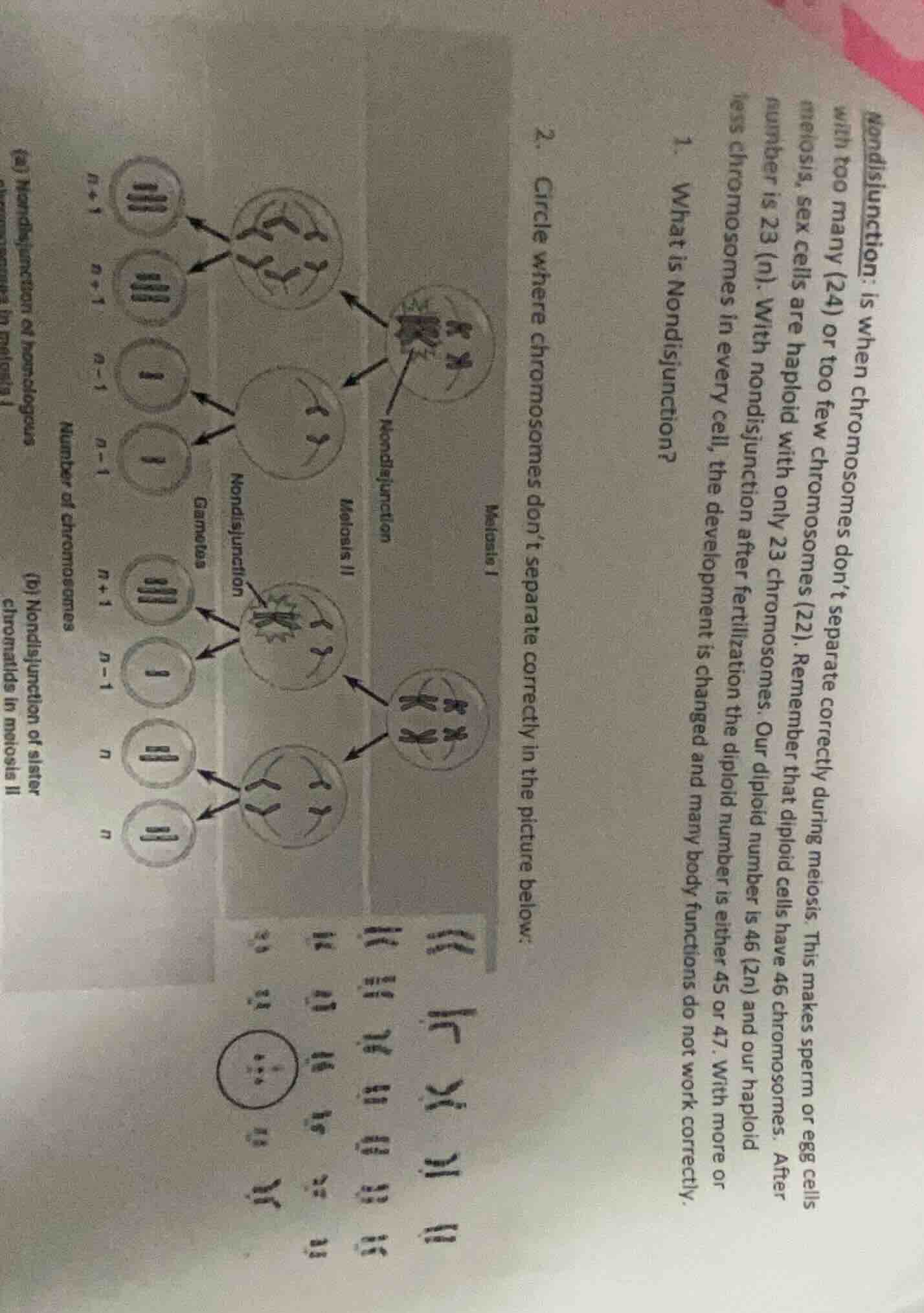
nondisjunction: is when chromosomes dont separate correctly during meiosis. this makes sperm or egg cells with too many (24) or too few chromosomes (22). remember that diploid cells have 46 chromosomes. after meiosis, sex cells are haploid with only 23 chromosomes. our diploid number is 46 (2n) and our haploid number is 23 (n). with nondisjunction after fertilization the diploid number is either 45 or 47. with more or less chromosomes in every cell, the development is changed and many body functions do not work correctly.1. what is nondisjunction?2. circle where chromosomes dont separate correctly in the picture below:meiosis inondisjunctionmeiosis iinondisjunctiongametesnumber of chromosomesn+1 n+1 n-1 n-1n+1 n-1 n n(a) nondisjunction of homologous chromosomes in meiosis i(b) nondisjunction of sister chromatids in meiosis ii
- Se define como el fallo en la separación correcta de los cromosomas durante la meiosis, lo que genera células sexuales con un número anormal de cromosomas (demasiados o muy pocos).
- Se deben marcar (circular) las dos celdas etiquetadas como "Nondisjunction": una en la fase de Meiosis I (con los cromosomas homólogos que no se separan) y otra en la fase de Meiosis II (con las cromátidas hermanas que no se separan).

Snap & solve any problem in the app
Get step-by-step solutions on Sovi AI
Photo-based solutions with guided steps
Explore more problems and detailed explanations
- Nondisjunction is when chromosomes don't separate correctly during meiosis, resulting in sex cells with too many (24) or too few (22) chromosomes, which alters development and bodily functions after fertilization.
- The circles should be drawn around:
- The cell labeled "Nondisjunction" in Meiosis I (top pathway, with paired chromosomes failing to separate)
- The cell labeled "Nondisjunction" in Meiosis II (bottom pathway, with sister chromatids failing to separate)