QUESTION IMAGE
Question
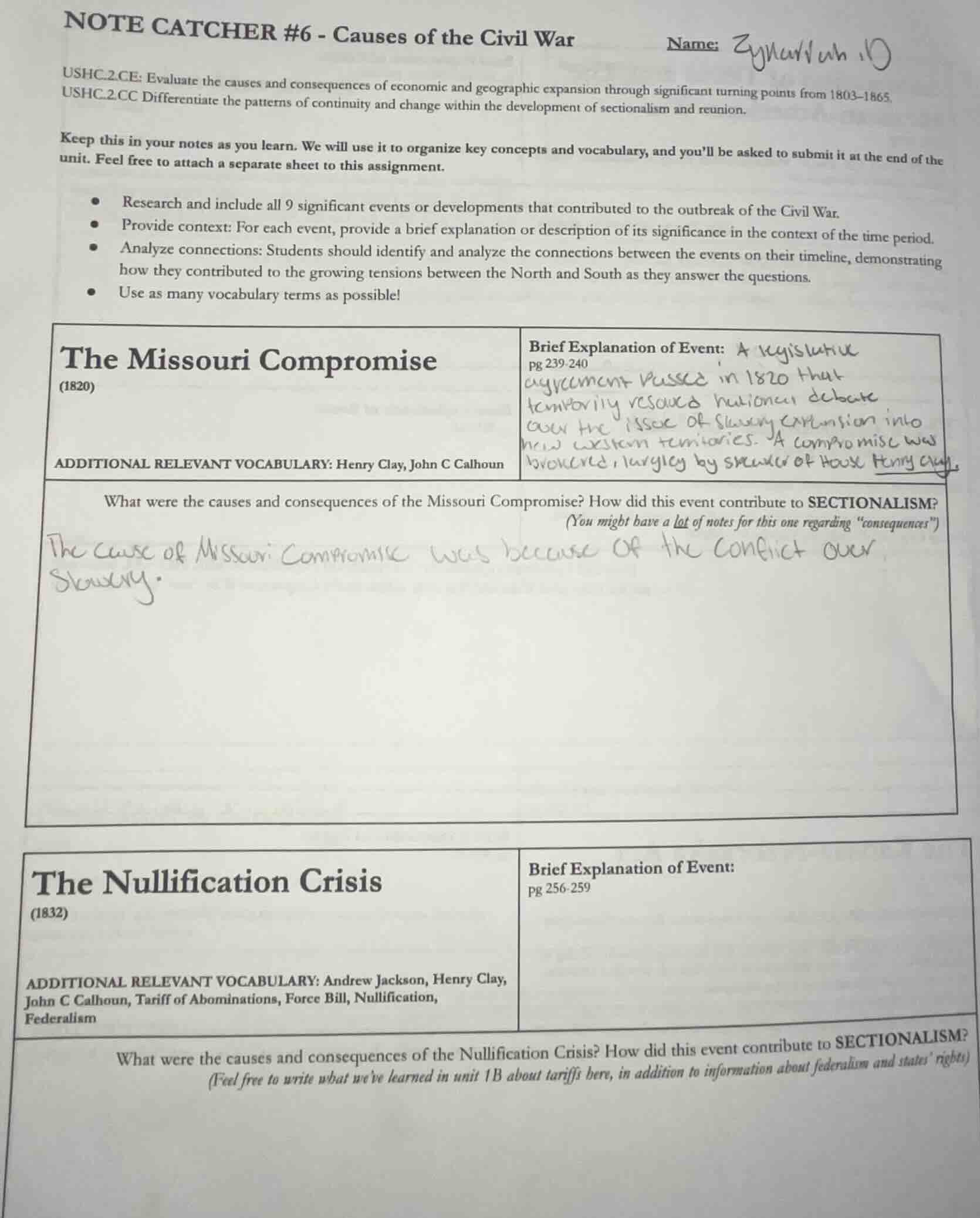
note catcher #6 - causes of the civil warname:ushc.2.ce: evaluate the causes and consequences of economic and geographic expansion through significant turning points from 1803-1865.ushc.2.cc differentiate the patterns of continuity and change within the development of sectionalism and reunion.keep this in your notes as you learn. we will use it to organize key concepts and vocabulary, and youll be asked to submit it at the end of the unit. feel free to attach a separate sheet to this assignment.• research and include all 9 significant events or developments that contributed to the outbreak of the civil war.• provide context: for each event, provide a brief explanation or description of its significance in the context of the time period.• analyze connections: students should identify and analyze the connections between the events on their timeline, demonstrating how they contributed to the growing tensions between the north and south as they answer the questions.• use as many vocabulary terms as possible!the missouri compromise(1820)brief explanation of event:pg 239-240a legislative agreement passed in 1820 that temporarily resolved national debate over the issue of slavery expansion into new western territories. a compromise was brokered largely by speaker of house henry clay.additional relevant vocabulary: henry clay, john c calhounwhat were the causes and consequences of the missouri compromise? how did this event contribute to sectionalism?(you might have a lot of notes for this one regarding \consequences\)the cause of missouri compromise was because of the conflict over slavery.the nullification crisis(1832)brief explanation of event:pg 256-259additional relevant vocabulary: andrew jackson, henry clay,john c calhoun, tariff of abominations, force bill, nullification,federalismwhat were the causes and consequences of the nullification crisis? how did this event contribute to sectionalism?(feel free to write what weve learned in unit 1b about tariffs here, in addition to information about federalism and states rights)
For The Missouri Compromise (1820)
- Causes: Growing sectional tension over whether slavery would be allowed in new western territories; Missouri sought statehood as a slave state, which would upset the free-slave state balance in Congress.
- Consequences: Missouri was admitted as a slave state, Maine as a free state; a line was drawn at 36°30' N latitude, banning slavery in territories north of the line (except Missouri).
- Contribution to Sectionalism: It temporarily resolved the crisis but formalized the geographic divide over slavery, deepening the North-South split by framing expansion as a zero-sum conflict over slavery's future.
For The Nullification Crisis (1832)
- Brief Explanation of Event: A political conflict where South Carolina declared the 1828 and 1832 protective tariffs (dubbed the "Tariff of Abominations") unconstitutional and unenforceable within its borders, arguing states had the right to nullify federal laws they deemed unjust. President Andrew Jackson responded with the Force Bill to enforce the tariffs, and a compromise tariff was later negotiated by Henry Clay to defuse the crisis.
- Causes: The protective tariffs favored Northern manufacturing by making imported goods more expensive, but raised costs for Southern planters who relied on imported European goods; Southern leaders (like John C. Calhoun) argued the tariffs were unfair and violated states' rights under federalism.
- Consequences: A compromise tariff (1833) reduced tariff rates over time; the crisis highlighted deep divisions over federal power vs. states' rights, and showed Southern willingness to challenge federal authority, setting a precedent for future sectional conflicts over federal policy.
- Contribution to Sectionalism: It pitted the industrial, tariff-supporting North against the agrarian, tariff-opposed South, framing sectional differences as a fight over core constitutional principles (federal power vs. states' rights) and economic self-interest, further alienating the two regions.

Snap & solve any problem in the app
Get step-by-step solutions on Sovi AI
Photo-based solutions with guided steps
Explore more problems and detailed explanations
The Missouri Compromise (1820)
- Causes: Conflict over slavery expansion into western territories; Missouri's bid for slave statehood threatened congressional balance.
- Consequences: Missouri (slave) + Maine (free) admitted; 36°30' line banned slavery in most northern territories.
- Sectionalism Impact: Formalized North-South geographic divide over slavery, framing expansion as a sectional conflict.
The Nullification Crisis (1832)
- Brief Explanation: South Carolina tried to nullify the "Tariff of Abominations," claiming states could reject unfair federal laws. Andrew Jackson threatened military force, and Henry Clay negotiated a compromise tariff to end the crisis.
- Causes: Protective tariffs benefited Northern manufacturers but harmed Southern planters; Southern leaders (John C. Calhoun) invoked states' rights and federalism to oppose the tariffs.
- Consequences: Compromise tariff lowered rates over time; crisis escalated tensions over federal vs. state authority.
- Sectionalism Impact: Deepened North-South rift by framing economic and constitutional disagreements as sectional, showing Southern willingness to defy federal power.