QUESTION IMAGE
Question
notes: cell membrane and cell transport
i. what is the cell membrane?
a. the ______ of the cell.
b. primary function: ____ helps maintain __ or ____.
c. it is ____ this means that the cell membrane only allows certain substances to __ or ____ the cell.
d. scientists use the ______ to describe the cell membranes structure and function.
ii. cell membrane structure and function (fluid mosaic model) - label each part of the model(s) shown!
a = peripheral/receptor proteins (green)
function:
- some are ____ that ____ happening around the cell membrane.
- helps with ______ between cells
b = carbohydrate chains (pink)
function:
- helps ______
- ____ each other ____ = carbohydrate chain attached to a phospholipid.
- ______ =
c = cholesterol (orange)
function:
- helps with the ____ of the cell membrane and its ability to control the passage of different __ such as ____
d = protein channel/ integral proteins (blue)
function:
- helps move ______ through the membrane.
- ____ help with ____
e = phospholipid bilayer (purple)
function:
- largest part of the cell membrane.
- allows ____ molecules such as ____
____ , & ____
I. What is the Cell Membrane?
a. The outer boundary of the cell. It encloses the cell, separating its internal environment from the external surroundings.
b. Primary Function: Helps Maintain homeostasis (stable internal environment) or regulate the movement of substances in and out of the cell.
c. It is selectively permeable. This means that the cell membrane only allows certain substances to pass through or interact with the cell.
d. Scientists use the Fluid Mosaic Model to describe the cell membrane’s structure and function.
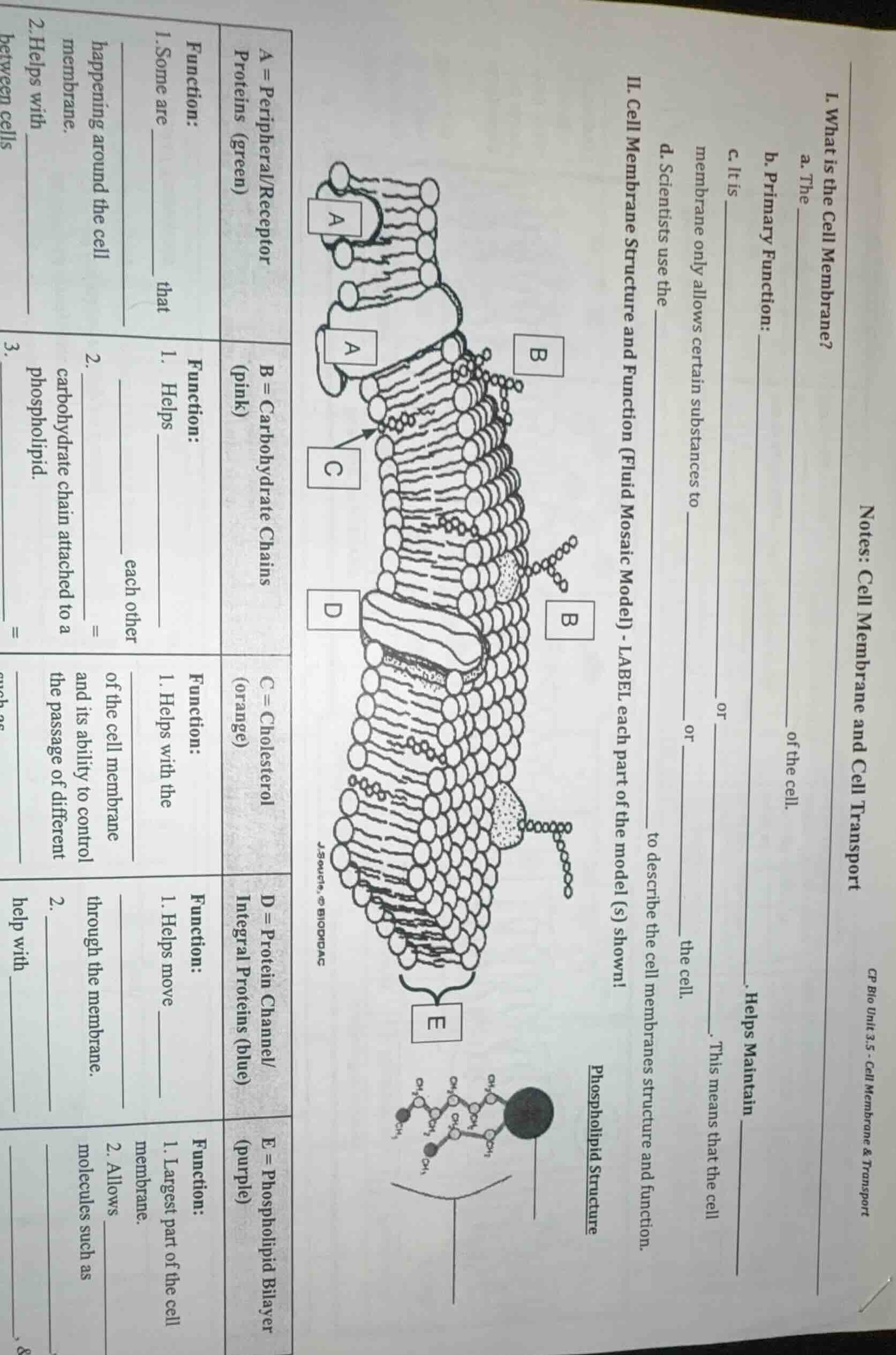
II. Cell Membrane Structure and Function (Fluid Mosaic Model) - LABEL each part:
A = Peripheral/Receptor Proteins (green)
Function:
- Some are receptors that detect signals (e.g., hormones, neurotransmitters) happening around the cell membrane.
- Helps with cell signaling between cells.
B = Carbohydrate Chains (pink)
Function:
- Helps with cell recognition (e.g., identifying “self” vs. “foreign” cells).
- Helps cells stick to each other (cell adhesion) = “glycoprotein” (carbohydrate chain attached to a protein) or “glycolipid” (carbohydrate chain attached to a lipid).
C = Cholesterol (orange)
Function:
- Helps with the fluidity of the cell membrane and its ability to control the passage of different molecules (e.g., prevents the membrane from becoming too rigid or too fluid).
D = Protein Channel/Integral Proteins (blue)
Function:
- Helps move molecules (e.g., ions, nutrients) through the membrane (facilitated diffusion or active transport).
- Helps with transport of substances across the membrane.
E = Phospholipid Bilayer (purple)
Function:
- Largest part of the cell membrane.
- Allows selective permeability (only certain molecules like oxygen, water, or small lipids can pass freely) & provides a barrier between the cell’s internal and external environments.
Phospholipid Structure (diagram below E)
- Head: Hydrophilic (water-attracting) region (contains phosphate group).
- Tails: Hydrophobic (water-repelling) region (fatty acid chains).
- Arranges into a bilayer (two layers) in water, with heads facing outward (toward water) and tails facing inward (away from water).
Key Notes:
- The cell membrane’s structure (phospholipids, proteins, cholesterol, carbohydrates) directly supports its function (selective permeability, cell communication, protection, etc.).
- The “Fluid Mosaic Model” emphasizes:
- Fluidity: Membrane components (lipids, proteins) can move laterally (side-to-side) within the bilayer.
- Mosaic: The membrane is a mix of different molecules (phospholipids, proteins, cholesterol, carbohydrates) with distinct roles.

Snap & solve any problem in the app
Get step-by-step solutions on Sovi AI
Photo-based solutions with guided steps
Explore more problems and detailed explanations
I. What is the Cell Membrane?
a. The outer boundary of the cell. It encloses the cell, separating its internal environment from the external surroundings.
b. Primary Function: Helps Maintain homeostasis (stable internal environment) or regulate the movement of substances in and out of the cell.
c. It is selectively permeable. This means that the cell membrane only allows certain substances to pass through or interact with the cell.
d. Scientists use the Fluid Mosaic Model to describe the cell membrane’s structure and function.
II. Cell Membrane Structure and Function (Fluid Mosaic Model) - LABEL each part:
A = Peripheral/Receptor Proteins (green)
Function:
- Some are receptors that detect signals (e.g., hormones, neurotransmitters) happening around the cell membrane.
- Helps with cell signaling between cells.
B = Carbohydrate Chains (pink)
Function:
- Helps with cell recognition (e.g., identifying “self” vs. “foreign” cells).
- Helps cells stick to each other (cell adhesion) = “glycoprotein” (carbohydrate chain attached to a protein) or “glycolipid” (carbohydrate chain attached to a lipid).
C = Cholesterol (orange)
Function:
- Helps with the fluidity of the cell membrane and its ability to control the passage of different molecules (e.g., prevents the membrane from becoming too rigid or too fluid).
D = Protein Channel/Integral Proteins (blue)
Function:
- Helps move molecules (e.g., ions, nutrients) through the membrane (facilitated diffusion or active transport).
- Helps with transport of substances across the membrane.
E = Phospholipid Bilayer (purple)
Function:
- Largest part of the cell membrane.
- Allows selective permeability (only certain molecules like oxygen, water, or small lipids can pass freely) & provides a barrier between the cell’s internal and external environments.
Phospholipid Structure (diagram below E)
- Head: Hydrophilic (water-attracting) region (contains phosphate group).
- Tails: Hydrophobic (water-repelling) region (fatty acid chains).
- Arranges into a bilayer (two layers) in water, with heads facing outward (toward water) and tails facing inward (away from water).
Key Notes:
- The cell membrane’s structure (phospholipids, proteins, cholesterol, carbohydrates) directly supports its function (selective permeability, cell communication, protection, etc.).
- The “Fluid Mosaic Model” emphasizes:
- Fluidity: Membrane components (lipids, proteins) can move laterally (side-to-side) within the bilayer.
- Mosaic: The membrane is a mix of different molecules (phospholipids, proteins, cholesterol, carbohydrates) with distinct roles.