QUESTION IMAGE
Question
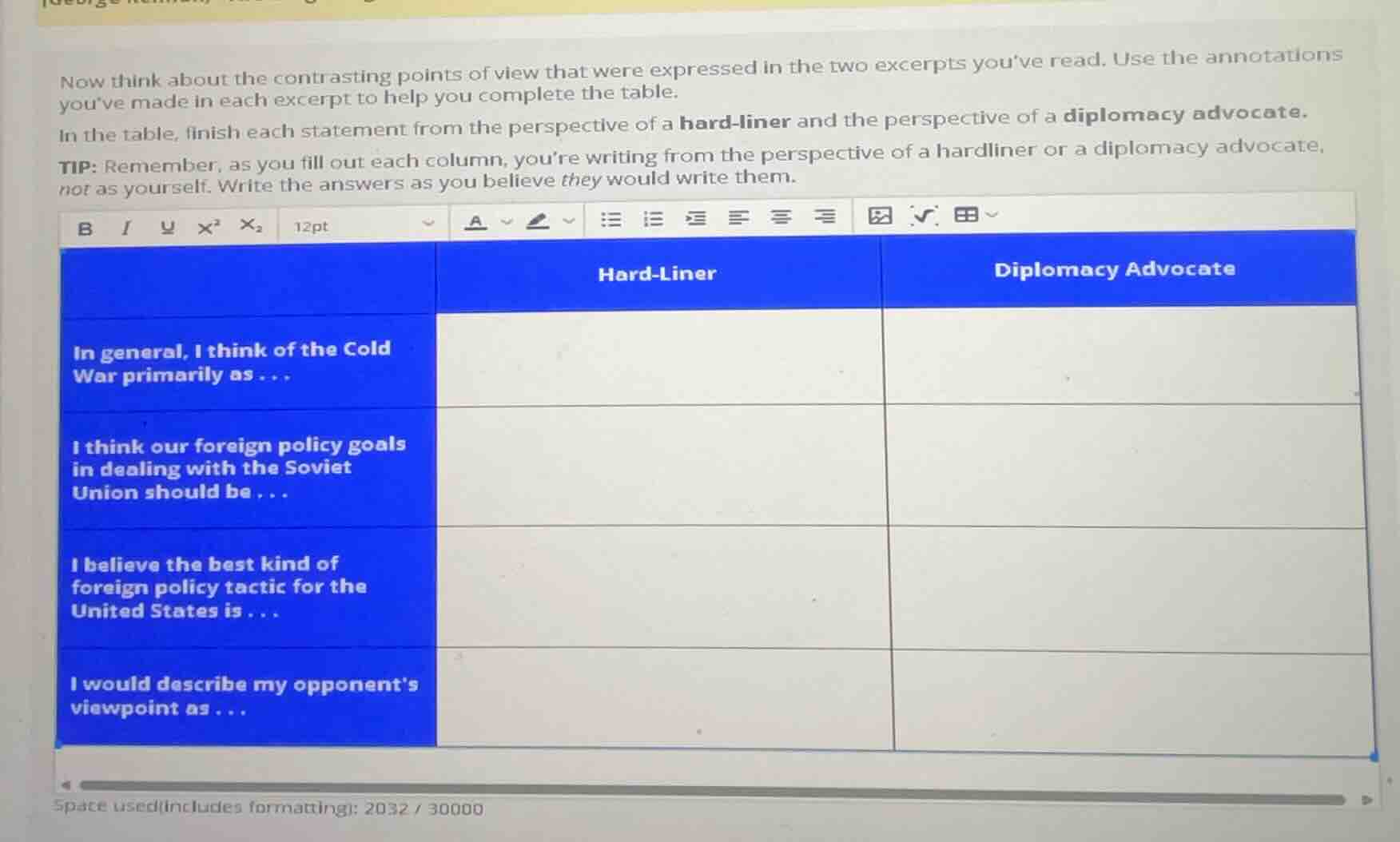
now think about the contrasting points of view that were expressed in the two excerpts youve read. use the annotations youve made in each excerpt to help you complete the table.
in the table, finish each statement from the perspective of a hard - liner and the perspective of a diplomacy advocate.
tip: remember, as you fill out each column, youre writing from the perspective of a hardliner or a diplomacy advocate, not as yourself. write the answers as you believe they would write them.
(the table has columns: hard - liner, diplomacy advocate and rows:
- in general, i think of the cold war primarily as...
- i think our foreign policy goals in dealing with the soviet union should be...
- i believe the best kind of foreign policy tactic for the united states is...
- i would describe my opponents viewpoint as...)
space used(includes formatting): 2032 / 30000
To complete the table, we analyze the typical perspectives of a hard - liner and a diplomacy advocate during the Cold War:
For the row "In general, I think of the Cold War primarily as..."
- Hard - Liner: A hard - liner would view the Cold War as a battle between good (capitalist, democratic systems) and evil (communist system). So, the statement could be "In general, I think of the Cold War primarily as a necessary struggle against the expansionist, totalitarian communist threat posed by the Soviet Union, where we must be firm and unyielding to protect our way of life and global influence."
- Diplomacy Advocate: A diplomacy advocate would see the Cold War as a complex international situation that can be managed through dialogue and negotiation. So, the statement could be "In general, I think of the Cold War primarily as a tense international rivalry that can be mitigated through communication, mutual understanding, and finding common ground with the Soviet Union to avoid catastrophic conflict."
For the row "I think our foreign policy goals in dealing with the Soviet Union should be..."
- Hard - Liner: The goal for a hard - liner would be to weaken the Soviet Union and contain its influence. So, "I think our foreign policy goals in dealing with the Soviet Union should be to contain and roll back Soviet influence at every turn, use economic and military pressure to undermine their system, and show no weakness in the face of their aggression."
- Diplomacy Advocate: The goal for a diplomacy advocate would be to reduce tensions and find areas of cooperation. So, "I think our foreign policy goals in dealing with the Soviet Union should be to engage in dialogue to reduce tensions, find areas of mutual interest (like arms control, trade in non - strategic goods) to build trust, and work towards a more stable international order."
For the row "I believe the best kind of foreign policy tactic for the United States is..."
- Hard - Liner: A hard - liner would favor strong, confrontational tactics. So, "I believe the best kind of foreign policy tactic for the United States is to use a strong military presence, economic sanctions, and support for anti - communist forces around the world to show the Soviet Union that we will not be pushed around and to limit their ability to expand."
- Diplomacy Advocate: A diplomacy advocate would favor diplomatic tactics. So, "I believe the best kind of foreign policy tactic for the United States is to engage in diplomatic negotiations, cultural exchanges, and build diplomatic channels to understand Soviet intentions and find peaceful solutions to disputes."
For the row "I would describe my opponent's viewpoint as..."
- Hard - Liner (describing diplomacy advocate's view): A hard - liner would see the diplomacy advocate's view as weak. So, "I would describe my opponent's viewpoint as naive and dangerous, as they are willing to compromise with a totalitarian regime and ignore the very real threat it poses to our values and security."
- Diplomacy Advocate (describing hard - liner's view): A diplomacy advocate would see the hard - liner's view as overly confrontational. So, "I would describe my opponent's viewpoint as overly aggressive and shortsighted, as they risk escalating tensions to the point of war and ignore the potential for peaceful coexistence and cooperation with the Soviet Union."
Final Table (filled)
| Hard - Liner | Diplomacy Advocate |
|---|
| In general, I think of the Cold War primarily as... | A necessary struggle against th…

Snap & solve any problem in the app
Get step-by-step solutions on Sovi AI
Photo-based solutions with guided steps
Explore more problems and detailed explanations
To complete the table, we analyze the typical perspectives of a hard - liner and a diplomacy advocate during the Cold War:
For the row "In general, I think of the Cold War primarily as..."
- Hard - Liner: A hard - liner would view the Cold War as a battle between good (capitalist, democratic systems) and evil (communist system). So, the statement could be "In general, I think of the Cold War primarily as a necessary struggle against the expansionist, totalitarian communist threat posed by the Soviet Union, where we must be firm and unyielding to protect our way of life and global influence."
- Diplomacy Advocate: A diplomacy advocate would see the Cold War as a complex international situation that can be managed through dialogue and negotiation. So, the statement could be "In general, I think of the Cold War primarily as a tense international rivalry that can be mitigated through communication, mutual understanding, and finding common ground with the Soviet Union to avoid catastrophic conflict."
For the row "I think our foreign policy goals in dealing with the Soviet Union should be..."
- Hard - Liner: The goal for a hard - liner would be to weaken the Soviet Union and contain its influence. So, "I think our foreign policy goals in dealing with the Soviet Union should be to contain and roll back Soviet influence at every turn, use economic and military pressure to undermine their system, and show no weakness in the face of their aggression."
- Diplomacy Advocate: The goal for a diplomacy advocate would be to reduce tensions and find areas of cooperation. So, "I think our foreign policy goals in dealing with the Soviet Union should be to engage in dialogue to reduce tensions, find areas of mutual interest (like arms control, trade in non - strategic goods) to build trust, and work towards a more stable international order."
For the row "I believe the best kind of foreign policy tactic for the United States is..."
- Hard - Liner: A hard - liner would favor strong, confrontational tactics. So, "I believe the best kind of foreign policy tactic for the United States is to use a strong military presence, economic sanctions, and support for anti - communist forces around the world to show the Soviet Union that we will not be pushed around and to limit their ability to expand."
- Diplomacy Advocate: A diplomacy advocate would favor diplomatic tactics. So, "I believe the best kind of foreign policy tactic for the United States is to engage in diplomatic negotiations, cultural exchanges, and build diplomatic channels to understand Soviet intentions and find peaceful solutions to disputes."
For the row "I would describe my opponent's viewpoint as..."
- Hard - Liner (describing diplomacy advocate's view): A hard - liner would see the diplomacy advocate's view as weak. So, "I would describe my opponent's viewpoint as naive and dangerous, as they are willing to compromise with a totalitarian regime and ignore the very real threat it poses to our values and security."
- Diplomacy Advocate (describing hard - liner's view): A diplomacy advocate would see the hard - liner's view as overly confrontational. So, "I would describe my opponent's viewpoint as overly aggressive and shortsighted, as they risk escalating tensions to the point of war and ignore the potential for peaceful coexistence and cooperation with the Soviet Union."
Final Table (filled)
| Hard - Liner | Diplomacy Advocate | |
|---|---|---|
| I think our foreign policy goals in dealing with the Soviet Union should be... | To contain and roll back Soviet influence at every turn, use economic and military pressure to undermine their system, and show no weakness in the face of their aggression. | To engage in dialogue to reduce tensions, find areas of mutual interest (like arms control, trade in non - strategic goods) to build trust, and work towards a more stable international order. |
| I believe the best kind of foreign policy tactic for the United States is... | To use a strong military presence, economic sanctions, and support for anti - communist forces around the world to show the Soviet Union that we will not be pushed around and to limit their ability to expand. | To engage in diplomatic negotiations, cultural exchanges, and build diplomatic channels to understand Soviet intentions and find peaceful solutions to disputes. |
| I would describe my opponent's viewpoint as... | Naive and dangerous, as they are willing to compromise with a totalitarian regime and ignore the very real threat it poses to our values and security. | Overly aggressive and shortsighted, as they risk escalating tensions to the point of war and ignore the potential for peaceful coexistence and cooperation with the Soviet Union. |