QUESTION IMAGE
Question
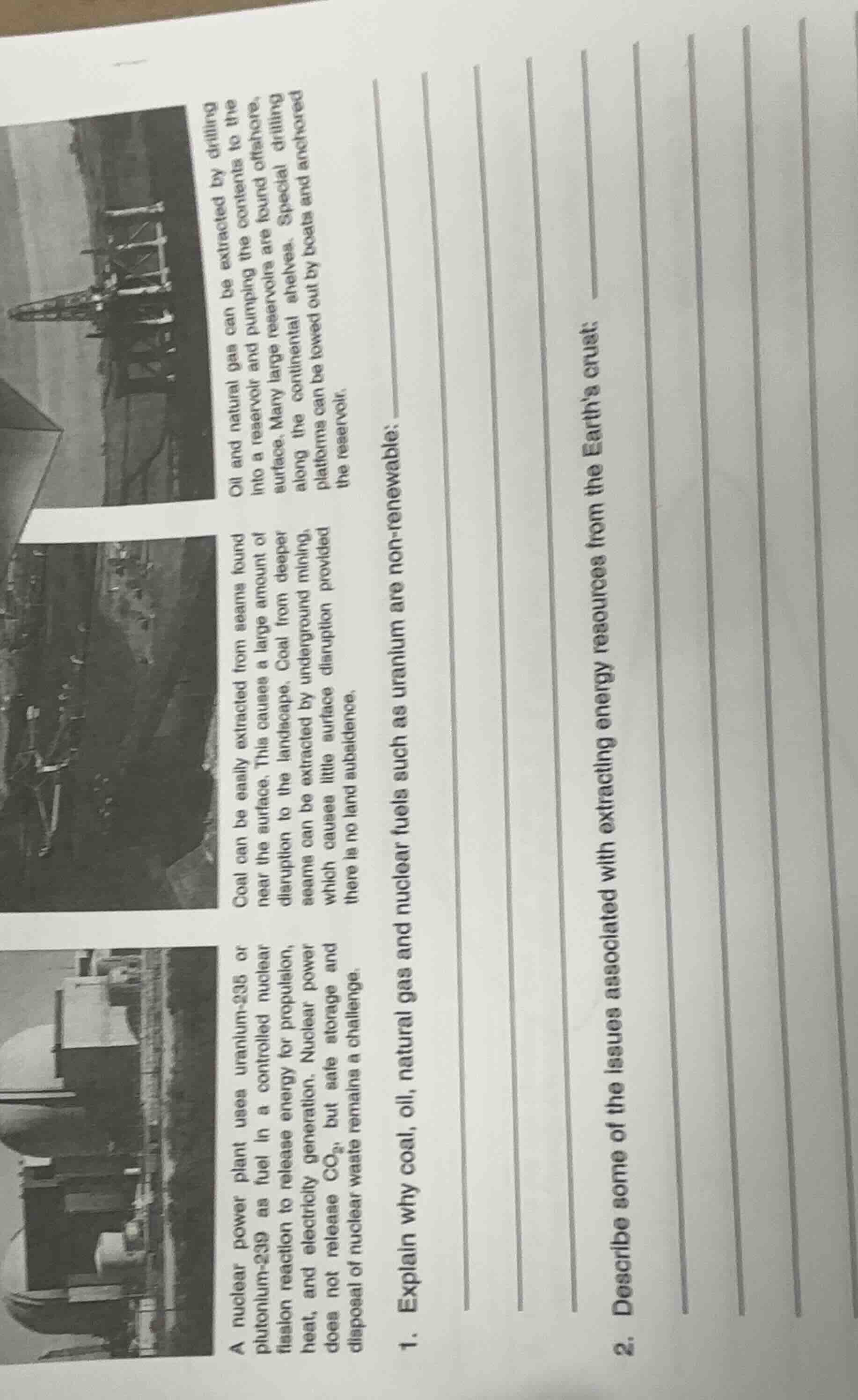
a nuclear power plant uses uranium-235 or plutonium-239 as fuel in a controlled nuclear fission reaction to release energy for propulsion, heat, and electricity generation. nuclear power does not release co₂, but safe storage and disposal of nuclear waste remains a challenge.
coal can be easily extracted from seams found near the surface. this causes a large amount of disruption to the landscape. coal from deeper seams can be extracted by underground mining, which causes little surface disruption provided there is no land subsidence.
oil and natural gas can be extracted by drilling into a reservoir and pumping the contents to the surface. many large reservoirs are found offshore, along the continental shelves. special drilling platforms can be towed out by boats and anchored the reservoir.
- explain why coal, oil, natural gas and nuclear fuels such as uranium are non - renewable:
- describe some of the issues associated with extracting energy resources from the earth’s crust.
Question 1: Explain why coal, oil, natural gas and nuclear fuels such as uranium are non - renewable.
- Coal: Coal is formed from the remains of plants that lived millions of years ago. The process of coal formation (peat to lignite to bituminous coal etc.) takes a very long time, on the order of millions of years. Once we mine and use coal, the rate at which it is consumed is much faster than the rate at which it can be naturally replenished.
- Oil and Natural Gas: They are formed from the remains of marine organisms that were buried under sediment over millions of years. The formation involves complex geological processes including heat and pressure acting on the organic matter. The time scale for their formation is so long that in the context of human time - frames (decades to centuries of consumption), they cannot be replaced as we use them.
- Uranium (Nuclear Fuel): Uranium deposits are formed through geological processes over millions of years. The amount of uranium available in the Earth's crust is finite. Once we extract and use uranium for nuclear power or other purposes, the natural processes that form new uranium deposits are extremely slow, and we cannot get the used uranium back in a form that can be easily reused (and the overall supply is limited). In general, non - renewable resources are those that are consumed faster than they can be naturally regenerated. For these energy sources, their formation processes are geologically slow, and human consumption rates are relatively high, leading to their classification as non - renewable.
- Environmental Disruption (Landscape): For coal mining, especially surface mining (strip mining), large areas of land are disrupted. Vegetation is removed, topsoil is disturbed, and the natural landscape is altered. This can lead to soil erosion, loss of habitat for wildlife, and a reduction in biodiversity. For example, in areas with extensive coal mining, large - scale deforestation and land degradation are common.
- Environmental Disruption (Marine): For offshore oil and gas drilling, there are risks of oil spills. Accidental spills (such as the Deepwater Horizon incident) can release large amounts of oil into the ocean. This oil can coat marine life (birds, fish, marine mammals), disrupt the food chain, and damage coral reefs and other marine ecosystems. The oil can also spread over large areas of the ocean surface, affecting coastal areas and fisheries.
- Geological Risks: Mining activities, especially underground mining (for coal or uranium), can lead to subsidence. When large underground chambers are created by mining, the overlying rock and soil can collapse, causing the land surface to sink. This can damage buildings, infrastructure (roads, railways), and even water tables (leading to changes in groundwater flow). Also, in the case of oil and gas drilling, the process of drilling can sometimes induce small - scale seismic activity (earthquakes) due to the changes in pressure within the Earth's crust.
- Waste Management: For nuclear power (uranium - based), there is the problem of nuclear waste disposal. Nuclear waste is radioactive and remains dangerous for thousands of years. Finding a safe and long - term storage solution (such as deep - geological repositories) is a major challenge. For coal mining, the waste products (such as coal ash) can be toxic. If not properly managed, coal ash can leach heavy metals (like mercury, arsenic) into the soil and water, contaminating local ecosystems and potentially affecting human health.
- Safety Risks to Workers: Mining (coal, uranium) and drilling (oil, gas) are dangerous occupations. Miners are at risk of cave - ins (in underground mines), exposure to harmful gases (such as methane in coal mines, which can be explosive), and dust - related diseases (like black lung disease from coal dust). Oil and gas workers are at risk of explosions (due to gas leaks), fires, and accidents related to the operation of drilling equipment.
- Resource Depletion and Economic Issues: As we extract more of these resources, the easily accessible and high - quality deposits are used up first. This means that in the future, we will have to extract from deeper, more difficult - to - reach, and lower - quality deposits. This will increase the cost of extraction (both in terms of financial cost and energy cost, as more energy is needed to extract the same amount of resource from deeper deposits). It can also lead to economic instability in regions that rely on a single resource as the resource becomes scarcer.

Snap & solve any problem in the app
Get step-by-step solutions on Sovi AI
Photo-based solutions with guided steps
Explore more problems and detailed explanations
- Coal: Formed from ancient plant remains over millions of years. Consumption rate > natural replenishment rate.
- Oil/Natural Gas: Formed from marine organisms over millions of years. Geological formation time >> human consumption time.
- Uranium: Finite Earth - crust deposits, formed over millions of years, slow natural replenishment relative to consumption. Overall, these resources are non - renewable as they are used faster than they can be naturally regenerated.