QUESTION IMAGE
Question
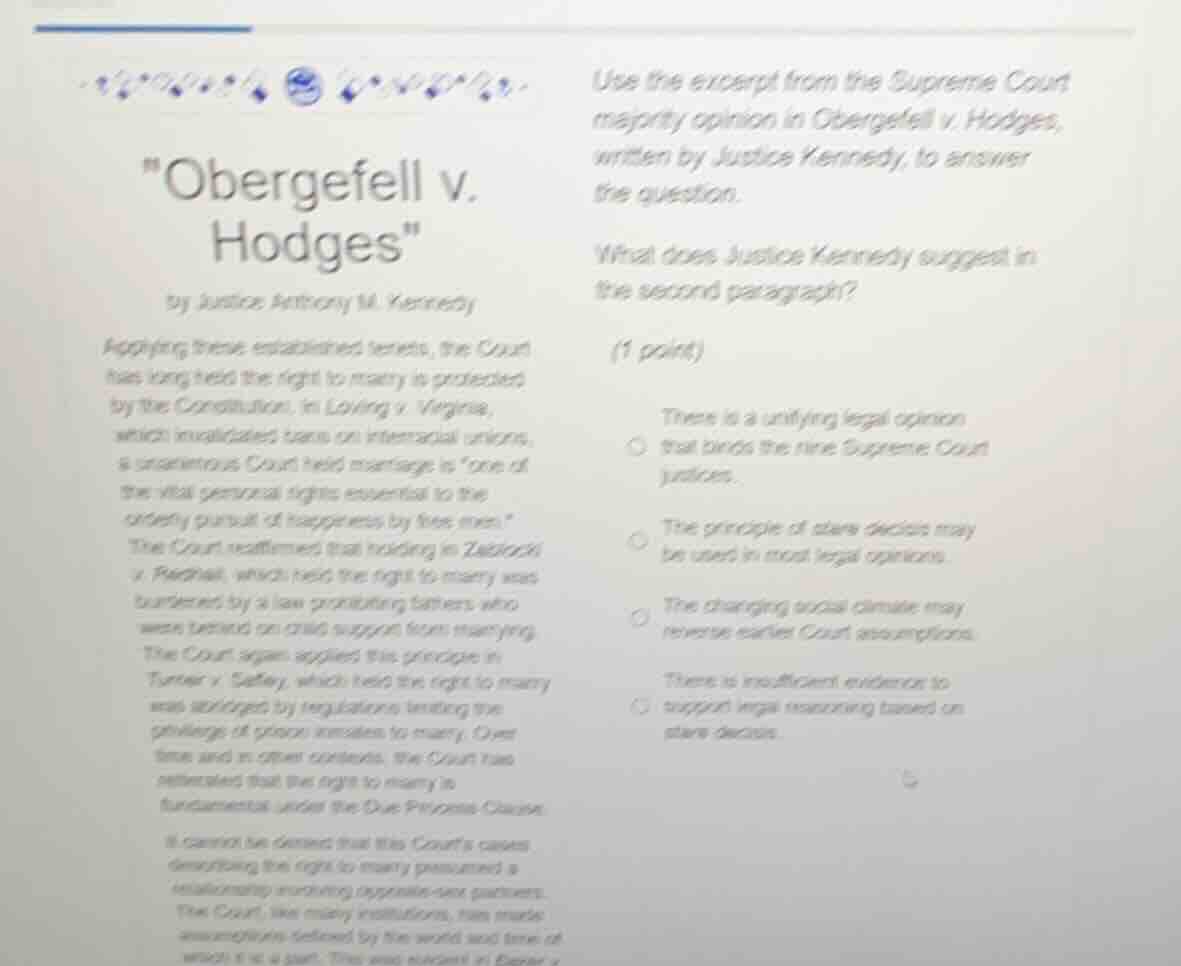
obergefell v. hodges by justice anthony m. kennedy applying these established tenets, the court has long held the right to marry is protected by the constitution. in loving v. virginia, which invalidated bans on interracial unions, a unanimous court held marriage is one of the vital personal rights essential to the orderly pursuit of happiness by free men. the court reaffirmed that holding in zablocki v. redhail, which held the right to marry was burdened by a law prohibiting fathers who were behind on child support from marrying. the court again applied this principle in turner v. safley, which held the right to marry was abridged by regulations limiting the privilege of prison inmates to marry. over time and in other contexts, the court has recognized that the right to marry is fundamental under the due process clause. it cannot be denied that this court’s cases describing the right to marry presumed a relationship involving opposite - sex partners. the court, like many institutions, has made assumptions defined by the world and time of which it is a part. this was evident in former use the excerpt from the supreme court majority opinion in obergefell v. hodges, written by justice kennedy, to answer the question. what does justice kennedy suggest in the second paragraph? (1 point) there is a unifying legal opinion that binds the nine supreme court justices. the principle of stare decisis may be used in most legal opinions. the changing social climate may reverse earlier court assumptions. there is insufficient evidence to support legal reasoning based on stare decisis.
To solve this, we analyze the second paragraph (the visible part after the first). The paragraph talks about the Court's cases on the right to marry, noting past cases assumed opposite - sex partners. Then it says the Court, like institutions, makes exceptions defined by world/time. Now let's analyze the options:
- Option 1: The paragraph doesn't suggest a unifying opinion binding all nine justices. The Court's past cases had assumptions and now may change, so this is wrong.
- Option 2: The paragraph doesn't promote state decisis as a principle for most legal opinions. It's about the Court's evolving view on marriage, so this is wrong.
- Option 3: The Court's cases on marriage had past assumptions (opposite - sex), and now with changing times (world and time defining exceptions), the social climate (changing world/time) could reverse earlier assumptions (like the opposite - sex assumption). This matches.
- Option 4: The paragraph doesn't discuss evidence for state decisis - based reasoning. It's about the Court's view on marriage evolving, so this is wrong.

Snap & solve any problem in the app
Get step-by-step solutions on Sovi AI
Photo-based solutions with guided steps
Explore more problems and detailed explanations
The changing social climate may reverse earlier Court assumptions.