QUESTION IMAGE
Question
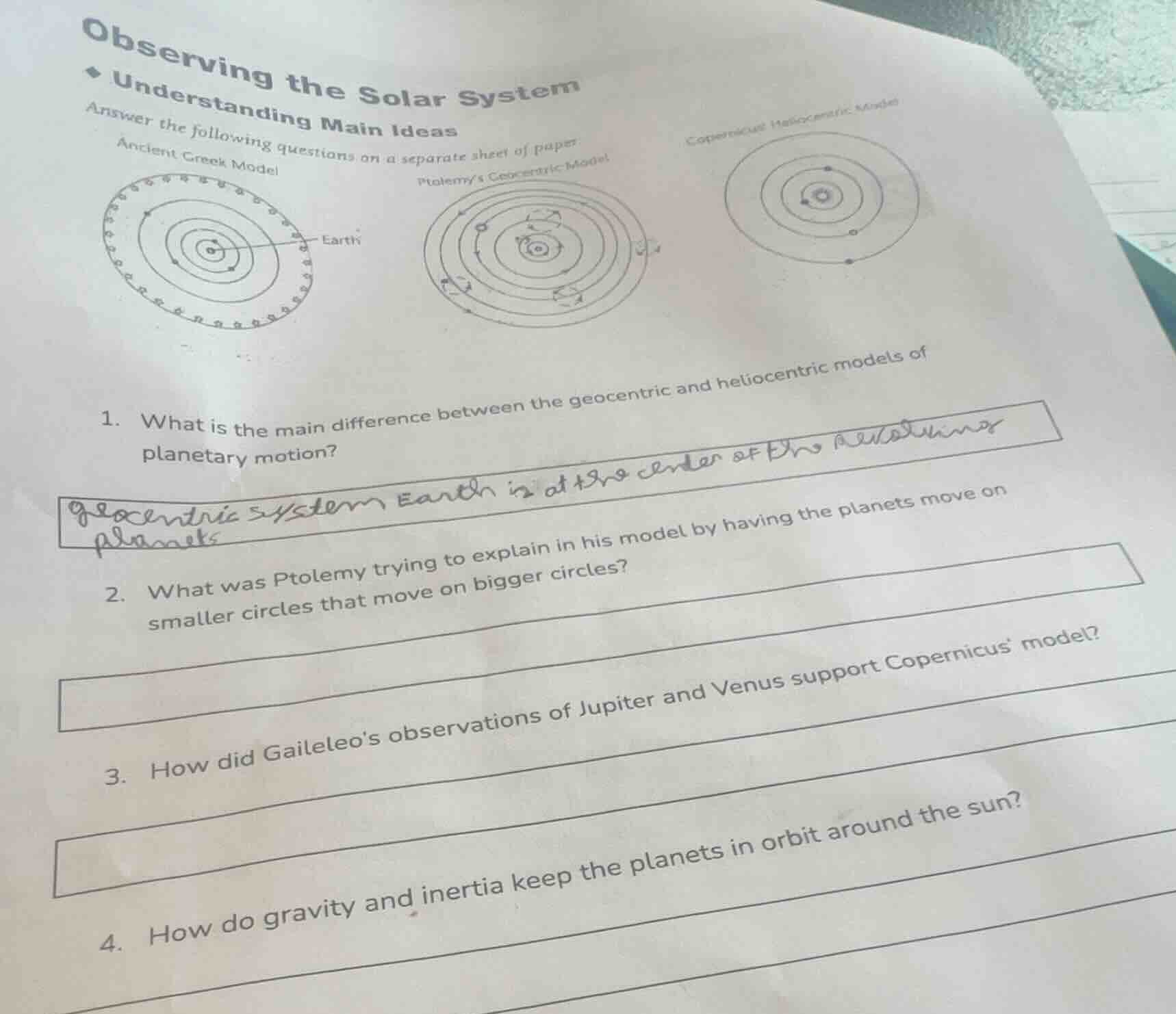
observing the solar system
understanding main ideas
answer the following questions on a separate sheet of paper
ancient greek model ptolemy’s geocentric model copernicus heliocentric model
- what is the main difference between the geocentric and heliocentric models of planetary motion?
- what was ptolemy trying to explain in his model by having the planets move on smaller circles that move on bigger circles?
- how did galileo’s observations of jupiter and venus support copernicus’ model?
- how do gravity and inertia keep the planets in orbit around the sun?
Brief Explanations
- For question 1: Geocentric models place Earth at the center of the solar system, with all other celestial bodies orbiting it. Heliocentric models place the Sun at the center, with planets (including Earth) orbiting the Sun.
- For question 2: Planets sometimes appear to move backward (retrograde motion) in the sky relative to background stars, which contradicts simple circular orbits around Earth. Ptolemy's epicycles (smaller circles on larger orbits) were designed to match this observed motion.
- For question 3: Galileo observed moons orbiting Jupiter, proving not all celestial bodies orbit Earth. He also observed Venus going through full phase cycles, which only makes sense if Venus orbits the Sun (as in the heliocentric model), not Earth.
- For question 4: Gravity from the Sun pulls planets inward toward the Sun, while inertia (the tendency of an object to maintain its straight-line motion) makes planets want to move forward in a straight path. These two forces balance, creating a curved, stable orbital path around the Sun.

Snap & solve any problem in the app
Get step-by-step solutions on Sovi AI
Photo-based solutions with guided steps
Explore more problems and detailed explanations
- The geocentric model has Earth as the center of the solar system with all planets and the Sun orbiting it, while the heliocentric model has the Sun as the center with all planets (including Earth) orbiting the Sun.
- Ptolemy was trying to explain the observed retrograde (backward) motion of planets in the sky.
- Galileo observed moons orbiting Jupiter (showing not all objects orbit Earth) and observed Venus going through full phase changes (which only occurs if Venus orbits the Sun, supporting the heliocentric model).
- The Sun's gravitational force pulls planets toward it, and the planets' inertia creates a tendency to move in a straight line. These two opposing forces balance out, resulting in the planets following a stable, curved orbital path around the Sun.