QUESTION IMAGE
Question
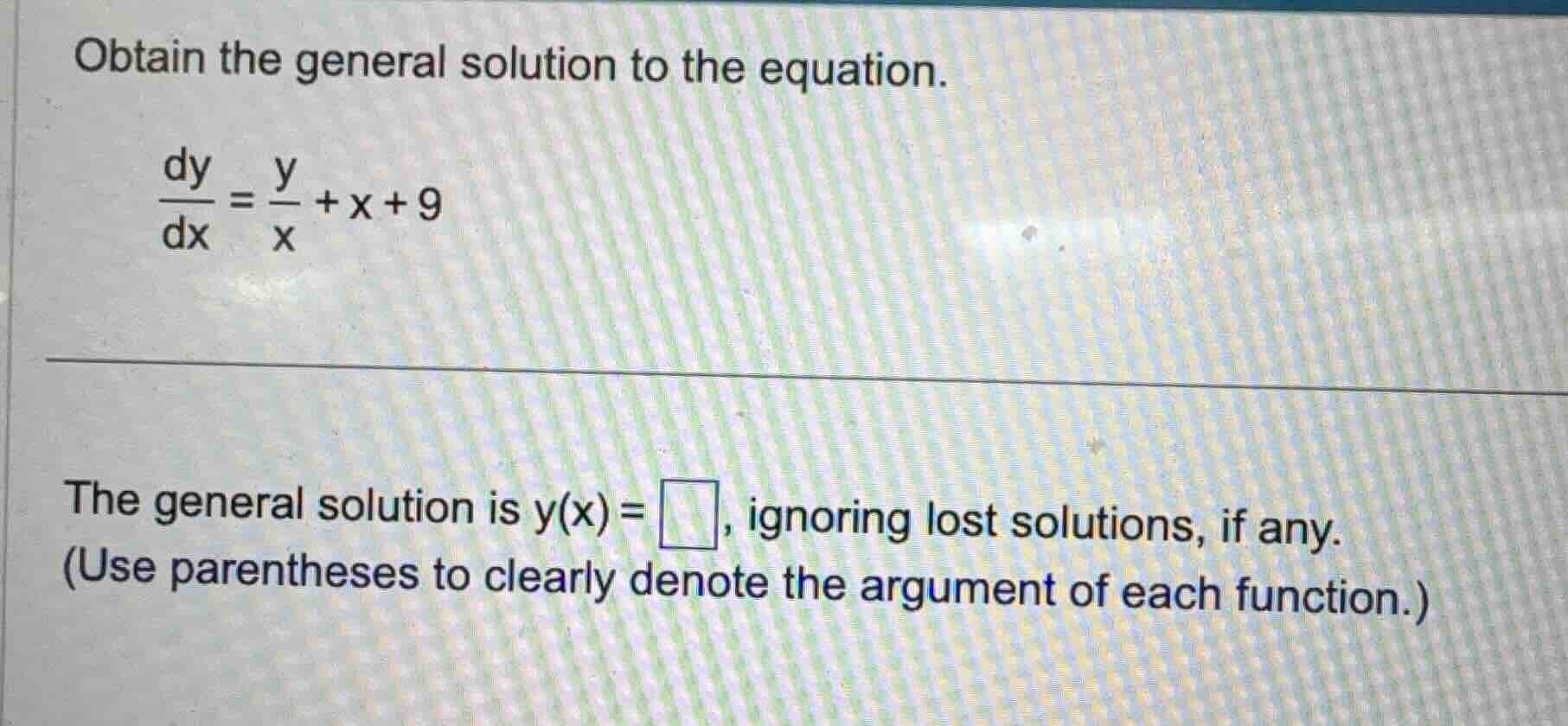
obtain the general solution to the equation.\\(\frac{dy}{dx} = \frac{y}{x} + x + 9\\)\\(\\)\\(\\)the general solution is \\(y(x) = \square\\), ignoring lost solutions, if any.\\((\text{use parentheses to clearly denote the argument of each function.})\\)
Step1: Identify the ODE type
The equation $\frac{dy}{dx}=\frac{y}{x}+x + 9$ is a first - order linear ordinary differential equation (ODE) of the form $\frac{dy}{dx}+P(x)y = Q(x)$. Rewrite it as $\frac{dy}{dx}-\frac{1}{x}y=x + 9$. Here, $P(x)=-\frac{1}{x}$ and $Q(x)=x + 9$.
Step2: Find the integrating factor
The formula for the integrating factor $\mu(x)$ of a first - order linear ODE $\frac{dy}{dx}+P(x)y = Q(x)$ is $\mu(x)=e^{\int P(x)dx}$.
Calculate $\int P(x)dx=\int-\frac{1}{x}dx=-\ln|x|=\ln|x^{-1}|$. Then $\mu(x)=e^{\ln|x^{-1}|}=\frac{1}{x}$ (for $x
eq0$).
Step3: Multiply the ODE by the integrating factor
Multiply the equation $\frac{dy}{dx}-\frac{1}{x}y=x + 9$ by $\frac{1}{x}$:
$\frac{1}{x}\frac{dy}{dx}-\frac{1}{x^{2}}y = 1+\frac{9}{x}$
The left - hand side is the derivative of the product $\frac{y}{x}$ with respect to $x$ by the product rule (since $\frac{d}{dx}(\frac{y}{x})=\frac{1}{x}\frac{dy}{dx}-\frac{y}{x^{2}}$). So we have $\frac{d}{dx}(\frac{y}{x})=1+\frac{9}{x}$.
Step4: Integrate both sides
Integrate both sides with respect to $x$:
$\int\frac{d}{dx}(\frac{y}{x})dx=\int(1 + \frac{9}{x})dx$
The left - hand side integrates to $\frac{y}{x}$.
For the right - hand side, $\int(1+\frac{9}{x})dx=\int 1dx+9\int\frac{1}{x}dx=x + 9\ln|x|+C$, where $C$ is the constant of integration.
Step5: Solve for y
Multiply both sides by $x$ to solve for $y$:
$y(x)=x(x + 9\ln|x|+C)=x^{2}+9x\ln|x|+Cx$

Snap & solve any problem in the app
Get step-by-step solutions on Sovi AI
Photo-based solutions with guided steps
Explore more problems and detailed explanations
$x^{2}+9x\ln|x|+Cx$ (where $C$ is an arbitrary constant)