QUESTION IMAGE
Question
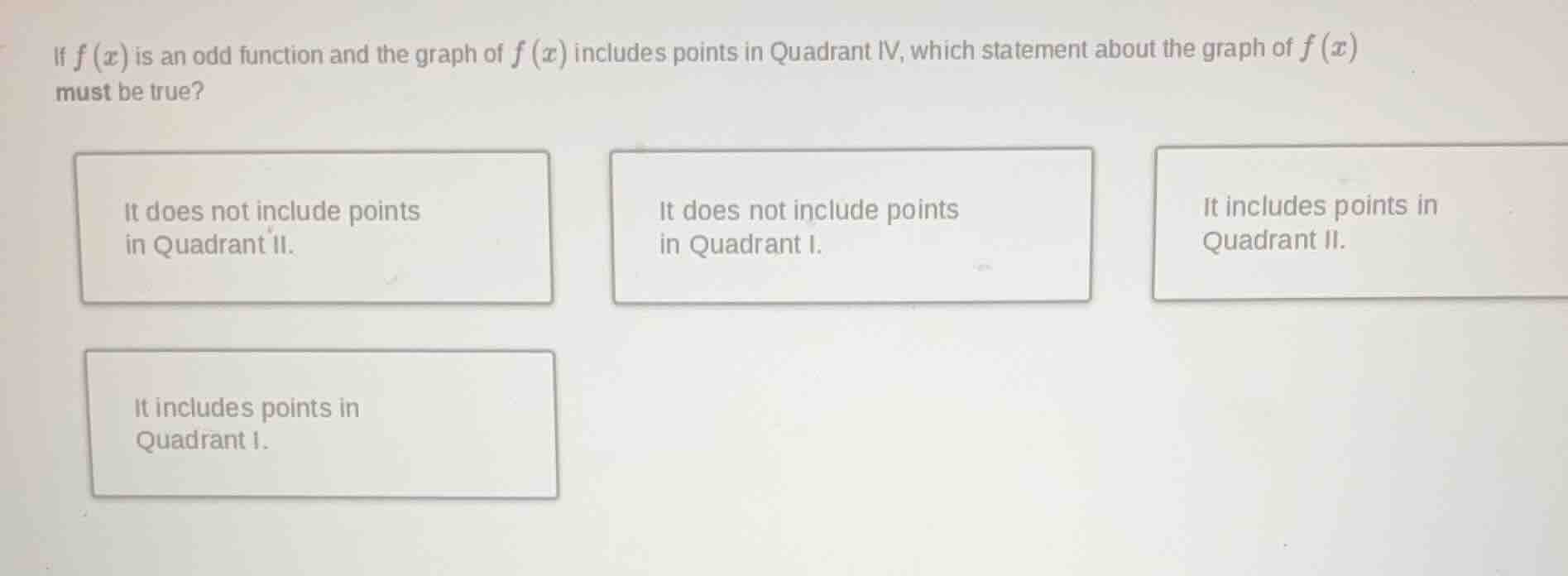
if $f(x)$ is an odd function and the graph of $f(x)$ includes points in quadrant iv, which statement about the graph of $f(x)$ must be true? it does not include points in quadrant ii. it does not include points in quadrant i. it includes points in quadrant ii. it includes points in quadrant i.
Step1: Recall the property of odd functions
An odd function satisfies the property \( f(-x)=-f(x) \). Geometrically, the graph of an odd function is symmetric about the origin.
Step2: Analyze points in Quadrant IV
A point in Quadrant IV has a positive \( x \)-coordinate and a negative \( y \)-coordinate, i.e., \( (x,y) \) where \( x>0 \) and \( y<0 \).
Step3: Use the odd function property
If \( (x,y) \) is on the graph of \( f(x) \) (with \( x>0,y<0 \) as it's in Quadrant IV), then for \( -x \) (which is negative), \( f(-x)=-f(x) \). Since \( f(x) = y<0 \), then \( -f(x)=-y>0 \). So the point \( (-x,-y) \) is also on the graph. Now, let's see the quadrant of \( (-x,-y) \): \( -x<0 \) and \( -y>0 \), which is Quadrant II? Wait, no. Wait, original point is \( (x,y) \) with \( x>0,y<0 \) (Quadrant IV). Then \( f(-x)=-f(x)=-y \). Since \( y<0 \), \( -y>0 \). So the point \( (-x, -y) \) has \( -x<0 \) and \( -y>0 \), which is Quadrant II? But wait, let's check the options. Wait, the first option: "It does not include points in Quadrant II." Wait, no, maybe I made a mistake. Wait, no, let's re - evaluate. Wait, if a point \( (x,y) \) is in Quadrant IV (\( x>0,y<0 \)), then by the odd function property, \( f(-x)=-f(x)=-y \). Since \( y < 0 \), \( -y>0 \). So the point \( (-x, -y) \) has \( x'=-x<0 \) and \( y'=-y>0 \), which is Quadrant II. But wait, that would mean the graph includes points in Quadrant II? But that's one of the options. Wait, no, maybe I messed up. Wait, no, let's think again. Wait, the question is which statement must be true. Wait, let's take an example. Let \( f(x)=-x \). This is an odd function. The graph of \( f(x)=-x \) passes through Quadrant IV (when \( x > 0 \), \( y=-x<0 \)) and Quadrant II (when \( x<0 \), \( y=-x>0 \)). But wait, another example: \( f(x)=x^3 - 4x \). Let's find a point in Quadrant IV. Let \( x = 2 \), \( f(2)=8 - 8 = 0 \), not good. Let \( x = 3 \), \( f(3)=27-12 = 15>0 \), no. Let \( x = 1 \), \( f(1)=1 - 4=-3 \). So the point \( (1, - 3) \) is in Quadrant IV. Then \( f(-1)=-f(1)=3 \), so the point \( (-1,3) \) is in Quadrant II. Wait, but the first option says "It does not include points in Quadrant II" which is false. Wait, maybe I made a mistake in the analysis. Wait, no, wait the options:
Option 1: It does not include points in Quadrant II.
Option 2: It does not include points in Quadrant I.
Option 3: It includes points in Quadrant II.
Option 4: It includes points in Quadrant I.
Wait, let's take the function \( f(x)=-x \). Points in Quadrant IV: \( (1, - 1) \), points in Quadrant II: \( (-1,1) \), and also, when \( x=-1 \), \( y = 1 \) (Quadrant II), when \( x = - 2 \), \( y = 2 \) (Quadrant II). But also, does it include points in Quadrant I? For \( f(x)=-x \), when \( x<0 \), \( y=-x>0 \) (Quadrant II), when \( x>0 \), \( y=-x<0 \) (Quadrant IV). So it does not include points in Quadrant I (where \( x>0,y>0 \)) because for \( x>0 \), \( y=-x<0 \). Wait, so in this case, the function \( f(x)=-x \) has points in Quadrant IV and II, but not in I. Let's check another odd function, say \( f(x)=x^3 \). Wait, \( f(x)=x^3 \): when \( x>0 \), \( y>0 \) (Quadrant I), when \( x<0 \), \( y<0 \) (Quadrant III). But the problem states that the graph includes points in Quadrant IV. So \( f(x)=x^3 \) does not have points in Quadrant IV, so it's not a valid example. Let's take \( f(x)=-x^3 \). When \( x>0 \), \( y=-x^3<0 \) (Quadrant IV), when \( x<0 \), \( y=-x^3>0 \) (Quadrant II). And when \( x>0 \), \( y<0 \), so no points in Quadrant I (where \( x>0,y>0 \)). So for a function that has…

Snap & solve any problem in the app
Get step-by-step solutions on Sovi AI
Photo-based solutions with guided steps
Explore more problems and detailed explanations
It includes points in Quadrant II.