QUESTION IMAGE
Question
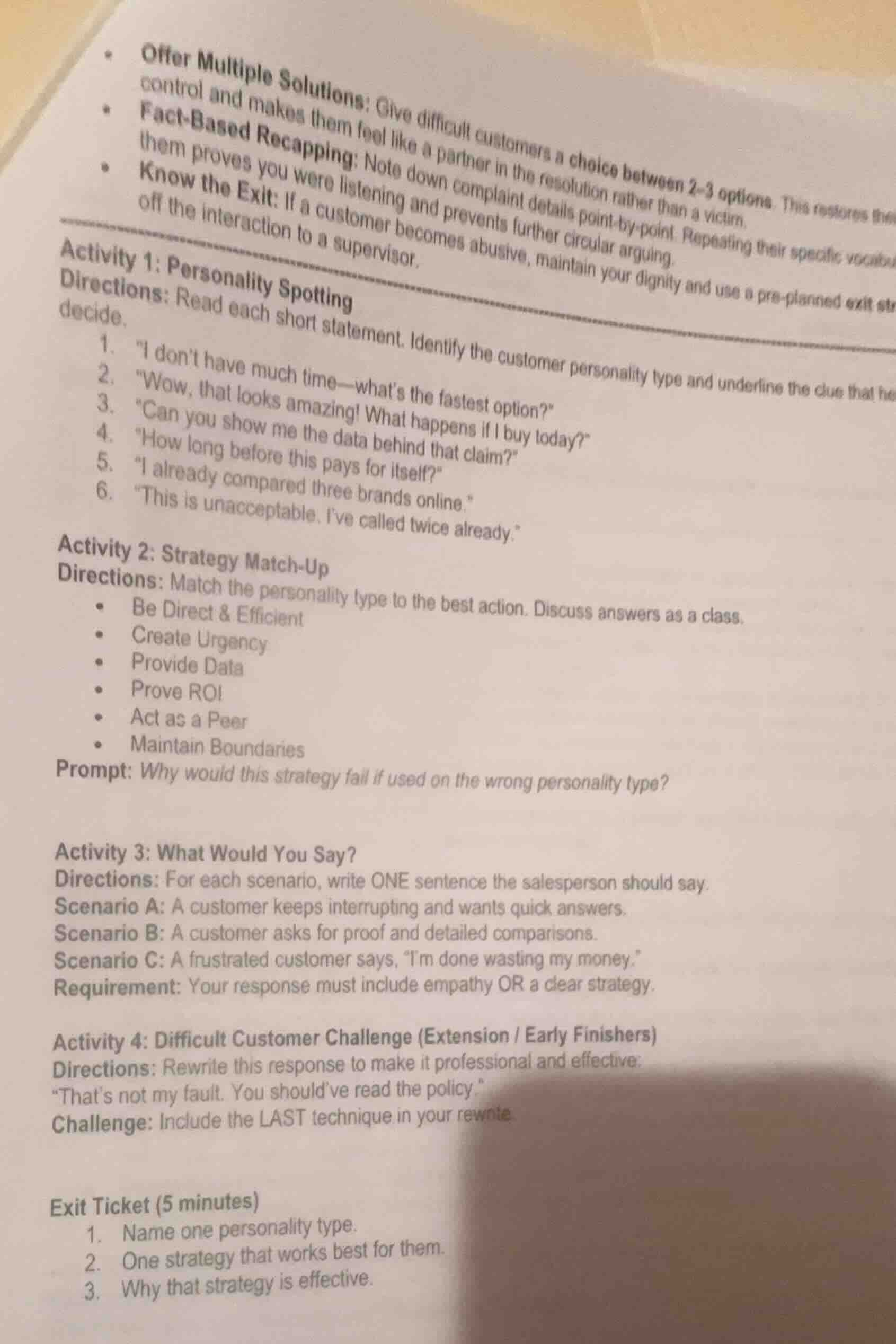
- offer multiple solutions: give difficult customers a choice between 2-3 options. this restores their control and makes them feel like a partner in the resolution rather than a victim. • fact - based recapping: note down complaint details point - by - point. repeating their specific vocabulary to them proves you were listening and prevents further circular arguing. • know the exit: if a customer becomes abusive, maintain your dignity and use a pre - planned exit strategy to off the interaction to a supervisor. activity 1: personality spotting directions: read each short statement. identify the customer personality type and underline the clue that helps you decide. 1. “i dont have much time—whats the fastest option?” 2. “wow, that looks amazing! what happens if i buy today?” 3. “can you show me the data behind that claim?” 4. “how long before this pays for itself?” 5. “i already compared three brands online.” 6. “this is unacceptable. ive called twice already.” activity 2: strategy match - up directions: match the personality type to the best action. discuss answers as a class. • be direct & efficient • create urgency • provide data • prove roi • act as a peer • maintain boundaries prompt: why would this strategy fail if used on the wrong personality type? activity 3: what would you say? directions: for each scenario, write one sentence the salesperson should say. scenario a: a customer keeps interrupting and wants quick answers. scenario b: a customer asks for proof and detailed comparisons. scenario c: a frustrated customer says, “im done wasting my money.” requirement: your response must include empathy or a clear strategy. activity 4: difficult customer challenge (extension / early finishers) directions: rewrite this response to make it professional and effective: “thats not my fault. you shouldve read the policy.” challenge: include the last technique in your rewrite. exit ticket (5 minutes) 1. name one personality type. 2. one strategy that works best for them. 3. why that strategy is effective.
To address these activities, we'll tackle them one by one:
Activity 1: Personality Spotting (Sample for one statement)
- Statement: "I don’t have much time—what’s the fastest option?"
Personality Type: Time - conscious/Impatient (clue: "I don’t have much time" and asking for the fastest option).
Activity 2: Strategy Match - Up (General Explanation)
- Be Direct & Efficient: Matches with time - conscious/impatient customers (like the one in statement 1) as they want quick answers.
- Create Urgency: Matches with customers who need a push to act, e.g., "Wow, that looks amazing! What happens if I buy today?" (clue about acting today).
- Provide Data: Matches with customers asking for proof, e.g., "Can you show me the data behind that claim?"
- Prove ROI: Matches with customers concerned about value, e.g., "How long before this pays for itself?"
- Act as a Peer: Could match with customers who want relatability, e.g., "I already compared three brands online." (wanting a peer - like understanding).
- Maintain Boundaries: Matches with abusive customers (from "Know the Exit" rule).
Activity 3: What Would You Say? (Sample for one scenario)
- Scenario A: "I understand you need quick answers! Let’s go with the [specific fast option]—it’s our most efficient choice." (includes empathy and a clear strategy).
Activity 4: Difficult Customer Challenge
Rewrite: "I apologize for the confusion. Let’s review the policy together so you can understand how it applies to your situation." (Professional, shifts from blame to helping, and includes a strategy to resolve the issue).
Exit Ticket (Sample)
- Personality Type: Time - conscious (from Activity 1).
- Strategy: Be Direct & Efficient.
- Why Effective: Time - conscious customers value speed and clarity; being direct and efficient meets their need for a quick resolution without unnecessary details.
These are general guidelines—you can adjust based on the full context of personality types (if provided) and deeper analysis of each scenario.

Snap & solve any problem in the app
Get step-by-step solutions on Sovi AI
Photo-based solutions with guided steps
Explore more problems and detailed explanations
To address these activities, we'll tackle them one by one:
Activity 1: Personality Spotting (Sample for one statement)
- Statement: "I don’t have much time—what’s the fastest option?"
Personality Type: Time - conscious/Impatient (clue: "I don’t have much time" and asking for the fastest option).
Activity 2: Strategy Match - Up (General Explanation)
- Be Direct & Efficient: Matches with time - conscious/impatient customers (like the one in statement 1) as they want quick answers.
- Create Urgency: Matches with customers who need a push to act, e.g., "Wow, that looks amazing! What happens if I buy today?" (clue about acting today).
- Provide Data: Matches with customers asking for proof, e.g., "Can you show me the data behind that claim?"
- Prove ROI: Matches with customers concerned about value, e.g., "How long before this pays for itself?"
- Act as a Peer: Could match with customers who want relatability, e.g., "I already compared three brands online." (wanting a peer - like understanding).
- Maintain Boundaries: Matches with abusive customers (from "Know the Exit" rule).
Activity 3: What Would You Say? (Sample for one scenario)
- Scenario A: "I understand you need quick answers! Let’s go with the [specific fast option]—it’s our most efficient choice." (includes empathy and a clear strategy).
Activity 4: Difficult Customer Challenge
Rewrite: "I apologize for the confusion. Let’s review the policy together so you can understand how it applies to your situation." (Professional, shifts from blame to helping, and includes a strategy to resolve the issue).
Exit Ticket (Sample)
- Personality Type: Time - conscious (from Activity 1).
- Strategy: Be Direct & Efficient.
- Why Effective: Time - conscious customers value speed and clarity; being direct and efficient meets their need for a quick resolution without unnecessary details.
These are general guidelines—you can adjust based on the full context of personality types (if provided) and deeper analysis of each scenario.