QUESTION IMAGE
Question
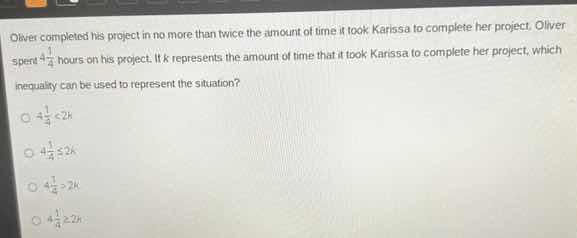
oliver completed his project in no more than twice the amount of time it took karissa to complete her project. oliver spent $4\frac{1}{4}$ hours on his project. if $k$ represents the amount of time that it took karissa to complete her project, which inequality can be used to represent the situation?\
\\(\bigcirc\\) $4\frac{1}{4} \geq 2k$\
\\(\bigcirc\\) $4\frac{1}{4} \leq 2k$\
\\(\bigcirc\\) $4\frac{2}{7} \geq 2k$\
\\(\bigcirc\\) $4\frac{1}{4} > 2k$
Step1: Understand the problem
Oliver's time is no more than twice Karissa's time. Oliver's time is \(4\frac{1}{4}\) hours, and \(k\) is twice Karissa's time. So Oliver's time should be less than or equal to \(k\)? Wait, no, wait. Wait, the problem says "k represents twice the amount of time that it took Karissa to complete her project". Wait, let's re - read: "Oliver completed his project in no more than twice the amount of time it took Karissa to complete her project. Oliver spent \(4\frac{1}{4}\) hours on his project. If \(k\) represents twice the amount of time that it took Karissa to complete her project, which inequality can be used to represent the situation?"
So Oliver's time (\(4\frac{1}{4}\)) is no more than (less than or equal to) \(k\) (since \(k\) is twice Karissa's time). So the inequality is \(4\frac{1}{4}\leq k\)? Wait, no, looking at the options, the options are in terms of \(4\frac{1}{4}\) and \(2k\). Wait, maybe I misread the definition of \(k\). Wait, the problem says "If \(k\) represents twice the amount of time that it took Karissa to complete her project". So twice Karissa's time is \(k\). Then Oliver's time ( \(4\frac{1}{4}\)) is no more than (less than or equal to) twice Karissa's time (\(k\))? But the options have \(2k\). Wait, maybe there is a misstatement, and \(k\) is Karissa's time, and twice Karissa's time is \(2k\). Let's re - interpret: Let's let \(k\) be the time Karissa took. Then twice Karissa's time is \(2k\). The problem says "Oliver completed his project in no more than twice the amount of time it took Karissa to complete her project". So Oliver's time (\(4\frac{1}{4}\)) \(\leq\) twice Karissa's time (\(2k\) if \(k\) is Karissa's time). But the problem says "If \(k\) represents twice the amount of time that it took Karissa to complete her project", so \(k = 2\times\) Karissa's time. Then Oliver's time (\(4\frac{1}{4}\)) \(\leq k\). But the options are:
- \(4\frac{1}{4}\geq2k\)
- \(4\frac{1}{4}\leq2k\)
- \(\frac{4}{2}\geq2k\) (this is \(2\geq2k\), which doesn't make sense)
- \(4\frac{1}{4}\geq2k\) (same as first, but first is \(4\frac{1}{4}\geq2k\), second is \(4\frac{1}{4}\leq2k\))
Wait, maybe the problem has a typo, and \(k\) is Karissa's time, so twice Karissa's time is \(2k\). Then "Oliver completed his project in no more than twice the amount of time it took Karissa to complete her project" means Oliver's time (\(4\frac{1}{4}\)) \(\leq\) twice Karissa's time (\(2k\)). So the inequality is \(4\frac{1}{4}\leq2k\), which is the second option.
Step2: Analyze the inequality direction
"no more than" means the value is less than or equal to the other value. Oliver's time is \(4\frac{1}{4}\) hours, and twice Karissa's time is represented as \(2k\) (assuming \(k\) is Karissa's time, maybe the problem's definition of \(k\) was miswritten). So we need an inequality where \(4\frac{1}{4}\) is less than or equal to \(2k\), which is \(4\frac{1}{4}\leq2k\).

Snap & solve any problem in the app
Get step-by-step solutions on Sovi AI
Photo-based solutions with guided steps
Explore more problems and detailed explanations
B. \(4\frac{1}{4}\leq2k\)