QUESTION IMAGE
Question
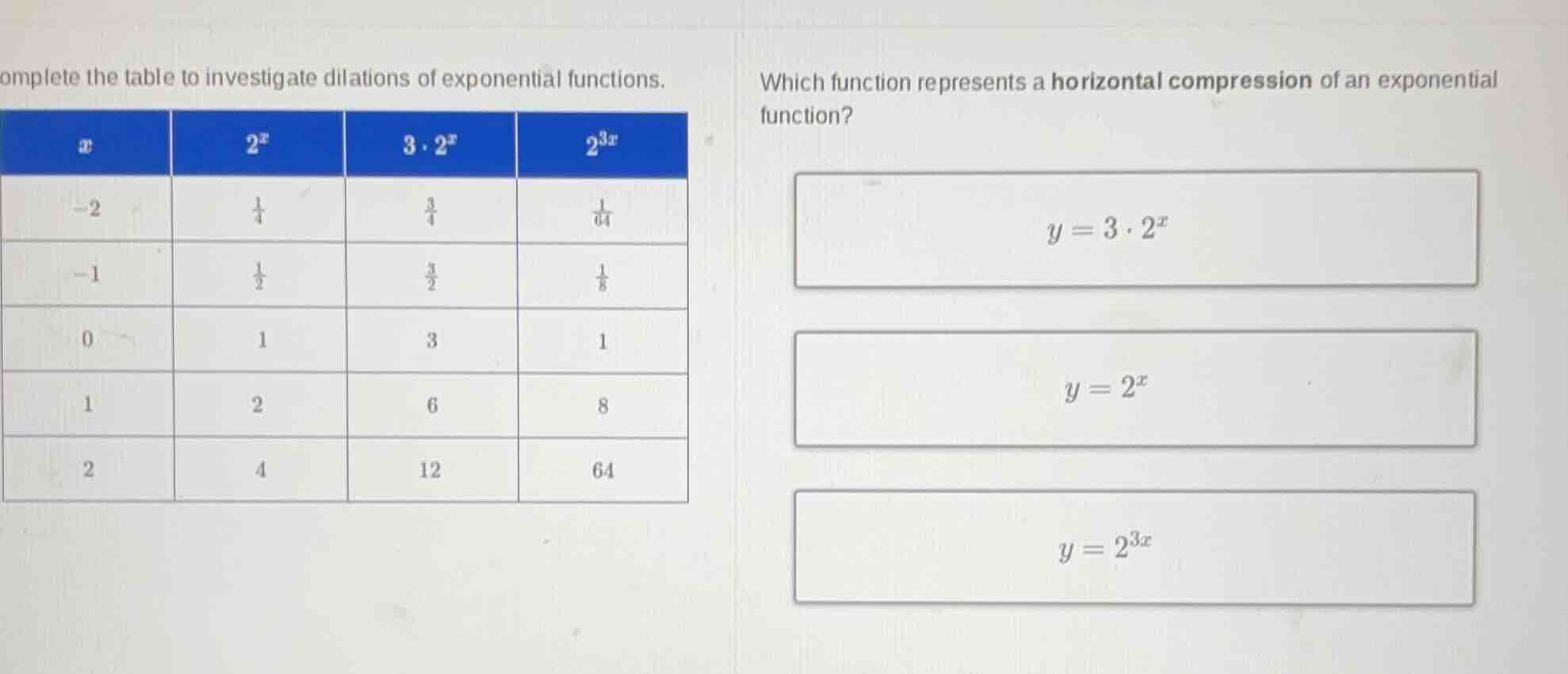
omplete the table to investigate dilations of exponential functions.
which function represents a horizontal compression of an exponential function?
| $x$ | $2^x$ | $3\cdot 2^x$ | $2^{3x}$ |
|---|---|---|---|
| $-1$ | $\frac{1}{2}$ | $\frac{3}{2}$ | $\frac{1}{8}$ |
| $0$ | $1$ | $3$ | $1$ |
| $1$ | $2$ | $6$ | $8$ |
| $2$ | $4$ | $12$ | $64$ |
$y = 3\cdot 2^x$
$y = 2^x$
$y = 2^{3x}$
Step1: Recall horizontal compression rule
For a function \( y = f(kx) \), if \( |k|>1 \), it's a horizontal compression of \( y = f(x) \).
Step2: Analyze each option
- \( y = 3\cdot2^{x} \): This is a vertical stretch (by factor 3) of \( y = 2^{x} \), not horizontal compression.
- \( y = 2^{x} \): This is the parent function, no compression.
- \( y = 2^{3x} \): Here, \( f(x)=2^{x} \), and \( k = 3>1 \), so it's a horizontal compression of \( y = 2^{x} \).

Snap & solve any problem in the app
Get step-by-step solutions on Sovi AI
Photo-based solutions with guided steps
Explore more problems and detailed explanations
\( y = 2^{3x} \) (the third option: \( y = 2^{3x} \))