QUESTION IMAGE
Question
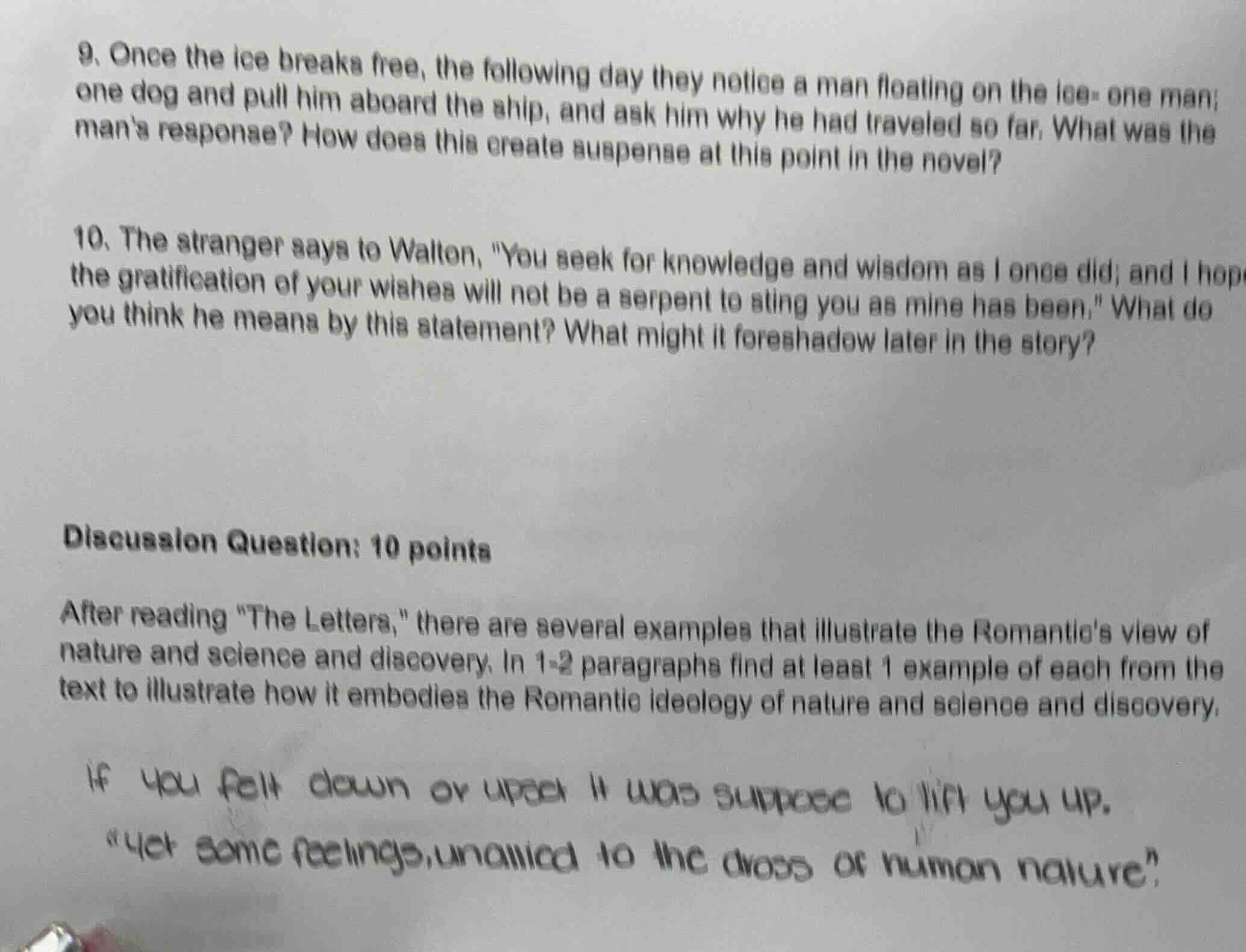
- once the ice breaks free, the following day they notice a man floating on the ice- one man; one dog and pull him aboard the ship, and ask him why he had traveled so far. what was the man’s response? how does this create suspense at this point in the novel?
- the stranger says to walton, \you seek for knowledge and wisdom as i once did; and i hope the gratification of your wishes will not be a serpent to sting you as mine has been.\ what do you think he means by this statement? what might it foreshadow later in the story?
discussion question: 10 points
after reading \the letters,\ there are several examples that illustrate the romantic’s view of nature and science and discovery. in 1-2 paragraphs find at least 1 example of each from the text to illustrate how it embodies the romantic ideology of nature and science and discovery.
if you felt down or upset it was suppose to lift you up.
\yet some feelings,unallied to the dross of human nature\.
Question 9 (Assuming the novel is Frankenstein):
The man (Victor Frankenstein's foe, likely the Creature's pursuit context, or Walton's encounter) – typically, the man (maybe the Creature's victim or Victor) has a tragic backstory. Suspense: His arrival hints at danger, mystery (why alone, on ice), and foreshadows dark events (like the Creature's revenge or Victor's fate).
The stranger (Victor) means Walton’s quest for knowledge mirrors his own, but his (Victor’s) pursuit of creating life (science) “stung” him (disaster: Creature’s destruction). Foreshadow: Walton may face similar hubris - driven tragedy (abandoning his expedition, or facing moral consequences of overreaching in science/exploration).
- Nature: Romanticism views nature as sublime, healing. Example: Walton’s letters describe Arctic nature (ice, storms) as awe - inspiring, a source of wonder (not just a resource). It embodies Romanticism’s reverence for nature’s power and beauty, separate from human chaos.
- Science/Discovery: Romanticism is wary of unbridled science (opposes Enlightenment - style rationalism). Example: Walton’s expedition (science - driven exploration) is contrasted with nature’s sublimity; his ambition hints at hubris, while Romanticism values emotion/intuition over cold science. Discovery in Romanticism is personal, spiritual (not just empirical), so Walton’s quest, while bold, risks losing touch with humanity (like Victor).

Snap & solve any problem in the app
Get step-by-step solutions on Sovi AI
Photo-based solutions with guided steps
Explore more problems and detailed explanations
The man’s response (in Frankenstein, likely Victor or a victim) reveals a harrowing tale (e.g., pursuit by the Creature, loss). Suspense: His isolated, desperate state makes readers wonder about the threat (Creature) and his/others’ fates, tying to the novel’s dark, mysterious tone.