QUESTION IMAGE
Question
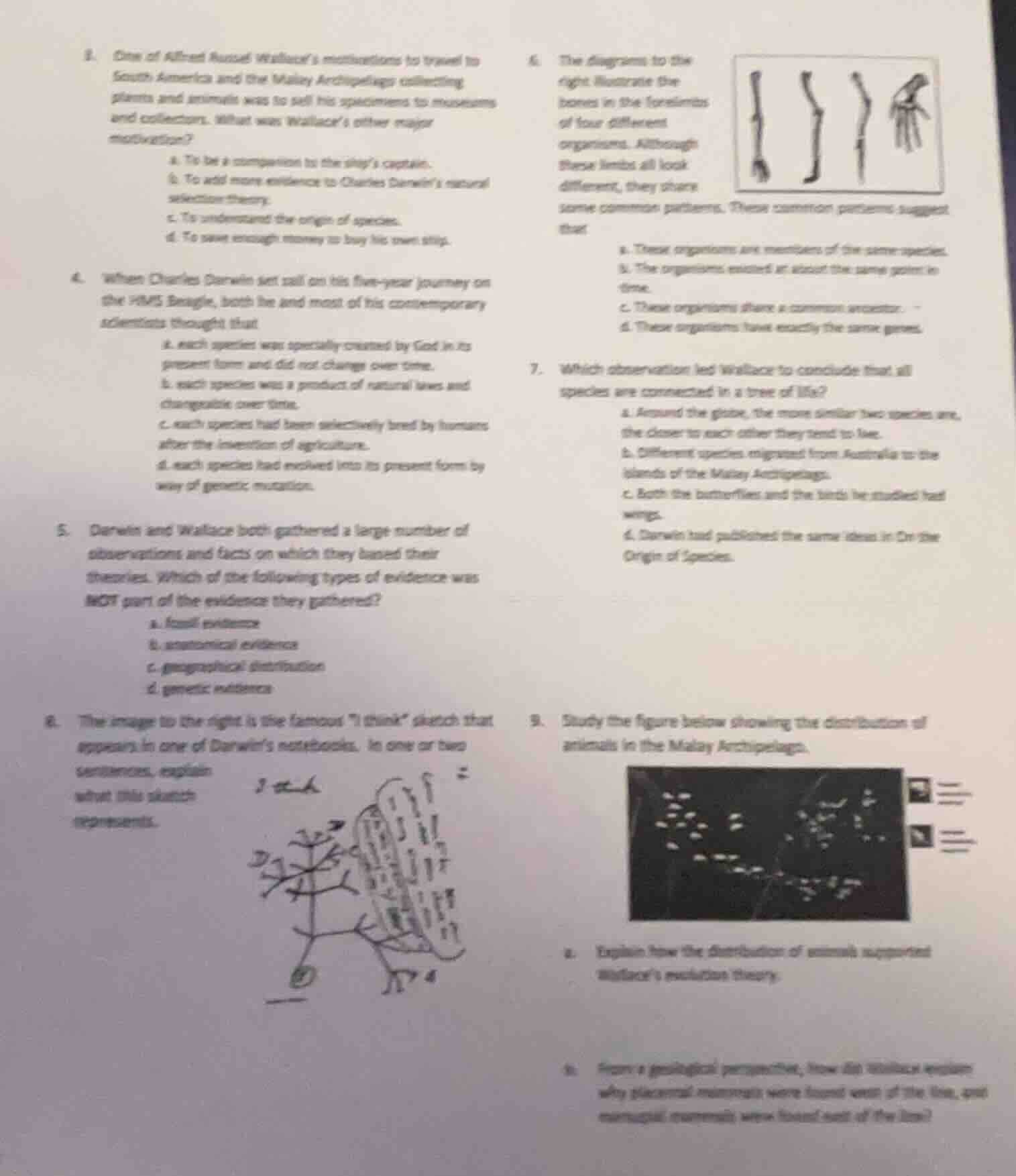
- one of alfred russel wallace’s motivations to travel to south america and the malay archipelago collecting plants and animals was to sell his specimens to museums and collectors. what was wallace’s other major motivation?
a. to be a companion to the ship’s captain.
b. to add more evidence to charles darwin’s natural selection theory.
c. to understand the origin of species.
d. to save enough money to buy his own ship.
- when charles darwin set sail on his five - year journey on the hms beagle, both he and most of his contemporary scientists thought that
a. each species was specially created by god in its present form and did not change over time.
b. each species was a product of natural laws and changeable over time.
c. each species had been selectively bred by humans after the invention of agriculture.
d. each species had evolved into its present form by way of genetic mutation.
- darwin and wallace both gathered a large number of observations and facts on which they based their theories. which of the following types of evidence was not part of the evidence they gathered?
a. fossil evidence
b. anatomical evidence
c. geographical distribution
d. genetic evidence
- the diagrams to the right illustrate the bones in the forelimbs of four different organisms. although these limbs all look different, they share some common patterns. these common patterns suggest that
a. these organisms are members of the same species.
b. the organisms existed at about the same point in time.
c. these organisms share a common ancestor.
d. these organisms have exactly the same genes.
- which observation led wallace to conclude that all species are connected in a tree of life?
a. around the globe, the more similar two species are, the closer to each other they tend to live.
b. different species migrated from australia to the islands of the malay archipelago.
c. both the butterflies and the birds he studied had wings.
d. darwin had published the same ideas in on the origin of species.
- the image to the right is the famous “i think” sketch that appears in one of darwin’s notebooks. in one or two sentences, explain what this sketch represents.
- study the figure below showing the distribution of animals in the malay archipelago.
a. explain how the distribution of animals supported wallace’s evolution theory.
b. from a geological perspective, how did wallace explain why placental mammals were found west of the line, and marsupial mammals were found east of the line?
Question 3:
Alfred Russel Wallace's core motivation for his travels was to study the origins of species, alongside selling specimens for income.
Question 4:
Before Darwin's voyage, the dominant scientific view was creationism, where species were fixed and divinely created.
Question 5:
Genetic evidence (DNA/genetics) was not understood or available in Darwin and Wallace's era; they relied on fossil, anatomical, and geographical data.
Question 6:
Homologous structures (similar bone patterns in forelimbs) indicate shared ancestry, as the same basic body plan is inherited from a common ancestor.
Question 7:
Wallace observed that geographically close species were more similar, leading him to conclude all life is connected in a tree of relationships.
Question 8:
Darwin's "I think" sketch is an early tree of life diagram, representing his idea that species descend from common ancestors and branch out over time as they evolve.
Question 9a:
Wallace found that closely located islands in the Malay Archipelago had distinct but related species, showing that species evolve and adapt to local environments from common ancestors, rather than being independently created.
Question 9b:
Wallace realized the line (Wallace Line) marked an ancient deep ocean barrier that prevented species migration. Placental mammals evolved west of the barrier, while marsupials evolved east, as the barrier stopped them from mixing.

Snap & solve any problem in the app
Get step-by-step solutions on Sovi AI
Photo-based solutions with guided steps
Explore more problems and detailed explanations
- c. To understand the origin of species.
- a. each species was specially created by God in its present form and did not change over time.
- d. genetic evidence
- c. These organisms share a common ancestor.
- a. Around the globe, the more similar two species are, the closer to each other they tend to live.
- This sketch is an early tree-of-life concept, representing Darwin's idea that all species descend from common ancestors and branch off as they evolve over time.
9a. The distinct but closely related species on nearby islands showed that species evolved from common ancestors to adapt to local habitats, supporting the idea of evolution rather than separate creation.
9b. Wallace recognized the line marked an ancient, impassable ocean barrier. Placental mammals evolved west of the barrier, marsupials east, as the barrier blocked their migration and allowed separate evolutionary paths.