QUESTION IMAGE
Question
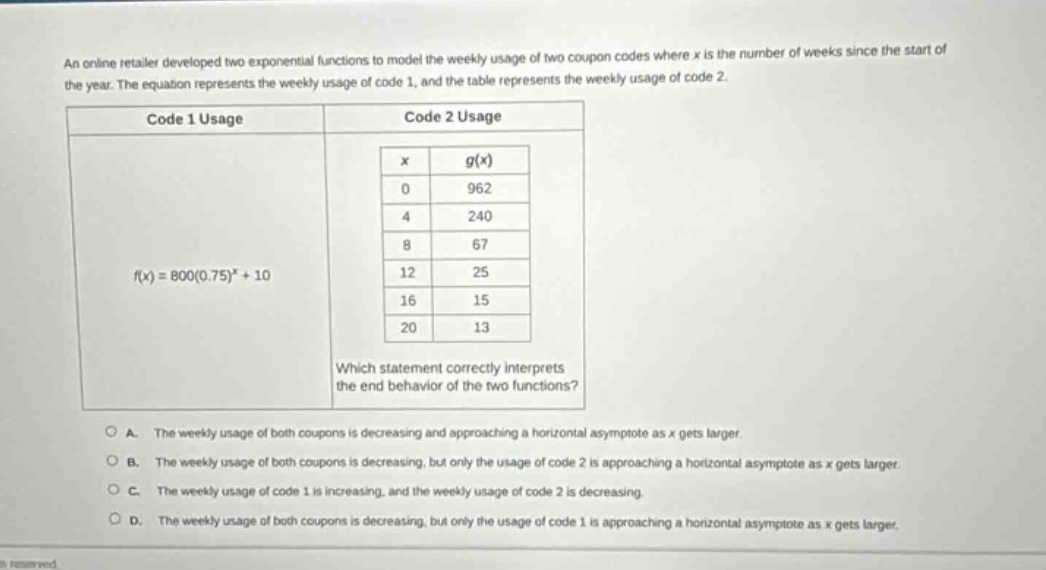
an online retailer developed two exponential functions to model the weekly usage of two coupon codes where x is the number of weeks since the start of the year. the equation represents the weekly usage of code 1, and the table represents the weekly usage of code 2.
| code 1 usage | code 2 usage | ||
|---|---|---|---|
| 0 | 962 | ||
| 4 | 240 | ||
| 8 | 67 | ||
| 12 | 25 | ||
| 16 | 15 | ||
| 20 | 13 | ||
| which statement correctly interprets the end behavior of the two functions? |
a. the weekly usage of both coupons is decreasing and approaching a horizontal asymptote as x gets larger.
b. the weekly usage of both coupons is decreasing, but only the usage of code 2 is approaching a horizontal asymptote as x gets larger.
c. the weekly usage of code 1 is increasing, and the weekly usage of code 2 is decreasing.
d. the weekly usage of both coupons is decreasing, but only the usage of code 1 is approaching a horizontal asymptote as x gets larger.
- Analyze Code 1 (\(f(x) = 800(0.75)^x + 10\)):
- The base of the exponential term, \(0.75\), is between \(0\) and \(1\), so as \(x\) (number of weeks) increases, \((0.75)^x\) decreases towards \(0\). Thus, \(800(0.75)^x\) decreases towards \(0\), and \(f(x)=800(0.75)^x + 10\) decreases towards \(10\) (horizontal asymptote \(y = 10\)) as \(x\) gets larger.
- Analyze Code 2 (table of \(g(x)\)):
- From the table, as \(x\) (weeks) increases (from \(0\) to \(20\)), \(g(x)\) values decrease (962 → 240 → 67 → 25 → 15 → 13). As \(x\) gets very large, looking at the trend, \(g(x)\) seems to approach a horizontal asymptote (since the decrease slows down, approaching a stable value, likely around \(13\) or lower as \(x\) increases further, but the key is the end - behavior of decreasing and approaching an asymptote? Wait, no—wait, for Code 1, the function has a horizontal asymptote because it's a transformed exponential function. For Code 2, the table shows values decreasing, but does it have a horizontal asymptote? Wait, no—wait, the options: Let's re - evaluate.
- Wait, Code 1: The function \(f(x)=800(0.75)^x+10\) is an exponential decay function (since \(0\lt0.75\lt1\)) with a horizontal asymptote at \(y = 10\) (because as \(x
ightarrow\infty\), \(800(0.75)^x
ightarrow0\), so \(f(x)
ightarrow10\)). So as \(x\) increases, \(f(x)\) decreases towards \(10\).
- Code 2: From the table, as \(x\) increases (from \(0\) to \(20\)), \(g(x)\) values are decreasing (962, 240, 67, 25, 15, 13). Now, for the end - behavior: Does \(g(x)\) have a horizontal asymptote? The values are decreasing but not approaching a fixed non - zero value in the same way as Code 1? Wait, no—wait, the options: Let's check the options again.
- Option D: "The weekly usage of both coupons is decreasing, but only the usage of code 1 is approaching a horizontal asymptote as \(x\) gets larger."
- Wait, why? Because Code 1 is a mathematical exponential function with a horizontal asymptote (\(y = 10\)). Code 2 is a set of data points. As \(x\) gets larger, the data for Code 2 is decreasing, but there's no indication that it's approaching a horizontal asymptote (the values are just decreasing, but we don't have a function for Code 2, just a table. However, Code 1 has a defined exponential function with a horizontal asymptote. So both are decreasing (Code 1: exponential decay, Code 2: data decreasing), but only Code 1 has a horizontal asymptote.

Snap & solve any problem in the app
Get step-by-step solutions on Sovi AI
Photo-based solutions with guided steps
Explore more problems and detailed explanations
D. The weekly usage of both coupons is decreasing, but only the usage of code 1 is approaching a horizontal asymptote as \(x\) gets larger.