QUESTION IMAGE
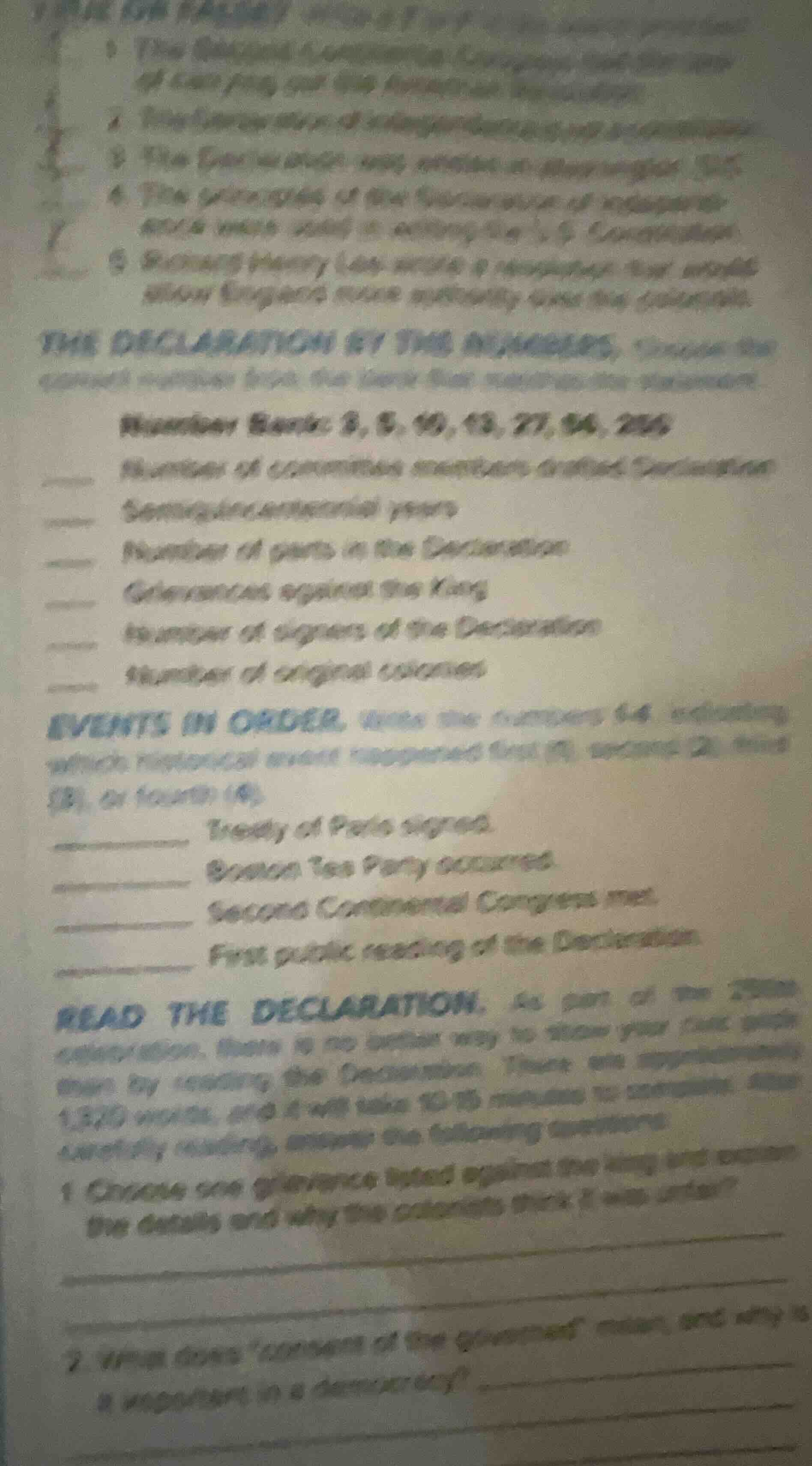
Question
- the original continental congress: what was the purpose of each ping (or the american revolution)?
- what are the steps of independence and its importance?
- the battle which was a turning - point: (like saratoga? (us)
- the principle of the consent of the governed was stated in which document? (constitution?)
- richard henry (lee wrote a resolution that would allow england to more specifically grant the colonies.
the declaration by the numbers: complete the correct numbers from the box that match the statements.
number bank: 3, 5, 10, 13, 27, 54, 2000
number of committee members drafted declaration
settling the territorial years
number of parts in the declaration
grievances against the king
number of signers of the declaration
number of original colonies
events in order: write the numbers (1 - 4, indicating which historical event happened first (1), second (2), third (3), or fourth (4).
______ treaty of paris signed.
______ boston tea party occurred.
______ second continental congress met.
______ first public reading of the declaration.
read the declaration: as part of the 250th celebration, there is no better way to show your full grasp than by reading the declaration. there are approximately 1,330 words, and it will take 10 - 15 minutes to complete. after carefully reading, answer the following questions:
- choose one grievance listed against the king and explain the details and why the colonists object. (i will ask?)
- what does consent of the governed mean, and why is it important in a democracy?
THE DECLARATION BY THE FOUNDERS Section:
- The number of committee members drafted the Declaration: The Committee of Five was tasked with writing the document.
- Semiquincentennial years: 2026 marks 250 years since the 1776 Declaration.
- Number of parts in the Declaration: It has an Introduction, Preamble, List of Grievances, Resolution of Independence, and Signatures (5 total).
- Grievances against the King: The document lists 27 specific grievances.
- Number of signers of the Declaration: 56 delegates signed the final document.
- Number of original colonies: 13 British colonies declared independence.
EVENTS IN ORDER Section:
- Boston Tea Party: Occurred in 1773, the earliest of the listed events.
- Second Continental Congress met: Convened in 1775, after the Tea Party.
- First public reading of the Declaration: Happened in July 1776, after the Congress began.
- Treaty of Paris signed: Ended the Revolutionary War in 1783, the latest event.
READ THE DECLARATION Section:
- Example grievance: "He has quartered large bodies of armed troops among us." The colonists saw this as an invasion of privacy and a violation of their rights to self-determination, as soldiers were housed in private homes without consent, burdening colonists financially and personally.
- "Consent of the governed" means a government's legitimacy comes from the approval and agreement of the people it rules. It is critical to democracy because it ensures the government acts on behalf of the people, not against them, upholding core democratic values of self-rule and accountability.

Snap & solve any problem in the app
Get step-by-step solutions on Sovi AI
Photo-based solutions with guided steps
Explore more problems and detailed explanations
THE DECLARATION BY THE FOUNDERS
- Number of committee members drafted the Declaration: 5
- Semiquincentennial years: 2026
- Number of parts in the Declaration: 5
- Grievances against the King: 27
- Number of signers of the Declaration: 56
- Number of original colonies: 13
EVENTS IN ORDER
- Treaty of Paris signed: 4
- Boston Tea Party occurred: 1
- Second Continental Congress met: 2
- First public reading of the Declaration: 3
READ THE DECLARATION
- Grievance: "He has quartered large bodies of armed troops among us." The colonists resented this because it forced private citizens to house and feed British soldiers without their permission, violating their property rights and personal liberty, and felt it was an oppressive tool to enforce British control.
- "Consent of the governed" refers to the idea that a government only has the right to rule if it has the approval of the people it governs. It is essential to democracy because it shifts power from a single ruler or elite to the general population, ensuring the government's actions reflect the will of the people and providing a basis for holding leaders accountable.