QUESTION IMAGE
Question
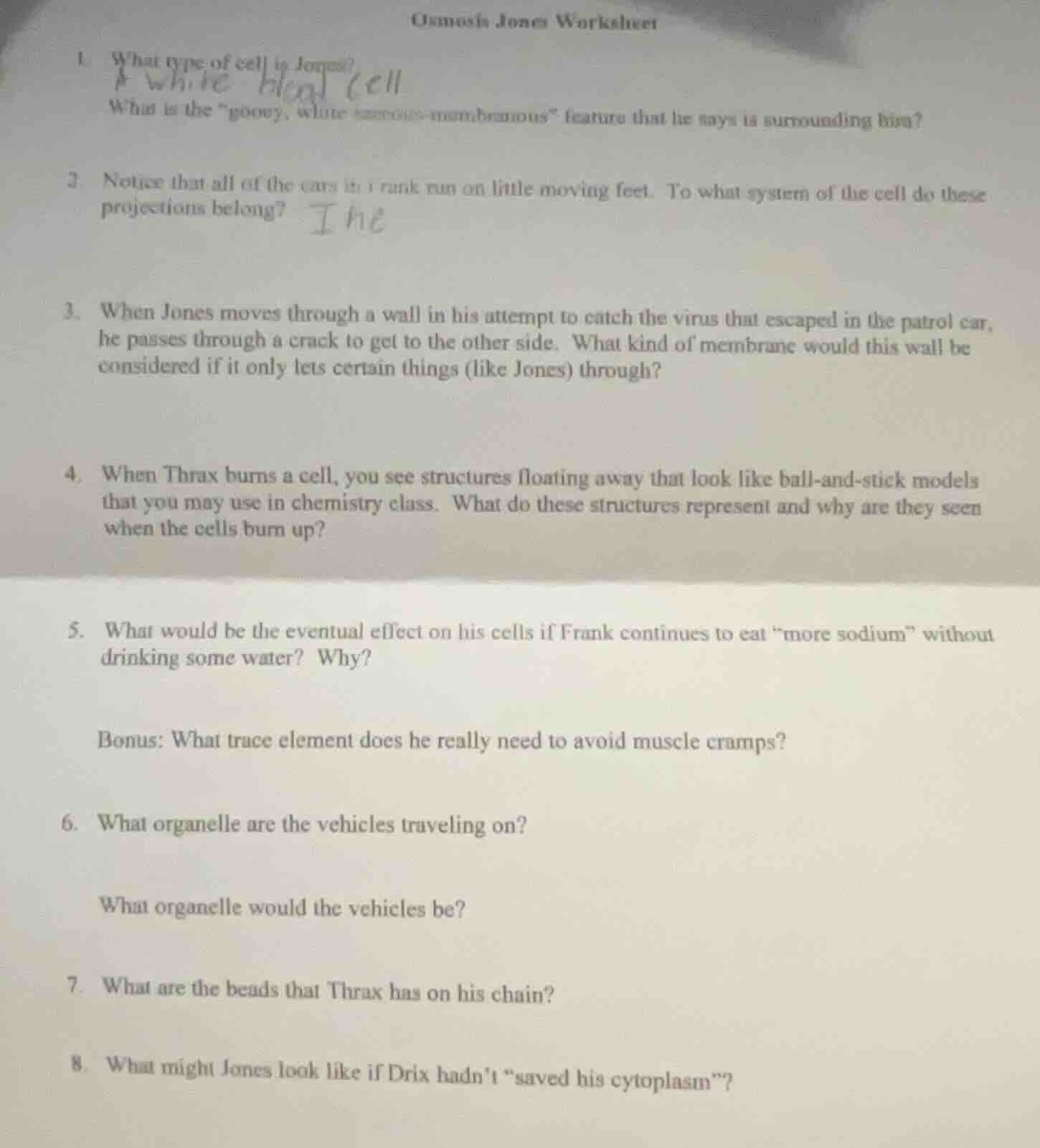
osmosis jones worksheet
- what type of cell is jones?
what is the \goowy, white membranous\ feature that he says is surrounding him?
- notice that all of the cars in frank run on little moving feet. to what system of the cell do these projections belong?
- when jones moves through a wall in his attempt to catch the virus that escaped in the patrol car, he passes through a crack to get to the other side. what kind of membrane would this wall be considered if it only lets certain things (like jones) through?
- when thrax burns a cell, you see structures floating away that look like ball-and-stick models that you may use in chemistry class. what do these structures represent and why are they seen when the cells burn up?
- what would be the eventual effect on his cells if frank continues to eat \more sodium\ without drinking some water? why?
bonus: what trace element does he really need to avoid muscle cramps?
- what organelle are the vehicles traveling on?
what organelle would the vehicles be?
- what are the beads that thrax has on his chain?
- what might jones look like if drix hadnt \saved his cytoplasm\?
Brief Explanations
- Jones is a white blood cell; the gooey white membranous structure is the cell membrane (plasma membrane) surrounding his cell.
- The moving feet-like projections are cilia/flagella, part of the cell's cytoskeleton/motility system.
- A membrane that only allows certain substances through is a selectively permeable (semipermeable) membrane.
- The ball-and-stick structures are organic molecules (like proteins, lipids, or carbohydrates); they float away because the cell's structure breaks down when burned, releasing its internal components.
- High sodium intake without water would create a hypertonic environment outside Frank's cells. Water would leave the cells via osmosis, causing them to shrink and function improperly, leading to dehydration-related cell damage.
- Vehicles travel on the cytoskeleton (cell's internal transport network); the vehicles represent motor proteins or vesicles that move materials within the cell.
- Thrax's chain beads are DNA nucleotides (or segments of DNA), representing his ability to damage genetic material.
- If Drix hadn't saved his cytoplasm, Jones's cell would lose its internal fluid and structural support, causing it to shrink, malfunction, and likely die.
Bonus: The trace element needed to avoid muscle cramps is potassium (K).

Snap & solve any problem in the app
Get step-by-step solutions on Sovi AI
Photo-based solutions with guided steps
Explore more problems and detailed explanations
- - Jones is a white blood cell.
- The structure is the cell (plasma) membrane.
- They belong to the cytoskeleton (cilia/flagella) system.
- Selectively permeable (semipermeable) membrane.
- - The structures are organic molecules (proteins, lipids, carbohydrates).
- They are released because the cell's internal structure breaks down when destroyed.
- Frank's cells would shrink and malfunction. This happens because high sodium creates a hypertonic environment, so water leaves the cells via osmosis.
- - Vehicles travel on the cytoskeleton.
- The vehicles are vesicles/motor proteins.
- The beads are DNA nucleotides/segments of DNA.
- Jones's cell would shrink, lose function, and likely die.
Bonus: Potassium (K)