QUESTION IMAGE
Question
other issues with galileo’s experiment.
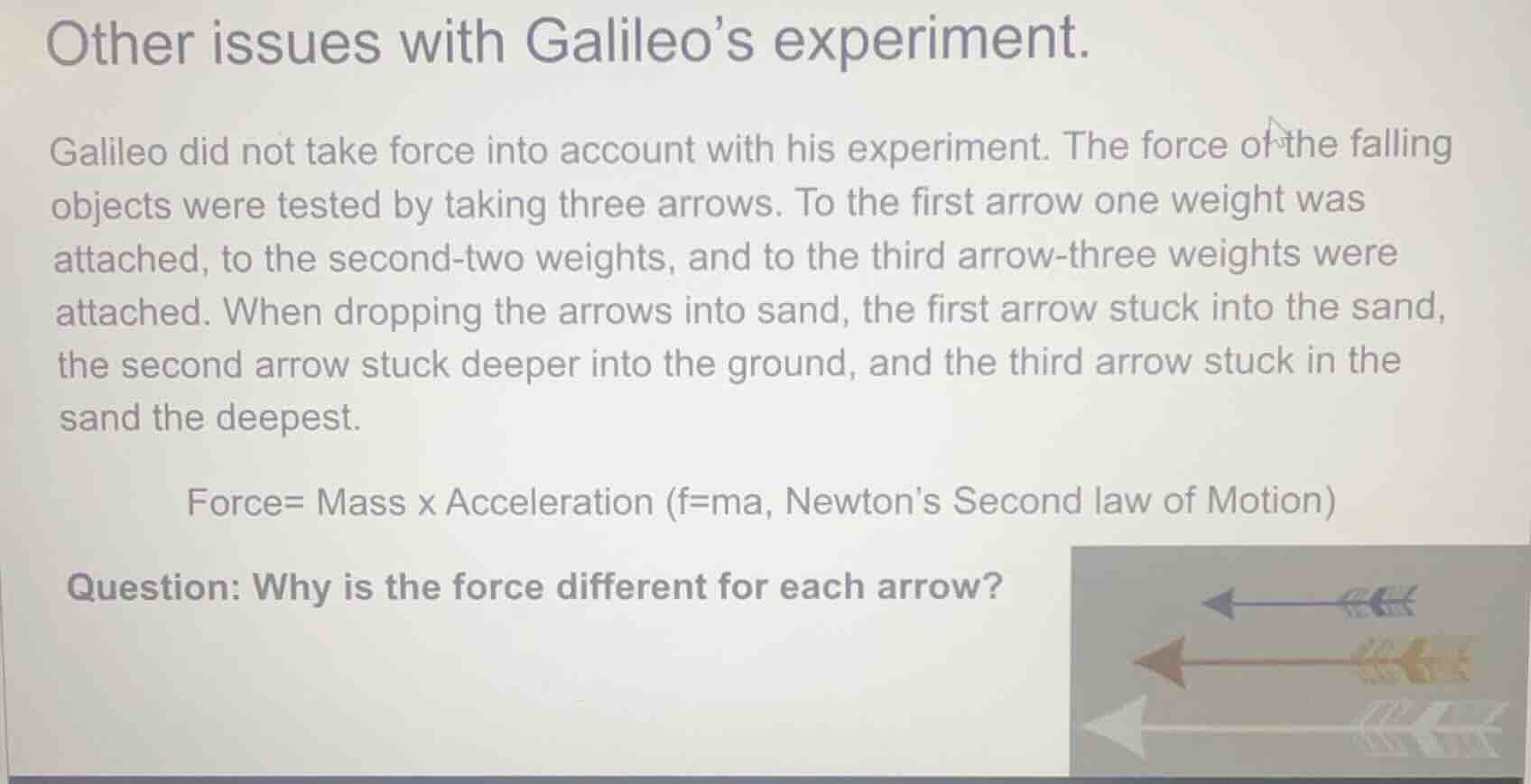
galileo did not take force into account with his experiment. the force of the falling objects were tested by taking three arrows. to the first arrow one weight was attached, to the second - two weights, and to the third arrow - three weights were attached. when dropping the arrows into sand, the first arrow stuck into the sand, the second arrow stuck deeper into the ground, and the third arrow stuck in the sand the deepest.
force = mass x acceleration (f = ma, newton’s second law of motion)
question: why is the force different for each arrow?
To determine why the force differs for each arrow, we use Newton's Second Law (\( F = ma \)). When the arrows fall, the acceleration due to gravity (\( a \)) is constant (near the Earth's surface). The mass of each arrow differs because different numbers of weights are attached: the first arrow has mass \( m_1 \), the second \( m_2 = 2m_1 \), and the third \( m_3 = 3m_1 \) (assuming each weight has the same mass). Since \( F = ma \) and \( a \) is constant, the force \( F \) is directly proportional to the mass \( m \). Thus, as the mass (number of weights) increases, the force (\( F \)) also increases. This explains why the arrow with more weights (greater mass) exerts a larger force and sticks deeper into the sand.

Snap & solve any problem in the app
Get step-by-step solutions on Sovi AI
Photo-based solutions with guided steps
Explore more problems and detailed explanations
The force differs for each arrow because of Newton's Second Law (\( F = ma \)). The acceleration (\( a \)) due to gravity is constant for all falling objects. However, the mass (\( m \)) of each arrow increases with the number of attached weights (first arrow: 1 weight, second: 2 weights, third: 3 weights). Since force is directly proportional to mass (\( F \propto m \) when \( a \) is constant), a greater mass results in a greater force. Thus, the arrow with more weights (higher mass) has a larger force and sticks deeper into the sand.