QUESTION IMAGE
Question
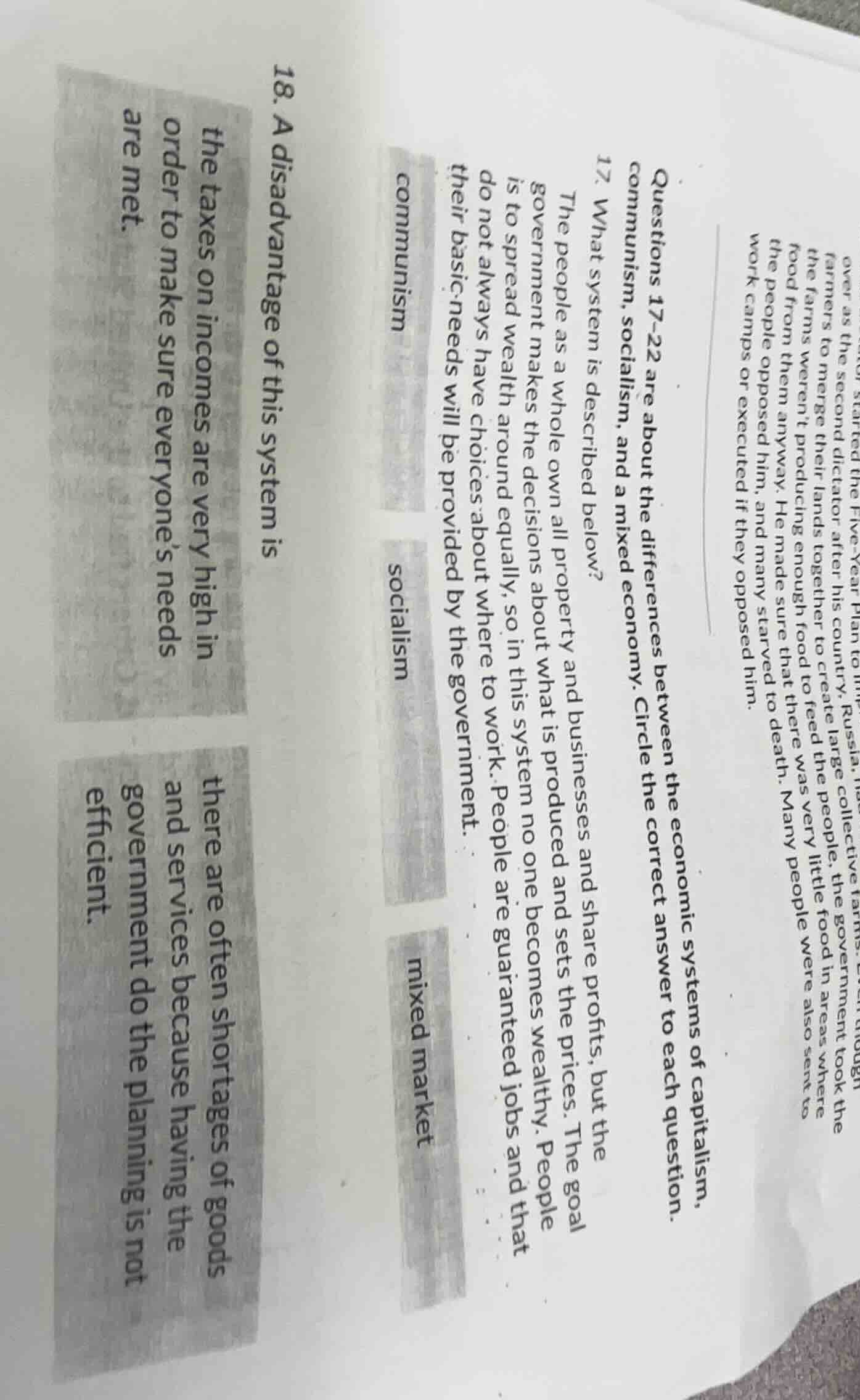
over as the second dictator after his country, russia, hadfarmers to merge their lands together to create large collective farms. even thoughthe farms werent producing enough food to feed the people, the government took thefood from them anyway. he made sure that there was very little food in areas wherethe people opposed him, and many starved to death. many people were also sent towork camps or executed if they opposed him.questions 17-22 are about the differences between the economic systems of capitalism,communism, socialism, and a mixed economy. circle the correct answer to each question.17. what system is described below?the people as a whole own all property and businesses and share profits, but thegovernment makes the decisions about what is produced and sets the prices. the goalis to spread wealth around equally, so in this system no one becomes wealthy. peopledo not always have choices about where to work. people are guaranteed jobs and thattheir basic needs will be provided by the government.communismsocialismmixed market18. a disadvantage of this system isthe taxes on incomes are very high inorder to make sure everyones needsare met.there are often shortages of goodsand services because having thegovernment do the planning is notefficient.
For Question 17:
This system has collective ownership of property by the people, government-controlled production/pricing, wealth equality as a goal, guaranteed jobs/basic needs, which aligns with core traits of socialism.
For Question 18:
High income taxes to fund universal needs are a characteristic trade-off of socialism, while shortages from inefficient central planning are a common issue in communism. Based on the system described in Q17 (socialism), the matching disadvantage is the high income taxes to meet everyone's needs.

Snap & solve any problem in the app
Get step-by-step solutions on Sovi AI
Photo-based solutions with guided steps
Explore more problems and detailed explanations
- socialism
- the taxes on incomes are very high in order to make sure everyone's needs are met.