QUESTION IMAGE
Question
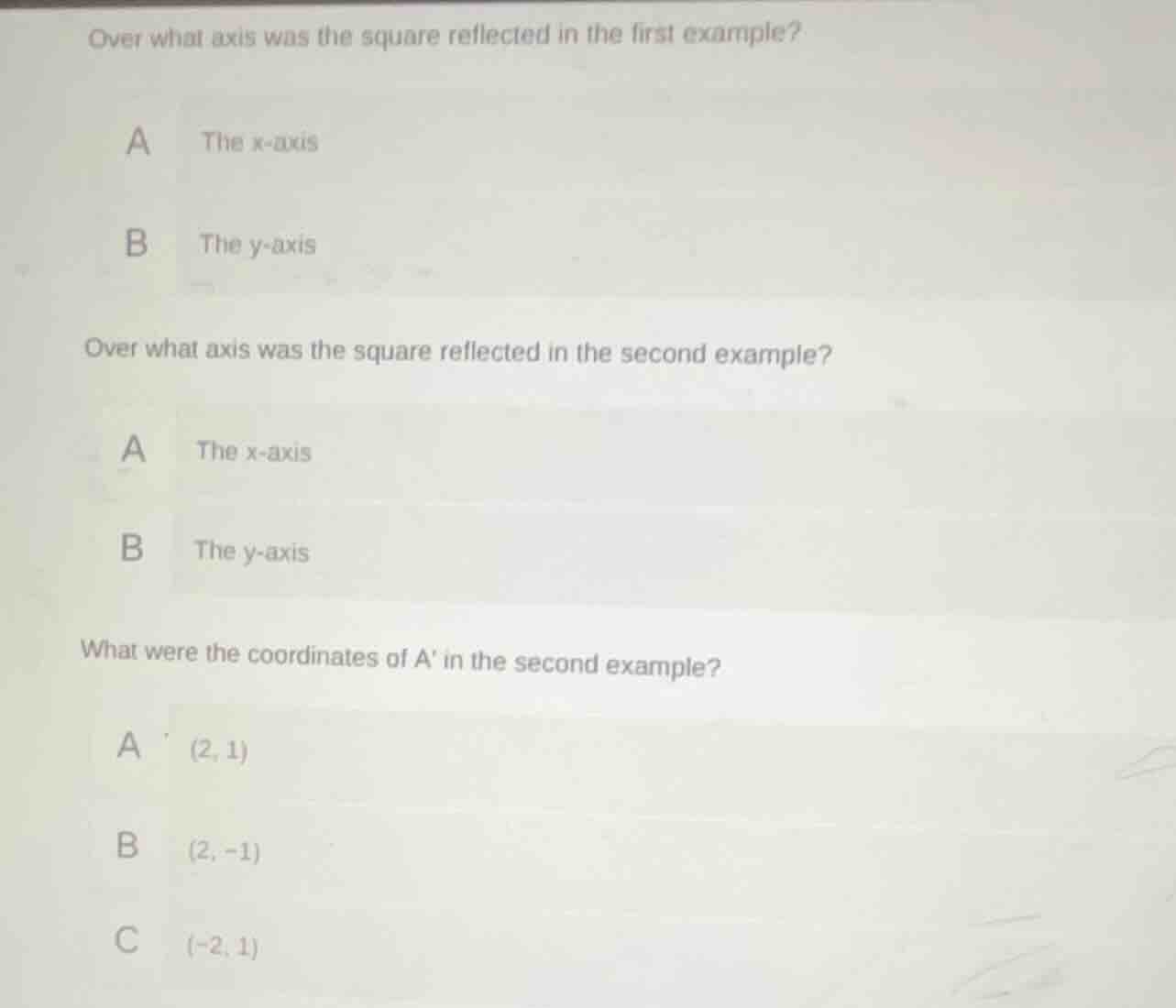
over what axis was the square reflected in the first example?
a the x - axis
b the y - axis
over what axis was the square reflected in the second example?
a the x - axis
b the y - axis
what were the coordinates of a in the second example?
a (2, 1)
b (2, -1)
c (-2, 1)
First Question: Over what axis was the square reflected in the first example?
To determine the reflection axis, we recall the rules of reflection over x - axis (\((x,y)\to(x, - y)\)) and y - axis (\((x,y)\to(-x,y)\)). Usually, if the first example's square has a reflection that swaps the sign of the x - coordinate (keeping y the same), it's over y - axis; if y - coordinate sign changes (x same), over x - axis. Assuming the first example's reflection follows the y - axis rule (e.g., original points \((x,y)\) become \((-x,y)\)), the answer is B.
For the second example, if the reflection changes the sign of the y - coordinate (keeping x the same), it's over x - axis (rule \((x,y)\to(x, - y)\)). If we assume the second example's reflection follows the x - axis reflection rule, the answer is A.
If the second example is a reflection over the x - axis, and let's assume the original coordinates of \(A\) were \((2,1)\). The rule for reflection over x - axis is \((x,y)\to(x, - y)\). So applying this rule, \((2,1)\) becomes \((2,-1)\), which is option B.

Snap & solve any problem in the app
Get step-by-step solutions on Sovi AI
Photo-based solutions with guided steps
Explore more problems and detailed explanations
B. The y - axis