QUESTION IMAGE
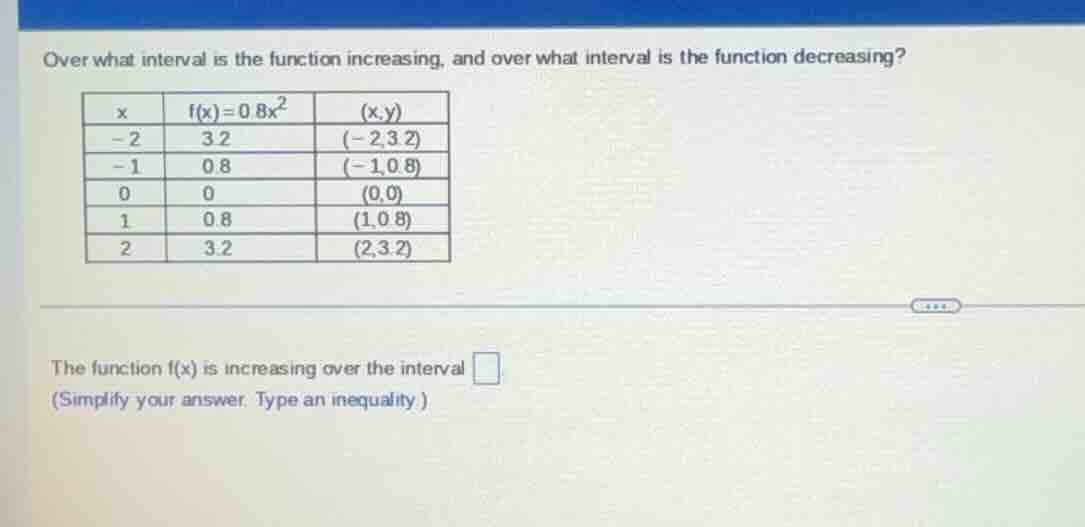
Question
over what interval is the function increasing, and over what interval is the function decreasing?
the function f(x) is increasing over the interval
(simplify your answer. type an inequality.)
Step1: Analyze the function type
The function is \( f(x) = 0.8x^2 \), which is a quadratic function with a positive leading coefficient (\( a = 0.8>0 \)). The graph of a quadratic function \( y = ax^2+bx + c \) (\( a
eq0 \)) is a parabola. When \( a>0 \), the parabola opens upward.
Step2: Determine the vertex and increasing/decreasing intervals
For the function \( f(x)=0.8x^2 \), the vertex is at \( (0,0) \) (since \( b = 0 \) and \( c = 0 \) in the standard form \( y=ax^2+bx + c \)). For a parabola opening upward, the function is decreasing on the interval \( (-\infty, 0) \) and increasing on the interval \( (0,+\infty) \). We can also verify this from the table: when \( x \) increases from \( 0 \) to \( 1 \) to \( 2 \), \( f(x) \) increases from \( 0 \) to \( 0.8 \) to \( 3.2 \). So the function is increasing when \( x>0 \), which in inequality form is \( x > 0 \) (or in interval notation \( (0,+\infty) \), but the question asks for an inequality).

Snap & solve any problem in the app
Get step-by-step solutions on Sovi AI
Photo-based solutions with guided steps
Explore more problems and detailed explanations
\( x > 0 \)