QUESTION IMAGE
Question
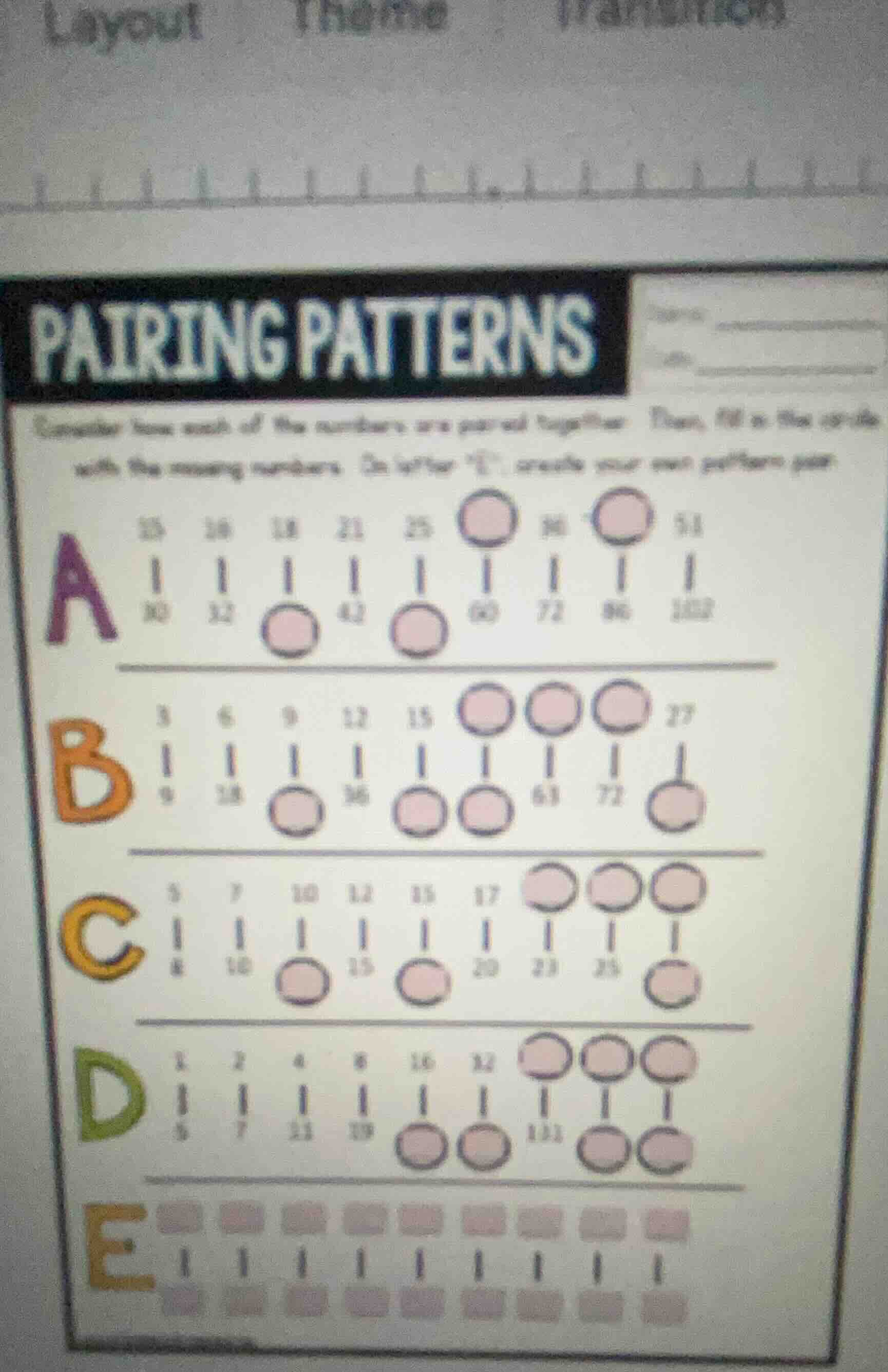
pairing patterns
consider how each of the numbers are paired together. then, fill in the circles with the missing numbers. on (sp?ce) “e”, create your own pattern pair.
a
25 26 18 21 25 circle 36 circle 54
30 32 circle 42 circle 60 72 86 102
b
3 6 9 12 15 circle circle circle 27
9 18 circle 36 circle circle 63 72 circle
c
5 7 10 12 15 17 circle circle circle
8 10 circle 15 circle 20 23 28 circle
d
1 2 4 8 16 32 circle circle circle
3 7 23 109 circle circle 121 circle circle
e
circle circle circle circle circle circle circle circle circle
circle circle circle circle circle circle circle circle circle
Part A
Step1: Find the pattern (sum)
Check the first two pairs: \(25 + 30 = 55\), \(36 + 32 = 68\)? Wait, no, wait \(25 + 30 = 55\)? Wait, no, \(25\) and \(30\): \(25 + 30 = 55\)? Wait, the top number is \(25\), bottom is \(30\)? Wait, no, looking at the first column: top is \(25\), bottom is \(30\)? Wait, no, maybe it's a sum or difference. Wait, \(30 - 25 = 5\), \(32 - 36 = -4\)? No, that's not. Wait, \(25 + 30 = 55\)? No, \(25 + 30 = 55\), but the next top is \(36\), bottom \(32\): \(36 + 32 = 68\)? No, that's not. Wait, maybe multiplication? \(25\times1.2 = 30\), \(36\times\frac{32}{36}=\frac{8}{9}\)? No. Wait, let's check the third column: top \(18\), bottom empty. Fourth column: top \(41\), bottom \(42\). \(42 - 41 = 1\). Fifth column: top \(25\), bottom empty. Sixth column: top empty, bottom \(60\). Seventh column: top \(36\), bottom \(72\). \(72 - 36 = 36\)? No, \(72\div36 = 2\). Eighth column: top empty, bottom \(86\). Ninth column: top \(54\), bottom \(102\). \(102 - 54 = 48\). Wait, maybe addition: \(25 + 30 = 55\) (no, 25+30=55, but top is 25, bottom 30? Wait, maybe the top and bottom are pairs that add up to a constant? Wait, 25 + 30 = 55, 36 + 32 = 68 – no. Wait, 30 - 25 = 5, 32 - 36 = -4 – no. Wait, 30 = 25 + 5, 32 = 36 - 4 – no. Wait, let's check the seventh column: top 36, bottom 72. 72 is 362. Oh! 251.2=30? No, 251.2=30? 251.2=30, yes! 251.2=30. 36 (32/36)= 32? No, 36(32/36)=32, but 360.888...=32. Wait, seventh column: 362=72. Yes! 362=72. Eighth column: bottom 86, so top would be 86/2=43? Because 362=72, so maybe bottom is top2? Let's check: 362=72 (correct). Then ninth column: top 54, bottom 102? No, 542=108, not 102. Wait, 54 + 48=102. No. Wait, sixth column: bottom 60, so top would be 60/2=30? Because 362=72, so maybe bottom is top2. Let's check: 362=72 (correct). Then eighth column: bottom 86, so top 86/2=43? Then ninth column: top 54, bottom 542=108, but it's 102. Hmm, maybe not. Wait, fourth column: top 41, bottom 42. 42-41=1. Seventh column: 72-36=36. No. Wait, maybe the difference: 30-25=5, 32-36=-4, 42-41=1, 72-36=36, 102-54=48. Not a pattern. Wait, maybe addition: 25+30=55, 36+32=68, 41+42=83, 36+72=108, 54+102=156. No. Wait, let's try another approach. Let's list the top and bottom:
Column 1: Top=25, Bottom=30
Column 2: Top=36, Bottom=32
Column 3: Top=18, Bottom=?
Column 4: Top=41, Bottom=42
Column 5: Top=25, Bottom=?
Column 6: Top=?, Bottom=60
Column 7: Top=36, Bottom=72
Column 8: Top=?, Bottom=86
Column 9: Top=54, Bottom=102
Now, check column 7: 36 and 72. 72 is 362. Column 1: 25 and 30. 30 is 25 + 5. Column 2: 36 and 32. 32 is 36 - 4. Column 4: 41 and 42. 42 is 41 + 1. Column 9: 54 and 102. 102 is 54 + 48. No. Wait, column 7: 362=72. Let's assume column 6: bottom=60, so top=60/2=30. Column 8: bottom=86, so top=86/2=43. Column 3: top=18, so bottom=182=36? Column 5: top=25, so bottom=252=50. Let's check:
Column 1: 251.2=30 (no, 252=50, not 30). Wait, column 7: 362=72 (correct). Column 9: 542=108, but it's 102. So that's wrong. Wait, 54 + 48=102, 36 + 36=72, 41 + 1=42, 36 - 4=32, 25 + 5=30. No, the differences are 5, -4, 1,?, 36, 48. Not a pattern. Wait, maybe the bottom numbers: 30, 32,?, 42,?, 60, 72, 86, 102. Let's find the differences between bottom numbers: 32-30=2,? -32, 42 -?,? -42, 60 -?, 72-60=12, 86-72=14, 102-86=16. Ah! 72 to 86: +14, 86 to 102: +16. So before that: 60 to 72: +12, so maybe the differences are increasing by 2: 10, 12, 14, 16? Wait, 30 to 32: +2, then 32 to? : +4 (2+2), so?=36. Then 36 to 42: +6 (4+2), then 42 to? : +8 (6+2), so?=50. Then 50 to 6…

Snap & solve any problem in the app
Get step-by-step solutions on Sovi AI
Photo-based solutions with guided steps
Explore more problems and detailed explanations
Step1: Find the pattern (sum)
Check the first two pairs: \(25 + 30 = 55\), \(36 + 32 = 68\)? Wait, no, wait \(25 + 30 = 55\)? Wait, no, \(25\) and \(30\): \(25 + 30 = 55\)? Wait, the top number is \(25\), bottom is \(30\)? Wait, no, looking at the first column: top is \(25\), bottom is \(30\)? Wait, no, maybe it's a sum or difference. Wait, \(30 - 25 = 5\), \(32 - 36 = -4\)? No, that's not. Wait, \(25 + 30 = 55\)? No, \(25 + 30 = 55\), but the next top is \(36\), bottom \(32\): \(36 + 32 = 68\)? No, that's not. Wait, maybe multiplication? \(25\times1.2 = 30\), \(36\times\frac{32}{36}=\frac{8}{9}\)? No. Wait, let's check the third column: top \(18\), bottom empty. Fourth column: top \(41\), bottom \(42\). \(42 - 41 = 1\). Fifth column: top \(25\), bottom empty. Sixth column: top empty, bottom \(60\). Seventh column: top \(36\), bottom \(72\). \(72 - 36 = 36\)? No, \(72\div36 = 2\). Eighth column: top empty, bottom \(86\). Ninth column: top \(54\), bottom \(102\). \(102 - 54 = 48\). Wait, maybe addition: \(25 + 30 = 55\) (no, 25+30=55, but top is 25, bottom 30? Wait, maybe the top and bottom are pairs that add up to a constant? Wait, 25 + 30 = 55, 36 + 32 = 68 – no. Wait, 30 - 25 = 5, 32 - 36 = -4 – no. Wait, 30 = 25 + 5, 32 = 36 - 4 – no. Wait, let's check the seventh column: top 36, bottom 72. 72 is 362. Oh! 251.2=30? No, 251.2=30? 251.2=30, yes! 251.2=30. 36 (32/36)= 32? No, 36(32/36)=32, but 360.888...=32. Wait, seventh column: 362=72. Yes! 362=72. Eighth column: bottom 86, so top would be 86/2=43? Because 362=72, so maybe bottom is top2? Let's check: 362=72 (correct). Then ninth column: top 54, bottom 102? No, 542=108, not 102. Wait, 54 + 48=102. No. Wait, sixth column: bottom 60, so top would be 60/2=30? Because 362=72, so maybe bottom is top2. Let's check: 362=72 (correct). Then eighth column: bottom 86, so top 86/2=43? Then ninth column: top 54, bottom 542=108, but it's 102. Hmm, maybe not. Wait, fourth column: top 41, bottom 42. 42-41=1. Seventh column: 72-36=36. No. Wait, maybe the difference: 30-25=5, 32-36=-4, 42-41=1, 72-36=36, 102-54=48. Not a pattern. Wait, maybe addition: 25+30=55, 36+32=68, 41+42=83, 36+72=108, 54+102=156. No. Wait, let's try another approach. Let's list the top and bottom:
Column 1: Top=25, Bottom=30
Column 2: Top=36, Bottom=32
Column 3: Top=18, Bottom=?
Column 4: Top=41, Bottom=42
Column 5: Top=25, Bottom=?
Column 6: Top=?, Bottom=60
Column 7: Top=36, Bottom=72
Column 8: Top=?, Bottom=86
Column 9: Top=54, Bottom=102
Now, check column 7: 36 and 72. 72 is 362. Column 1: 25 and 30. 30 is 25 + 5. Column 2: 36 and 32. 32 is 36 - 4. Column 4: 41 and 42. 42 is 41 + 1. Column 9: 54 and 102. 102 is 54 + 48. No. Wait, column 7: 362=72. Let's assume column 6: bottom=60, so top=60/2=30. Column 8: bottom=86, so top=86/2=43. Column 3: top=18, so bottom=182=36? Column 5: top=25, so bottom=252=50. Let's check:
Column 1: 251.2=30 (no, 252=50, not 30). Wait, column 7: 362=72 (correct). Column 9: 542=108, but it's 102. So that's wrong. Wait, 54 + 48=102, 36 + 36=72, 41 + 1=42, 36 - 4=32, 25 + 5=30. No, the differences are 5, -4, 1,?, 36, 48. Not a pattern. Wait, maybe the bottom numbers: 30, 32,?, 42,?, 60, 72, 86, 102. Let's find the differences between bottom numbers: 32-30=2,? -32, 42 -?,? -42, 60 -?, 72-60=12, 86-72=14, 102-86=16. Ah! 72 to 86: +14, 86 to 102: +16. So before that: 60 to 72: +12, so maybe the differences are increasing by 2: 10, 12, 14, 16? Wait, 30 to 32: +2, then 32 to? : +4 (2+2), so?=36. Then 36 to 42: +6 (4+2), then 42 to? : +8 (6+2), so?=50. Then 50 to 60: +10 (8+2), then 60 to 72: +12 (10+2), 72 to 86: +14 (12+2), 86 to 102: +16 (14+2). Yes! That works. Let's check:
Bottom numbers: 30, 32, 36, 42, 50, 60, 72, 86, 102.
Differences: 32-30=2, 36-32=4, 42-36=6, 50-42=8, 60-50=10, 72-60=12, 86-72=14, 102-86=16. Perfect, each difference increases by 2.
Now, the top numbers:
Column 1: Top=25, Bottom=30
Column 2: Top=36, Bottom=32
Column 3: Top=18, Bottom=36 (from above)
Column 4: Top=41, Bottom=42 (matches, 42 is next)
Column 5: Top=25, Bottom=50 (from above)
Column 6: Top=?, Bottom=60. Since bottom is 60, top: let's see the top numbers. Column 1:25, Column2:36, Column3:18, Column4:41, Column5:25, Column6:?, Column7:36, Column8:?, Column9:54.
Wait, top numbers: 25, 36, 18, 41, 25,?, 36,?, 54. Let's check the differences between top numbers: 36-25=11, 18-36=-18, 41-18=23, 25-41=-16,? -25, 36 -?,? -36, 54 -?. Not obvious. But maybe the top and bottom are related by some operation. Wait, bottom=30, top=25: 30-5=25. Bottom=32, top=36: 32+4=36. Bottom=36, top=18: 36-18=18. Bottom=42, top=41: 42-1=41. Bottom=50, top=25: 50-25=25. Bottom=60, top=?: 60 -? = x. Bottom=72, top=36: 72-36=36. Bottom=86, top=?: 86 -? = y. Bottom=102, top=54: 102-54=48.
Now, the differences (bottom - top): 5, -4, 18, 1, 25, x, 36, y, 48.
Looking at these differences: 5, -4, 18, 1, 25, x, 36, y, 48.
Notice that 5, 18, 25, 36, 48 are 5=5, 18=9+9? No, 5=2²+1, 18=4²+2, 25=5², 36=6², 48=6²+12? No, 5, 18, 25, 36, 48: 5, 18 (5+13), 25 (18+7), 36 (25+11), 48 (36+12). Not. Wait, 5, 25, 36, 48: 5=5, 25=5², 36=6², 48=6*8. No. Wait, the negative differences: -4, 1, x, y. -4, 1: difference of 5. Maybe x=6, y=11? Then differences: 5, -4, 18, 1, 25, 6, 36, 11, 48. No, not.
Alternatively, maybe the top numbers are related to the bottom numbers by division. Bottom=30, top=25: 30(5/6)=25. Bottom=32, top=36: 32(9/8)=36. Bottom=36, top=18: 36(1/2)=18. Bottom=42, top=41: 42(41/42)=41. Bottom=50, top=25: 50(1/2)=25. Bottom=60, top=?: 60(x/60)=x. Bottom=72, top=36: 72(1/2)=36. Bottom=86, top=?: 86(y/86)=y. Bottom=102, top=54: 102(9/17)=54 (since 102÷17=6, 54÷17=3.176… no, 10254/102=54). Wait, bottom=72, top=36: 72/2=36. Bottom=50, top=25: 50/2=25. Bottom=36, top=18: 36/2=18. Oh! Here we go. Bottom=36, top=18 (36/2=18). Bottom=50, top=25 (50/2=25). Bottom=72, top=36 (72/2=36). So that's a pattern: bottom/2=top for columns 3,5,7. Let's check:
Column3: bottom=36, top=18 (36/2=18) – correct.
Column5: bottom=50, top=25 (50/2=25) – correct.
Column7: bottom=72, top=36 (72/2=36) – correct.
Yes! So that's the pattern for these columns. Now, column1: bottom=30, top=25. 30/2=15≠25. Column2: bottom=32, top=36. 32/2=16≠36. Column4: bottom=42, top=41. 42/2=21≠41. Column6: bottom=60, top=? If we follow the other pattern, but column3,5,7 have bottom/2=top. Let's check column9: bottom=102, top=54. 102/2=51≠54. So maybe column3,5,7 are bottom/2=top, and others are different.
So column3: bottom=36, top=18 (36/2=18)
Column5: bottom=50, top=25 (50/2=25)
Column7: bottom=72, top=36 (72/2=36)
Now, column6: bottom=60, so top=60/2=30 (since column3,5,7 are bottom/2=top, maybe column6 is also? Wait, column6 is between column5 and 7. Column5: bottom=50, top=25 (50/2=25). Column6: bottom=60, top=60/2=30. Then column8: bottom=86, top=86/2=43. Column9: bottom=102, top=102/2=51, but it's 54. Hmm, maybe column9 is different. But let's proceed with the pattern we have.
So column3: bottom=36 (since bottom differences: 30,32,36,42,50,60,...), top=18 (36/2=18)
Column5: bottom=50 (42+8=50), top=25 (50/2=25)
Column6: top=30 (60/2=30)
Column8: top=43 (86/2=43)
Let's verify the bottom differences again: 30,32 (30+2), 36 (32+4), 42 (36+6), 50 (42+8), 60 (50+10), 72 (60+12), 86 (72+14), 102 (86+16). Yes, each time +2, +4, +6, +8, +10, +12, +14, +16 (increasing by 2 each time). Perfect.
And the top numbers for columns3,5,7,6,8:
Column3: 18 (36/2)
Column5:25 (50/2)
Column6:30 (60/2)
Column7:36 (72/2)
Column8:43 (86/2)
Now, let's check column1 and 2:
Column1: bottom=30, top=25. 30-5=25
Column2