QUESTION IMAGE
Question
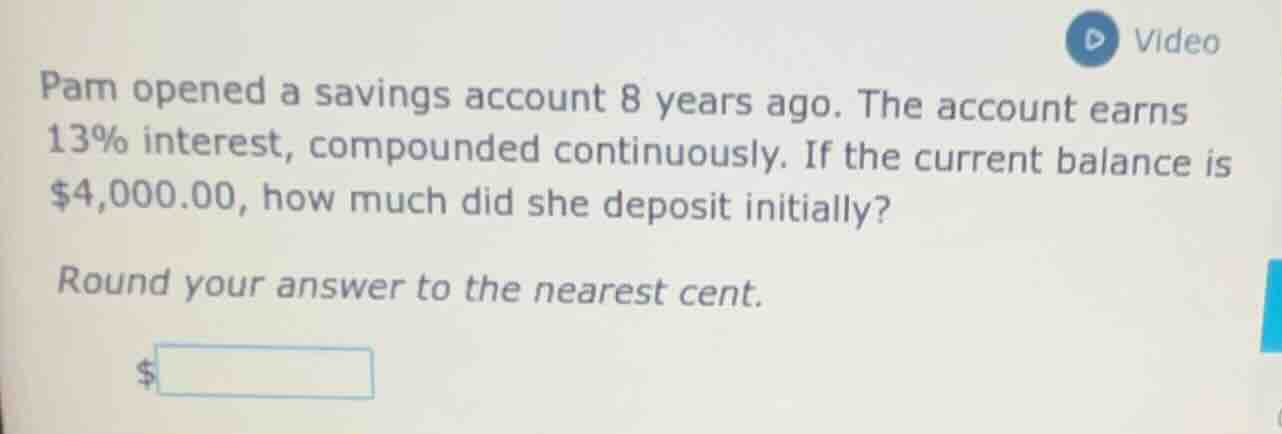
pam opened a savings account 8 years ago. the account earns 13% interest, compounded continuously. if the current balance is $4,000.00, how much did she deposit initially? round your answer to the nearest cent.
Step1: Recall the formula for continuous compounding
The formula for continuous compounding is $A = Pe^{rt}$, where $A$ is the final amount, $P$ is the principal (initial deposit), $r$ is the annual interest rate (in decimal), and $t$ is the time in years.
We know $A = 4000$, $r = 0.13$ (since 13% = 0.13), and $t = 8$. We need to solve for $P$.
Step2: Rearrange the formula to solve for $P$
Starting with $A = Pe^{rt}$, divide both sides by $e^{rt}$ to get $P=\frac{A}{e^{rt}}$.
Step3: Substitute the known values into the formula
Substitute $A = 4000$, $r = 0.13$, and $t = 8$ into the formula:
First, calculate the exponent $rt$: $rt=0.13\times8 = 1.04$.
Then, calculate $e^{1.04}$. We know that $e\approx2.71828$, so $e^{1.04}\approx2.71828^{1.04}\approx2.8328$.
Now, $P=\frac{4000}{e^{1.04}}\approx\frac{4000}{2.8328}\approx1412.03$.

Snap & solve any problem in the app
Get step-by-step solutions on Sovi AI
Photo-based solutions with guided steps
Explore more problems and detailed explanations
$\$1412.03$