QUESTION IMAGE
Question
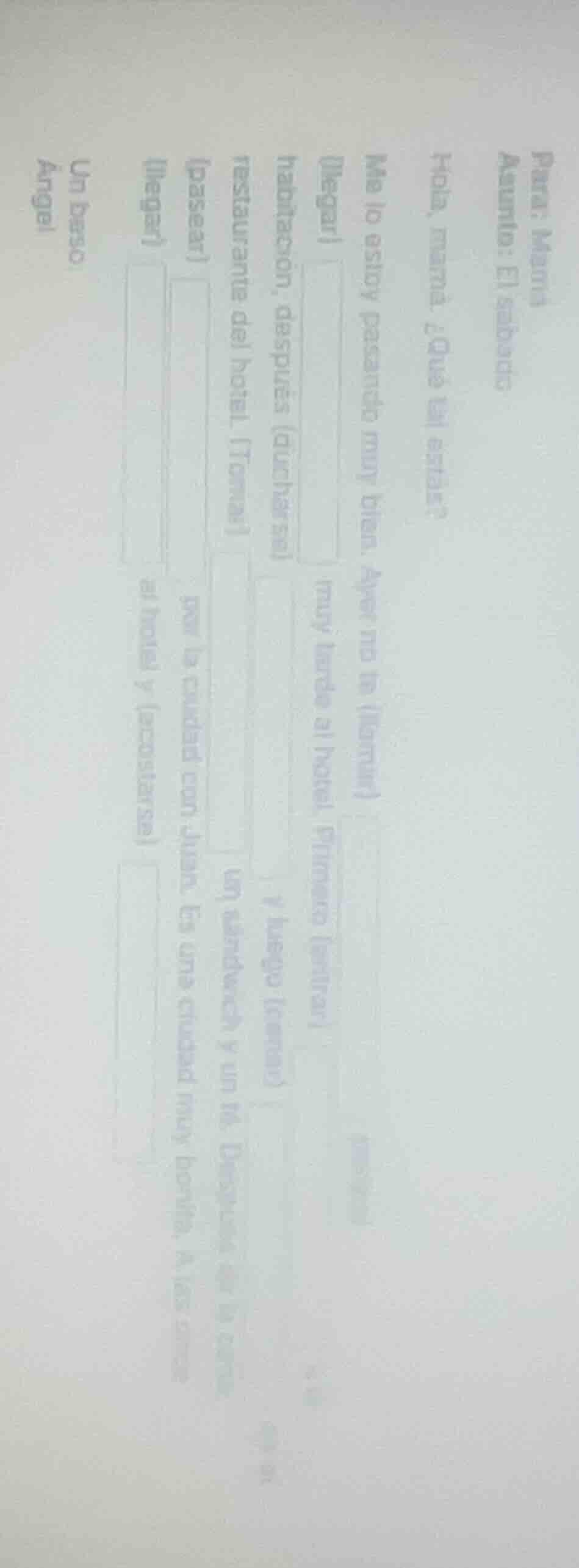
para: mami
asunto: el sábado
hola, mamá. ¿qué tal estás?
me lo estoy pasando muy bien. ayer no te (llamar)
(lllegar) muy tarde al hotel. primero (sentar)
habitación, después (ducharse)
restaurante del hotel. (tomar) 1 huevo (tener)
un sandwich y un té. después
(pasear) por la ciudad con juan. es una ciudad muy bonita. a las
(llegar) al hotel y (acostarse)
un beso
ángel
To solve this Spanish verb conjugation and sentence completion task, we analyze each blank based on context and verb tense (likely preterite or imperfect, but here we focus on correct verb forms):
- “Ayer no te (llamar)”: The correct preterite form of llamar (to call) for “te” (you, informal) is llamé? Wait, no—“te llamar” structure: “Ayer no te llamé” (I didn’t call you yesterday). Wait, maybe “llamar” in the context of “no te (llamar)” – the infinitive? No, the sentence is past. Wait, maybe the correct form is llamé (preterite, first person singular). Wait, let's re-examine:
Wait, the text is a dialogue, so let's parse each blank:
- “Ayer no te (llamar)”: Correct form: llamé (I didn’t call you yesterday – “Ayer no te llamé”).
- “(Llegar) muy tarde al hotel”: Subject is “yo” (implied), so preterite of llegar: Llegué (I arrived very late to the hotel).
- “primero (sentar)”: “Sentar” (to sit) – “me senté” (I sat down) – but the blank is “primero (sentar)”: maybe sentarme? No, context: “llegar... primero (sentar) en la habitación” – “primero me senté” (first I sat down). Wait, maybe the infinitive? No, past tense.
- “después (ducharse)”: “Ducharse” (to shower) – preterite: me duché (then I showered).
- “(Tomar) un sándwich y un té”: Preterite of tomar: Tomé (I ate a sandwich and tea).
- “(Pasear) por la ciudad con Juan”: Preterite of pasear: Paseé (I walked around the city with Juan).
- “(Llegar) al hotel y (acostarse)”: “Llegar” – Llegué (I arrived at the hotel) and “acostarse” – me acosté (I went to bed).
- “Un beso (Ángel)”: Just “Un beso, Ángel” (A kiss, Ángel).
But let's list the correct forms for each blank:
- llamar → llamé
- Llegar → Llegué
- sentar → senté (or me senté)
- ducharse → me duché
- Tomar → Tomé
- Pasear → Paseé
- Llegar → Llegué; acostarse → me acosté
However, if the task is to conjugate verbs in the preterite tense (past actions), here are the correct forms:
- Ayer no te llamé
- Llegué muy tarde al hotel
- primero me senté (or senté if “me” is implied)
- después me duché
- Tomé un sándwich y un té
- Paseé por la ciudad con Juan
- Llegué al hotel y me acosté
For the final “Un beso (Ángel)”, it’s just “Un beso, Ángel” (no verb, just a closing).
Step-by-Step (for key blanks):
- “Ayer no te (llamar)”:
- Tense: Preterite (past action: “ayer”).
- Verb: llamar (to call), first person singular (yo) → llamé.
- “(Llegar) muy tarde al hotel”:
- Tense: Preterite.
- Verb: llegar (to arrive), first person singular → Llegué.
- “(Tomar) un sándwich y un té”:
- Tense: Preterite.
- Verb: tomar (to eat/drink), first person singular → Tomé.
- “(Pasear) por la ciudad con Juan”:
- Tense: Preterite.
- Verb: pasear (to walk), first person singular → Paseé.
Final Answers (filled blanks):
- Ayer no te llamé
- Llegué muy tarde al hotel
- primero me senté (or senté)
- después me duché
- Tomé un sándwich y un té
- Paseé por la ciudad con Juan
- Llegué al hotel y me acosté
- Un beso, Ángel
(Note: The exact forms depend on context and subject, but these are the standard preterite conjugations for the implied first-person singular subject.)

Snap & solve any problem in the app
Get step-by-step solutions on Sovi AI
Photo-based solutions with guided steps
Explore more problems and detailed explanations
To solve this Spanish verb conjugation and sentence completion task, we analyze each blank based on context and verb tense (likely preterite or imperfect, but here we focus on correct verb forms):
- “Ayer no te (llamar)”: The correct preterite form of llamar (to call) for “te” (you, informal) is llamé? Wait, no—“te llamar” structure: “Ayer no te llamé” (I didn’t call you yesterday). Wait, maybe “llamar” in the context of “no te (llamar)” – the infinitive? No, the sentence is past. Wait, maybe the correct form is llamé (preterite, first person singular). Wait, let's re-examine:
Wait, the text is a dialogue, so let's parse each blank:
- “Ayer no te (llamar)”: Correct form: llamé (I didn’t call you yesterday – “Ayer no te llamé”).
- “(Llegar) muy tarde al hotel”: Subject is “yo” (implied), so preterite of llegar: Llegué (I arrived very late to the hotel).
- “primero (sentar)”: “Sentar” (to sit) – “me senté” (I sat down) – but the blank is “primero (sentar)”: maybe sentarme? No, context: “llegar... primero (sentar) en la habitación” – “primero me senté” (first I sat down). Wait, maybe the infinitive? No, past tense.
- “después (ducharse)”: “Ducharse” (to shower) – preterite: me duché (then I showered).
- “(Tomar) un sándwich y un té”: Preterite of tomar: Tomé (I ate a sandwich and tea).
- “(Pasear) por la ciudad con Juan”: Preterite of pasear: Paseé (I walked around the city with Juan).
- “(Llegar) al hotel y (acostarse)”: “Llegar” – Llegué (I arrived at the hotel) and “acostarse” – me acosté (I went to bed).
- “Un beso (Ángel)”: Just “Un beso, Ángel” (A kiss, Ángel).
But let's list the correct forms for each blank:
- llamar → llamé
- Llegar → Llegué
- sentar → senté (or me senté)
- ducharse → me duché
- Tomar → Tomé
- Pasear → Paseé
- Llegar → Llegué; acostarse → me acosté
However, if the task is to conjugate verbs in the preterite tense (past actions), here are the correct forms:
- Ayer no te llamé
- Llegué muy tarde al hotel
- primero me senté (or senté if “me” is implied)
- después me duché
- Tomé un sándwich y un té
- Paseé por la ciudad con Juan
- Llegué al hotel y me acosté
For the final “Un beso (Ángel)”, it’s just “Un beso, Ángel” (no verb, just a closing).
Step-by-Step (for key blanks):
- “Ayer no te (llamar)”:
- Tense: Preterite (past action: “ayer”).
- Verb: llamar (to call), first person singular (yo) → llamé.
- “(Llegar) muy tarde al hotel”:
- Tense: Preterite.
- Verb: llegar (to arrive), first person singular → Llegué.
- “(Tomar) un sándwich y un té”:
- Tense: Preterite.
- Verb: tomar (to eat/drink), first person singular → Tomé.
- “(Pasear) por la ciudad con Juan”:
- Tense: Preterite.
- Verb: pasear (to walk), first person singular → Paseé.
Final Answers (filled blanks):
- Ayer no te llamé
- Llegué muy tarde al hotel
- primero me senté (or senté)
- después me duché
- Tomé un sándwich y un té
- Paseé por la ciudad con Juan
- Llegué al hotel y me acosté
- Un beso, Ángel
(Note: The exact forms depend on context and subject, but these are the standard preterite conjugations for the implied first-person singular subject.)