QUESTION IMAGE
Question
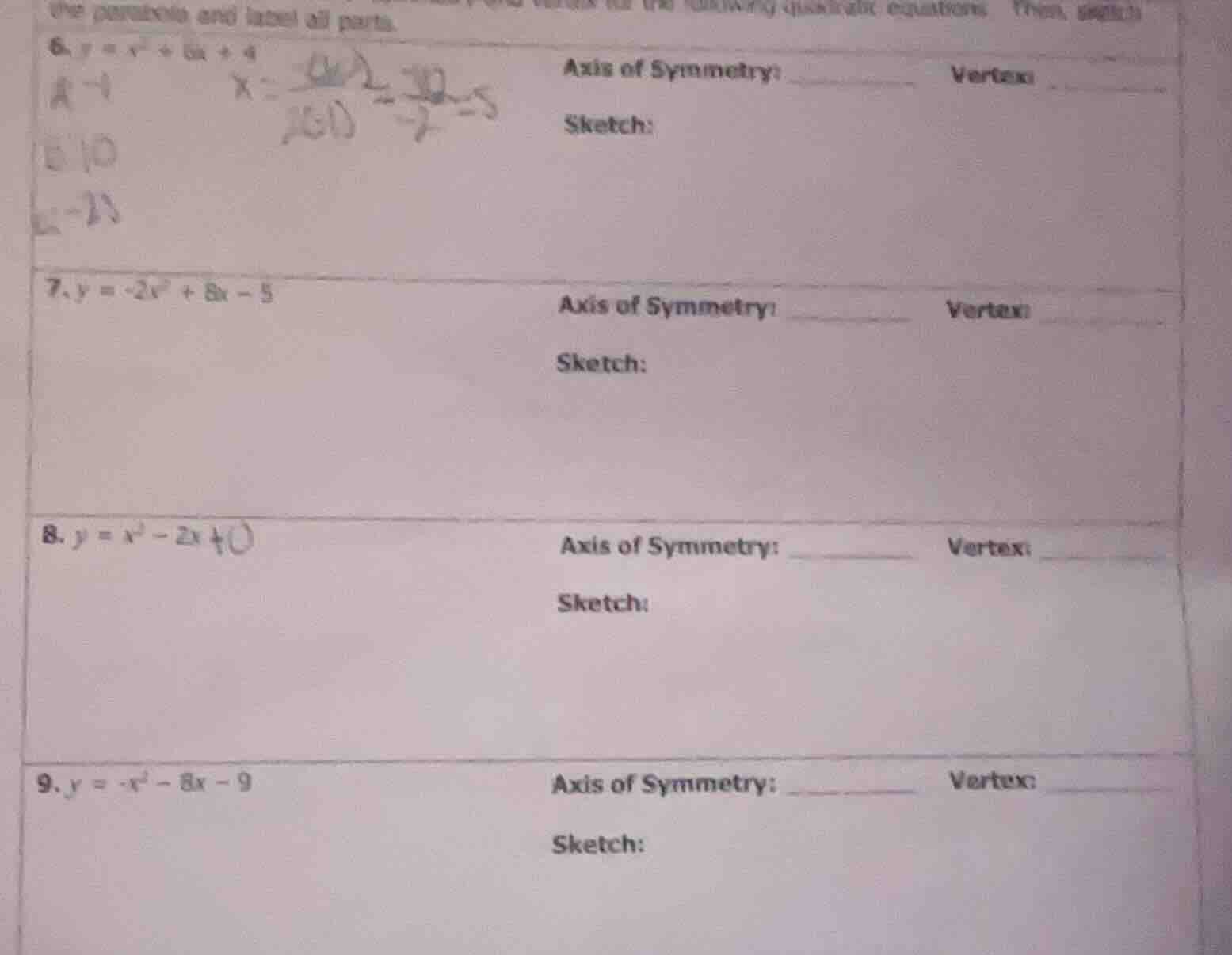
the parabola and label all parts.
- $y = x^2 + 10x + 4$
axis of symmetry: ________ vertex
sketch:
- $y = -2x^2 + 8x - 5$
axis of symmetry: ________ vertex:
sketch:
- $y = x^2 - 2x + 0$
axis of symmetry: ________ vertex:
sketch:
- $y = -x^2 - 8x - 9$
axis of symmetry: ________ vertex:
sketch:
Let's solve each quadratic equation for the axis of symmetry and vertex. We'll use the formula for the axis of symmetry of a quadratic \( y = ax^2 + bx + c \), which is \( x = -\frac{b}{2a} \), and then find the corresponding \( y \)-value for the vertex.
Problem 6: \( y = x^2 + 10x + 4 \) (assuming the middle term is \( 10x \) from the handwritten note)
Step 1: Find the axis of symmetry
For \( y = x^2 + 10x + 4 \), \( a = 1 \), \( b = 10 \).
Using \( x = -\frac{b}{2a} \):
\( x = -\frac{10}{2(1)} = -5 \)
Step 2: Find the vertex
Substitute \( x = -5 \) into the equation to find \( y \):
\( y = (-5)^2 + 10(-5) + 4 = 25 - 50 + 4 = -21 \)
So the vertex is \( (-5, -21) \).
Problem 7: \( y = -2x^2 + 8x - 5 \)
Step 1: Find the axis of symmetry
For \( y = -2x^2 + 8x - 5 \), \( a = -2 \), \( b = 8 \).
Using \( x = -\frac{b}{2a} \):
\( x = -\frac{8}{2(-2)} = -\frac{8}{-4} = 2 \)
Step 2: Find the vertex
Substitute \( x = 2 \) into the equation:
\( y = -2(2)^2 + 8(2) - 5 = -8 + 16 - 5 = 3 \)
So the vertex is \( (2, 3) \).
Problem 8: \( y = x^2 - 2x + 0 \) (simplifies to \( y = x^2 - 2x \))
Step 1: Find the axis of symmetry
For \( y = x^2 - 2x \), \( a = 1 \), \( b = -2 \).
Using \( x = -\frac{b}{2a} \):
\( x = -\frac{-2}{2(1)} = \frac{2}{2} = 1 \)
Step 2: Find the vertex
Substitute \( x = 1 \) into the equation:
\( y = (1)^2 - 2(1) = 1 - 2 = -1 \)
So the vertex is \( (1, -1) \).
Problem 9: \( y = -x^2 - 8x - 9 \)
Step 1: Find the axis of symmetry
For \( y = -x^2 - 8x - 9 \), \( a = -1 \), \( b = -8 \).
Using \( x = -\frac{b}{2a} \):
\( x = -\frac{-8}{2(-1)} = -\frac{-8}{-2} = -4 \)
Step 2: Find the vertex
Substitute \( x = -4 \) into the equation:
\( y = -(-4)^2 - 8(-4) - 9 = -16 + 32 - 9 = 7 \)
So the vertex is \( (-4, 7) \).
Summary of Results:
| Equation | Axis of Symmetry | Vertex |
|---|---|---|
| \( y = -2x^2 + 8x - 5 \) | \( x = 2 \) | \( (2, 3) \) |
| \( y = x^2 - 2x \) | \( x = 1 \) | \( (1, -1) \) |
| \( y = -x^2 - 8x - 9 \) | \( x = -4 \) | \( (-4, 7) \) |
To sketch the parabolas:
- For \( y = x^2 + 10x + 4 \) and \( y = x^2 - 2x \), since \( a > 0 \), the parabolas open upward.
- For \( y = -2x^2 + 8x - 5 \) and \( y = -x^2 - 8x - 9 \), since \( a < 0 \), the parabolas open downward.
- Plot the vertex, then find a few other points (e.g., by plugging in \( x \)-values to the left and right of the axis of symmetry) to draw the parabola.

Snap & solve any problem in the app
Get step-by-step solutions on Sovi AI
Photo-based solutions with guided steps
Explore more problems and detailed explanations
Let's solve each quadratic equation for the axis of symmetry and vertex. We'll use the formula for the axis of symmetry of a quadratic \( y = ax^2 + bx + c \), which is \( x = -\frac{b}{2a} \), and then find the corresponding \( y \)-value for the vertex.
Problem 6: \( y = x^2 + 10x + 4 \) (assuming the middle term is \( 10x \) from the handwritten note)
Step 1: Find the axis of symmetry
For \( y = x^2 + 10x + 4 \), \( a = 1 \), \( b = 10 \).
Using \( x = -\frac{b}{2a} \):
\( x = -\frac{10}{2(1)} = -5 \)
Step 2: Find the vertex
Substitute \( x = -5 \) into the equation to find \( y \):
\( y = (-5)^2 + 10(-5) + 4 = 25 - 50 + 4 = -21 \)
So the vertex is \( (-5, -21) \).
Problem 7: \( y = -2x^2 + 8x - 5 \)
Step 1: Find the axis of symmetry
For \( y = -2x^2 + 8x - 5 \), \( a = -2 \), \( b = 8 \).
Using \( x = -\frac{b}{2a} \):
\( x = -\frac{8}{2(-2)} = -\frac{8}{-4} = 2 \)
Step 2: Find the vertex
Substitute \( x = 2 \) into the equation:
\( y = -2(2)^2 + 8(2) - 5 = -8 + 16 - 5 = 3 \)
So the vertex is \( (2, 3) \).
Problem 8: \( y = x^2 - 2x + 0 \) (simplifies to \( y = x^2 - 2x \))
Step 1: Find the axis of symmetry
For \( y = x^2 - 2x \), \( a = 1 \), \( b = -2 \).
Using \( x = -\frac{b}{2a} \):
\( x = -\frac{-2}{2(1)} = \frac{2}{2} = 1 \)
Step 2: Find the vertex
Substitute \( x = 1 \) into the equation:
\( y = (1)^2 - 2(1) = 1 - 2 = -1 \)
So the vertex is \( (1, -1) \).
Problem 9: \( y = -x^2 - 8x - 9 \)
Step 1: Find the axis of symmetry
For \( y = -x^2 - 8x - 9 \), \( a = -1 \), \( b = -8 \).
Using \( x = -\frac{b}{2a} \):
\( x = -\frac{-8}{2(-1)} = -\frac{-8}{-2} = -4 \)
Step 2: Find the vertex
Substitute \( x = -4 \) into the equation:
\( y = -(-4)^2 - 8(-4) - 9 = -16 + 32 - 9 = 7 \)
So the vertex is \( (-4, 7) \).
Summary of Results:
| Equation | Axis of Symmetry | Vertex |
|---|---|---|
| \( y = -2x^2 + 8x - 5 \) | \( x = 2 \) | \( (2, 3) \) |
| \( y = x^2 - 2x \) | \( x = 1 \) | \( (1, -1) \) |
| \( y = -x^2 - 8x - 9 \) | \( x = -4 \) | \( (-4, 7) \) |
To sketch the parabolas:
- For \( y = x^2 + 10x + 4 \) and \( y = x^2 - 2x \), since \( a > 0 \), the parabolas open upward.
- For \( y = -2x^2 + 8x - 5 \) and \( y = -x^2 - 8x - 9 \), since \( a < 0 \), the parabolas open downward.
- Plot the vertex, then find a few other points (e.g., by plugging in \( x \)-values to the left and right of the axis of symmetry) to draw the parabola.