QUESTION IMAGE
Question
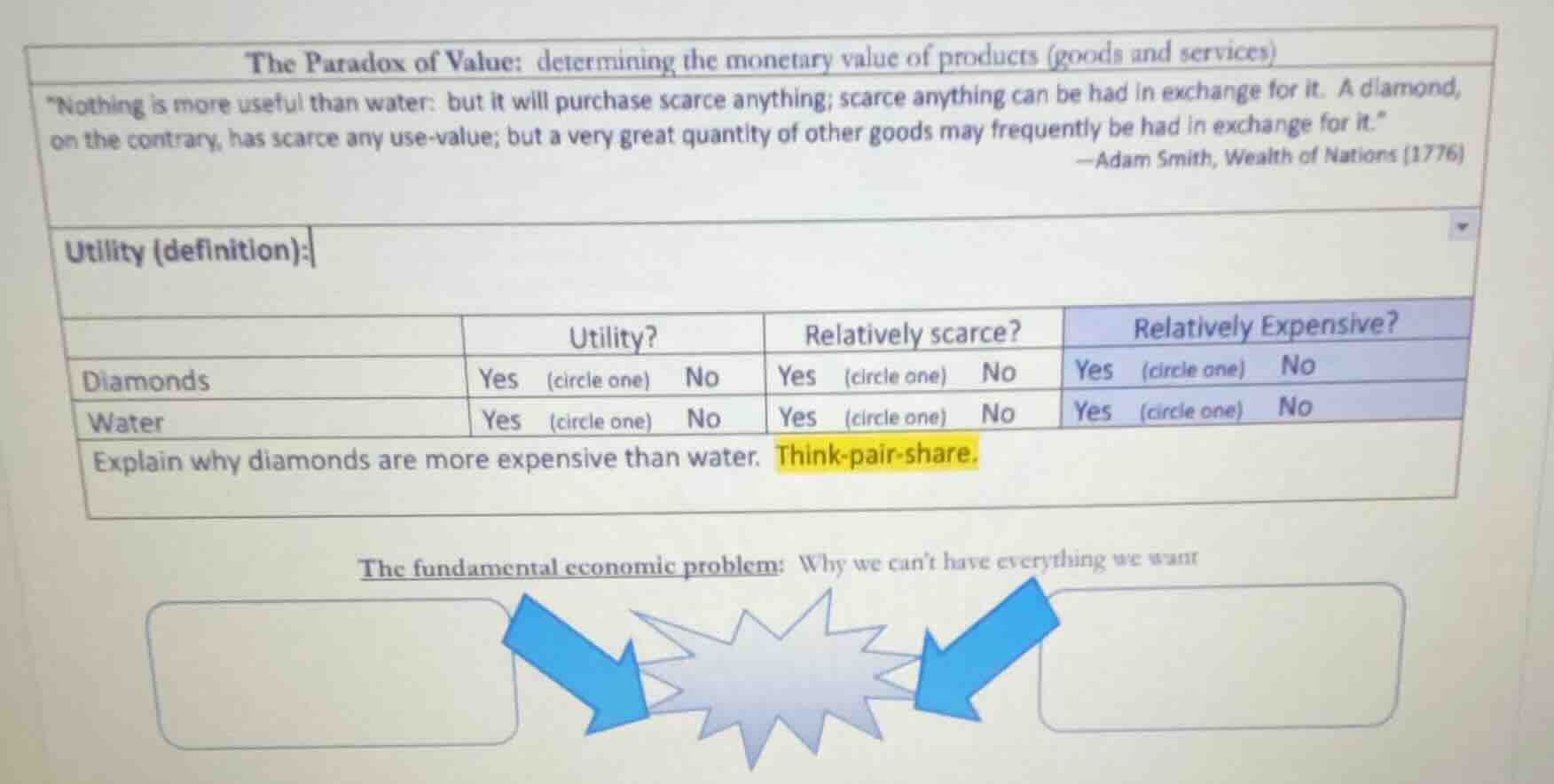
the paradox of value: determining the monetary value of products (goods and services)
othing is more useful than water: but it will purchase scarce anything; scarce anything can be had in exchange for it. a diamond, on the contrary, has scarce any use - value; but a very great quantity of other goods may frequently be had in exchange for it.\
—adam smith, wealth of nations (1776)
utility (definition):
| utility? | relatively scarce? | relatively expensive? | |
|---|---|---|---|
| water | yes (circle one) no | yes (circle one) no | yes (circle one) no |
explain why diamonds are more expensive than water. think - pair - share.
the fundamental economic problem: why we cant have everything we want
Brief Explanations
- Utility Definition: Utility in economics refers to the satisfaction or benefit a consumer gains from using a good or service.
- Table Completion:
- Diamonds have utility (they satisfy desires like adornment), are relatively scarce (limited supply), and are relatively expensive.
- Water has high utility (vital for survival), is not relatively scarce (abundant in most regions), and is not relatively expensive.
- Diamond-Water Paradox Explanation: The price of a good depends on marginal utility (the satisfaction from the last unit consumed) and scarcity, not total utility. Water has high total utility but low marginal utility because it is abundant—each additional unit provides little extra benefit. Diamonds have low total utility but very high marginal utility because they are scarce; each diamond provides a large amount of additional satisfaction. Prices reflect this marginal utility, making diamonds more expensive.
- Fundamental Economic Problem: The core issue is the conflict between unlimited human wants and limited (scarce) economic resources (land, labor, capital, entrepreneurship). This mismatch means we cannot have everything we desire, forcing choices about resource allocation.

Snap & solve any problem in the app
Get step-by-step solutions on Sovi AI
Photo-based solutions with guided steps
Explore more problems and detailed explanations
- Utility (definition): The satisfaction/benefit from consuming a good/service.
- Table Responses:
- Diamonds: Utility? Yes; Relatively scarce? Yes; Relatively Expensive? Yes
- Water: Utility? Yes; Relatively scarce? No; Relatively Expensive? No
- Why diamonds are more expensive than water: Prices depend on marginal utility and scarcity. Water is abundant, so its marginal utility (benefit of one more unit) is very low. Diamonds are scarce, so their marginal utility is very high, driving up their price, even though water has higher total utility for survival.
- Fundamental economic problem boxes:
- Left box: Unlimited human wants
- Right box: Limited (scarce) economic resources