QUESTION IMAGE
Question
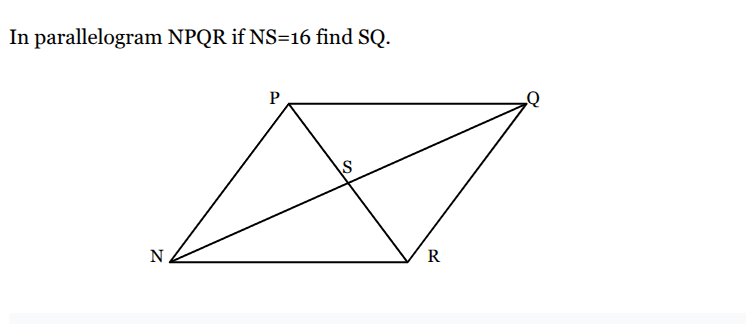
in parallelogram npqr if ns=16 find sq.
Step1: Recall property of parallelogram diagonals
In a parallelogram, the diagonals bisect each other. So, in parallelogram \( NPQR \), the diagonals \( NQ \) and \( PR \) intersect at \( S \), which means \( NS = SQ \). Wait, no, actually, the diagonals bisect each other, so \( NS = SQ \)? Wait, no, let's correct. Wait, the diagonals of a parallelogram bisect each other, so the point of intersection \( S \) divides each diagonal into two equal parts. So, for diagonal \( NQ \), \( NS = SQ \)? Wait, no, if \( NS = 16 \), then since \( S \) is the midpoint, \( SQ = NS \)? Wait, no, wait, maybe I mixed up. Wait, in a parallelogram, diagonals bisect each other, so \( NS = SQ \)? Wait, no, let's think again. The diagonals are \( NQ \) and \( PR \). They intersect at \( S \), so \( NS = SQ \) and \( PS = SR \). Wait, so if \( NS = 16 \), then \( SQ = NS = 16 \)? Wait, no, that can't be. Wait, maybe the diagonal is \( NQ \), so \( NQ = NS + SQ \), and since \( S \) is the midpoint, \( NS = SQ \), so \( SQ = 16 \)? Wait, no, maybe I made a mistake. Wait, no, in a parallelogram, diagonals bisect each other, so the length from \( N \) to \( S \) is equal to the length from \( S \) to \( Q \). So if \( NS = 16 \), then \( SQ = 16 \)? Wait, but that seems too simple. Wait, maybe the diagram is different. Wait, the parallelogram is \( NPQR \), with vertices \( N, P, Q, R \). So the diagonals are \( NQ \) and \( PR \), intersecting at \( S \). So \( S \) is the midpoint of both diagonals. Therefore, \( NS = SQ \), so \( SQ = 16 \). Wait, but maybe the problem is that \( NS \) is half of \( NQ \), so \( NQ = 2 \times NS \), but \( SQ \) is equal to \( NS \)? Wait, no, \( NQ = NS + SQ \), and since \( S \) is the midpoint, \( NS = SQ \), so \( SQ = NS = 16 \). Wait, that makes sense. So the key property is that diagonals of a parallelogram bisect each other, so \( S \) is the midpoint of \( NQ \), hence \( NS = SQ \).
Step1: Apply the property of parallelogram diagonals
In a parallelogram, the diagonals bisect each other. This means that the point of intersection \( S \) of the diagonals \( NQ \) and \( PR \) divides each diagonal into two equal parts. Therefore, \( NS = SQ \).
Step2: Substitute the given value
Given that \( NS = 16 \), we use the property \( NS = SQ \) to find \( SQ \). So, \( SQ = NS = 16 \).

Snap & solve any problem in the app
Get step-by-step solutions on Sovi AI
Photo-based solutions with guided steps
Explore more problems and detailed explanations
\( \boxed{16} \)