QUESTION IMAGE
Question
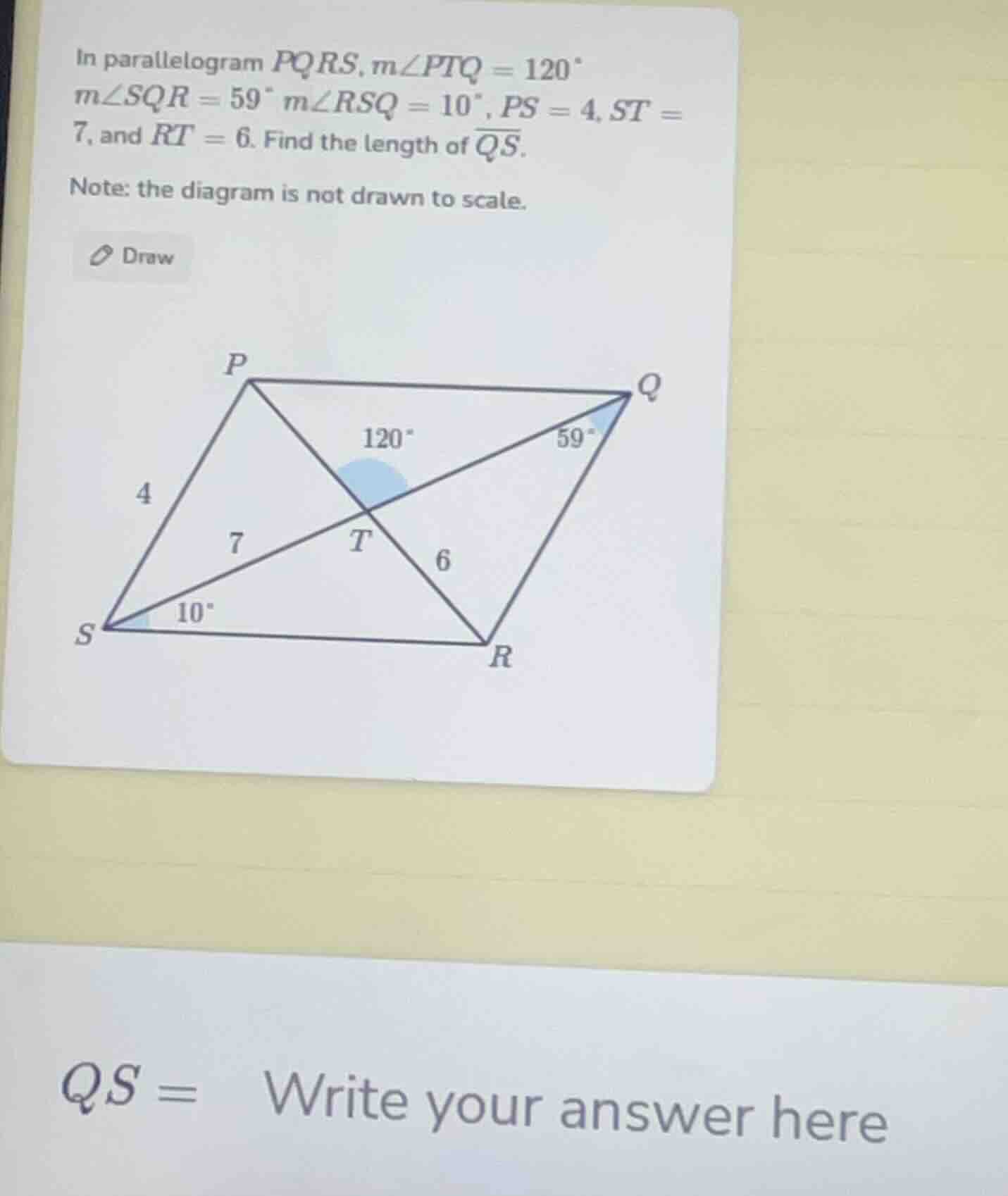
in parallelogram pqrs, ( mangle ptq = 120^circ )( mangle sqr = 59^circ ) ( mangle rsq = 10^circ ), ( ps = 4 ), ( st = 7 ), and ( rt = 6 ). find the length of ( overline{qs} ).
note: the diagram is not drawn to scale.
Step1: Analyze the parallelogram properties
In a parallelogram \(PQRS\), the diagonals bisect each other? Wait, no, actually, in a parallelogram, the diagonals bisect each other, but here we need to find \(QS\). Wait, \(QS\) is a diagonal? Wait, no, looking at the diagram, \(S\) to \(Q\) is a diagonal? Wait, no, \(ST\) and \(TQ\) are parts of \(QS\)? Wait, \(ST = 7\), and we need to find \(TQ\) first? Wait, maybe we can use the Law of Sines or Law of Cosines in triangle \(SQR\) or triangle \(STQ\)? Wait, let's check the angles.
Wait, in triangle \(SQR\), we have \(\angle RSQ = 10^\circ\), \(\angle SQR = 59^\circ\), so the third angle \(\angle SRQ = 180^\circ - 10^\circ - 59^\circ = 111^\circ\). But maybe that's not helpful. Wait, \(PS = 4\), and in a parallelogram, \(PS = QR = 4\). Also, \(RT = 6\), so \(PR = PT + RT\), but \(PT\) is unknown. Wait, maybe we can use the Law of Sines in triangle \(QRT\) or \(PTS\)? Wait, no, let's look at triangle \(STQ\) and \(STR\)? Wait, maybe the key is that \(QS = ST + TQ\), so we need to find \(TQ\). Let's check triangle \(QRT\) and \(PTS\). Wait, in parallelogram \(PQRS\), \(PS \parallel QR\), so \(\angle PST = \angle RQT\)? Wait, maybe not. Wait, let's check the angles at \(T\). \(\angle PTQ = 120^\circ\), so \(\angle STQ = 180^\circ - 120^\circ = 60^\circ\) (since they are supplementary). Wait, \(\angle STQ = 60^\circ\). Now, in triangle \(STQ\), we have \(ST = 7\), \(RT = 6\), \(QR = 4\). Wait, maybe use the Law of Sines in triangle \(QRT\) and triangle \(PTS\)? Wait, no, let's see: in triangle \(PTS\) and triangle \(QRT\), are they similar? Wait, \(PS = QR = 4\), \(\angle PTS = \angle QTR = 120^\circ\) (vertical angles). Wait, if we can use the Law of Sines: \(\frac{PS}{\sin \angle PTS} = \frac{PT}{\sin \angle PSP}\)? No, maybe not. Wait, another approach: in triangle \(SQR\), we have sides \(QR = 4\), \(RT = 6\)? No, \(RT\) is part of \(PR\). Wait, maybe I made a mistake. Wait, the problem is to find \(QS\), which is \(ST + TQ\), so \(QS = 7 + TQ\). So we need to find \(TQ\). Let's look at triangle \(QRT\) and triangle \(PTS\). Since \(PQRS\) is a parallelogram, \(PS = QR = 4\), and \(\angle PTS = \angle QTR = 120^\circ\) (vertical angles). Also, \(\angle RST = 10^\circ\), \(\angle SQR = 59^\circ\). Wait, maybe use the Law of Sines in triangle \(PTS\): \(\frac{PS}{\sin \angle PTS} = \frac{ST}{\sin \angle SPT}\). Wait, \(\angle PTS = 120^\circ\), \(PS = 4\), \(ST = 7\). So \(\frac{4}{\sin 120^\circ} = \frac{7}{\sin \angle SPT}\). \(\sin 120^\circ = \frac{\sqrt{3}}{2}\), so \(\frac{4}{\frac{\sqrt{3}}{2}} = \frac{7}{\sin \angle SPT}\) → \(\frac{8}{\sqrt{3}} = \frac{7}{\sin \angle SPT}\) → \(\sin \angle SPT = \frac{7\sqrt{3}}{8}\), which is greater than 1, which is impossible. So that approach is wrong. Wait, maybe the angles are different. Wait, \(\angle PTQ = 120^\circ\), so \(\angle STQ = 60^\circ\) (supplementary). Now, in triangle \(STQ\), we have \(ST = 7\), \(QR = 4\), \(RT = 6\). Wait, maybe use the Law of Sines in triangle \(QRT\): \(\frac{QR}{\sin \angle QTR} = \frac{RT}{\sin \angle RQT}\). \(\angle QTR = 120^\circ\), \(QR = 4\), \(RT = 6\). So \(\frac{4}{\sin 120^\circ} = \frac{6}{\sin \angle RQT}\) → \(\sin \angle RQT = \frac{6 \times \frac{\sqrt{3}}{2}}{4} = \frac{3\sqrt{3}}{4}\), which is also greater than 1. Impossible. So I must have misidentified the angles. Wait, the problem says \(m\angle SQR = 59^\circ\), \(m\angle RSQ = 10^\circ\). So in triangle \(SQR\), angles at \(S\) is \(10^\circ\), at \(Q\) is \(59^\circ\), so angle at \(R\) is \(180 - 10 - 59 = 111^\circ\). Now,…

Snap & solve any problem in the app
Get step-by-step solutions on Sovi AI
Photo-based solutions with guided steps
Explore more problems and detailed explanations
\(14\)