QUESTION IMAGE
Question
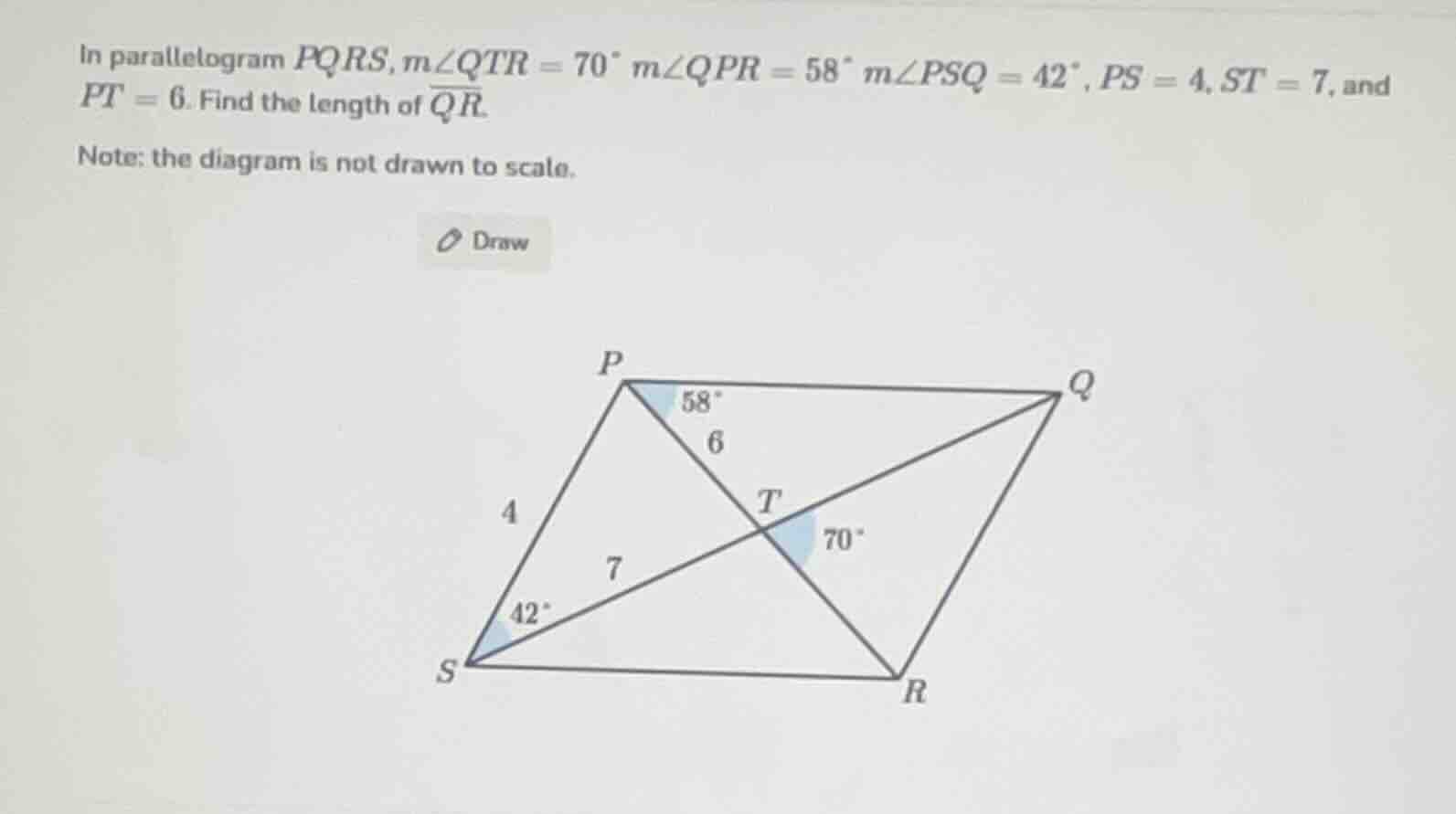
in parallelogram pqrs, ( mangle qtr = 70^circ ), ( mangle qpr = 58^circ ), ( mangle psq = 42^circ ), ( ps = 4 ), ( st = 7 ), and ( pt = 6 ). find the length of ( overline{qr} ).
note: the diagram is not drawn to scale.
Step 1: Recall properties of parallelograms
In a parallelogram, opposite sides are equal, and also, the triangles formed by the diagonals have some congruent or similar properties. Also, \(PS \parallel QR\) and \(PS = QR\)? Wait, no, in a parallelogram \(PS = QR\) and \(PQ = SR\), but also, the alternate interior angles might be equal. Wait, but let's check the triangles. Wait, in parallelogram \(PQRS\), \(PS \parallel QR\), so \(\angle PSQ=\angle RQS\) (alternate interior angles). Given \(\angle PSQ = 42^\circ\), so \(\angle RQS = 42^\circ\). Also, let's look at triangles \(PTS\) and \(QTR\)? Wait, no, maybe triangles \(PSQ\) and \(RQS\)? Wait, no, let's check the sides. Wait, in a parallelogram, \(PS = QR\)? Wait, no, \(PS\) and \(QR\) are opposite sides, so they should be equal. Wait, \(PS = 4\), so is \(QR = 4\)? Wait, that can't be right, maybe I made a mistake. Wait, no, wait the problem is to find \(QR\), and in a parallelogram, opposite sides are equal. So \(PS\) and \(QR\) are opposite sides, so \(PS = QR\). Wait, \(PS = 4\), so \(QR = 4\)? But that seems too easy. Wait, maybe I misread the diagram. Wait, the diagram has \(PS = 4\), and in a parallelogram, \(PS \parallel QR\) and \(PS = QR\). So regardless of the angles, the length of \(QR\) should be equal to \(PS\) because they are opposite sides of a parallelogram.
Step 2: Confirm with parallelogram properties
In a parallelogram, opposite sides are congruent. So \(PS \cong QR\), which means \(PS = QR\). Given \(PS = 4\), so \(QR = 4\).

Snap & solve any problem in the app
Get step-by-step solutions on Sovi AI
Photo-based solutions with guided steps
Explore more problems and detailed explanations
\(4\)