QUESTION IMAGE
Question
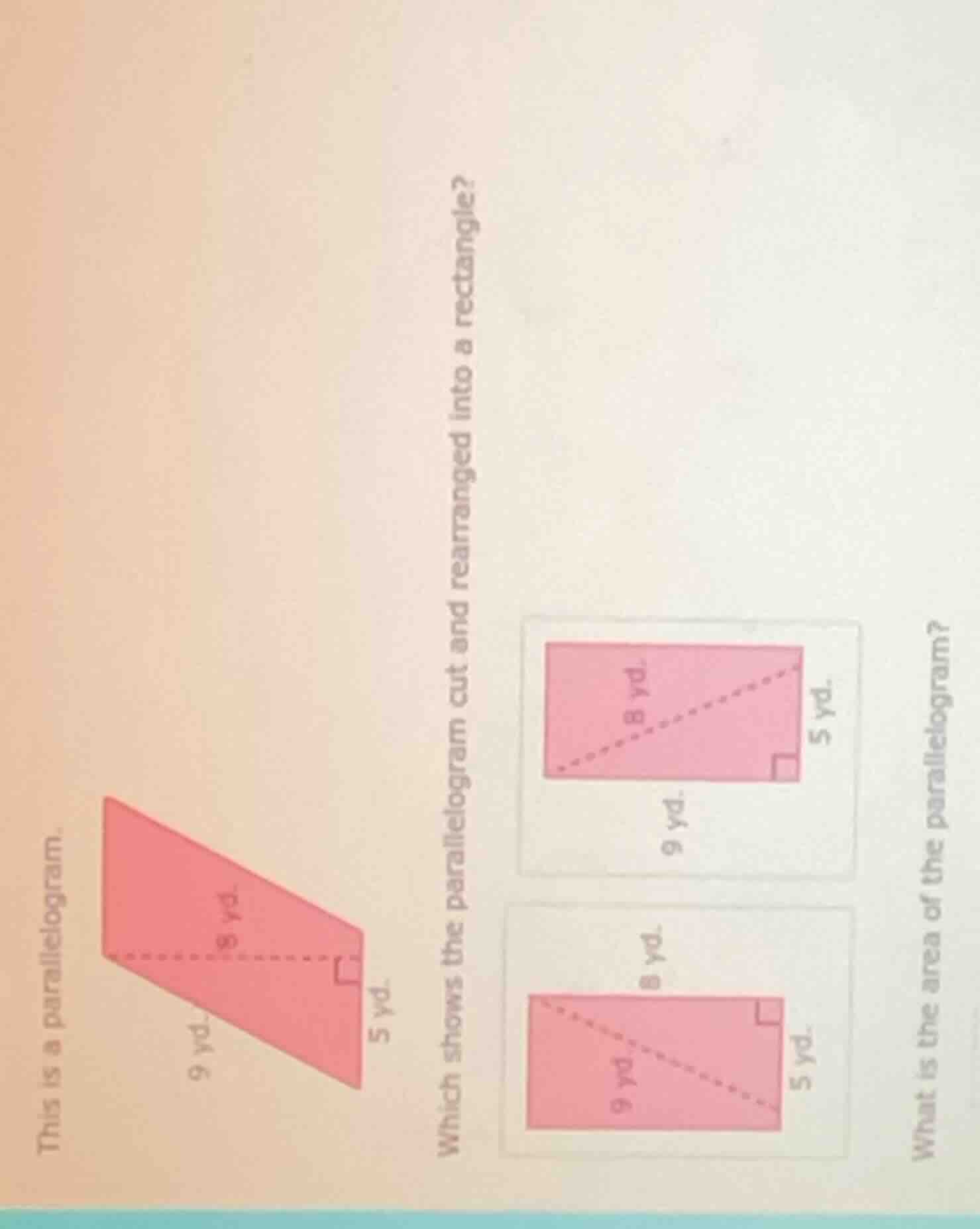
this is a parallelogram.
which shows the parallelogram cut and rearranged into a rectangle?
what is the area of the parallelogram?
Part 1: Identifying the Correct Rearrangement
To determine which diagram shows the parallelogram cut and rearranged into a rectangle, we recall that when a parallelogram is cut along a height and rearranged, the resulting rectangle should have a length equal to the base of the parallelogram and a width equal to the height of the parallelogram. The original parallelogram has a base of 9 yd and a height of 5 yd (the vertical side). When cut and rearranged, the rectangle should have length 9 yd and width 5 yd. Looking at the options, the second diagram (the lower one) shows a rectangle with length 9 yd and width 5 yd, formed by rearranging the cut part of the parallelogram. The first diagram has a slanted side which is not part of the rectangle formation. So the correct diagram is the lower one (the second option).
Part 2: Calculating the Area of the Parallelogram
The area of a parallelogram is given by the formula \( A = base \times height \). Here, the base of the parallelogram is 9 yards and the height is 5 yards (since when rearranged into a rectangle, the height of the parallelogram becomes the width of the rectangle and the base remains the same).
Step 1: Identify the base and height
The base (\( b \)) of the parallelogram is 9 yd, and the height (\( h \)) is 5 yd.
Step 2: Apply the area formula for a parallelogram
The formula for the area of a parallelogram is \( A = b \times h \). Substituting the values, we get \( A = 9 \times 5 \).
Step 3: Calculate the product
\( 9 \times 5 = 45 \).

Snap & solve any problem in the app
Get step-by-step solutions on Sovi AI
Photo-based solutions with guided steps
Explore more problems and detailed explanations
- The diagram that shows the parallelogram cut and rearranged into a rectangle is the lower one (with length 9 yd and width 5 yd).
- The area of the parallelogram is 45 square yards.