QUESTION IMAGE
Question
parallelograms
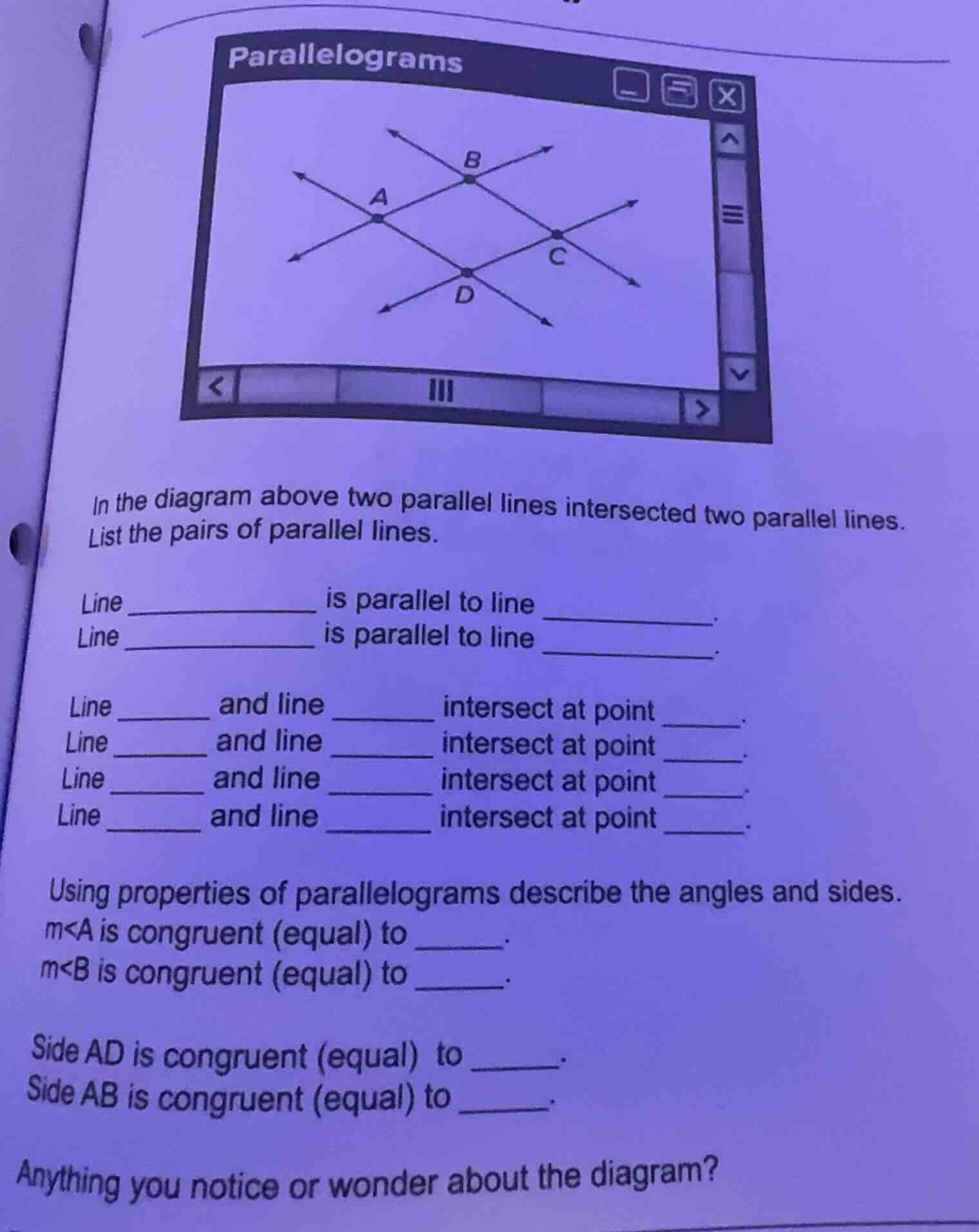
in the diagram above two parallel lines intersected two parallel lines.
list the pairs of parallel lines.
line __________ is parallel to line __________.
line __________ is parallel to line __________.
line ____ and line __ intersect at point ____.
line ____ and line __ intersect at point ____.
line ____ and line __ intersect at point ____.
line ____ and line __ intersect at point ____.
using properties of parallelograms describe the angles and sides.
m< a is congruent (equal) to ______.
m< b is congruent (equal) to ______.
side ad is congruent (equal) to ______.
side ab is congruent (equal) to ______.
anything you notice or wonder about the diagram?
Part 1: Pairs of Parallel Lines
From the diagram (a parallelogram formed by intersecting parallel lines), we identify the parallel line pairs:
- Line \( AB \) is parallel to line \( CD \) (since \( ABCD \) is a parallelogram, opposite sides are parallel).
- Line \( AD \) is parallel to line \( BC \) (same reasoning, opposite sides of a parallelogram are parallel).
Part 2: Intersecting Lines and Points
- Line \( AB \) and line \( AD \) intersect at point \( A \).
- Line \( AB \) and line \( BC \) intersect at point \( B \).
- Line \( BC \) and line \( CD \) intersect at point \( C \).
- Line \( CD \) and line \( AD \) intersect at point \( D \).
Part 3: Angles and Sides (Properties of Parallelograms)
Angles:
- In a parallelogram, opposite angles are congruent. So \( m\angle A \) is congruent to \( m\angle C \).
- \( m\angle B \) is congruent to \( m\angle D \).
Sides:
- In a parallelogram, opposite sides are congruent. So side \( AD \) is congruent to side \( BC \).
- Side \( AB \) is congruent to side \( CD \).
Final Answers (Filling in the Blanks):
Parallel Lines:
Line \( \boldsymbol{AB} \) is parallel to line \( \boldsymbol{CD} \).
Line \( \boldsymbol{AD} \) is parallel to line \( \boldsymbol{BC} \).
Intersecting Lines:
Line \( \boldsymbol{AB} \) and line \( \boldsymbol{AD} \) intersect at point \( \boldsymbol{A} \).
Line \( \boldsymbol{AB} \) and line \( \boldsymbol{BC} \) intersect at point \( \boldsymbol{B} \).
Line \( \boldsymbol{BC} \) and line \( \boldsymbol{CD} \) intersect at point \( \boldsymbol{C} \).
Line \( \boldsymbol{CD} \) and line \( \boldsymbol{AD} \) intersect at point \( \boldsymbol{D} \).
Angles:
\( m\angle A \) is congruent to \( \boldsymbol{m\angle C} \).
\( m\angle B \) is congruent to \( \boldsymbol{m\angle D} \).
Sides:
Side \( AD \) is congruent to \( \boldsymbol{BC} \).
Side \( AB \) is congruent to \( \boldsymbol{CD} \).
(For the "Anything you notice or wonder" part: The diagram forms a parallelogram, so the diagonals bisect each other, and consecutive angles are supplementary. You might wonder if the lines are equally spaced or if the parallelogram is a rhombus/square, but that depends on more details.)

Snap & solve any problem in the app
Get step-by-step solutions on Sovi AI
Photo-based solutions with guided steps
Explore more problems and detailed explanations
Part 1: Pairs of Parallel Lines
From the diagram (a parallelogram formed by intersecting parallel lines), we identify the parallel line pairs:
- Line \( AB \) is parallel to line \( CD \) (since \( ABCD \) is a parallelogram, opposite sides are parallel).
- Line \( AD \) is parallel to line \( BC \) (same reasoning, opposite sides of a parallelogram are parallel).
Part 2: Intersecting Lines and Points
- Line \( AB \) and line \( AD \) intersect at point \( A \).
- Line \( AB \) and line \( BC \) intersect at point \( B \).
- Line \( BC \) and line \( CD \) intersect at point \( C \).
- Line \( CD \) and line \( AD \) intersect at point \( D \).
Part 3: Angles and Sides (Properties of Parallelograms)
Angles:
- In a parallelogram, opposite angles are congruent. So \( m\angle A \) is congruent to \( m\angle C \).
- \( m\angle B \) is congruent to \( m\angle D \).
Sides:
- In a parallelogram, opposite sides are congruent. So side \( AD \) is congruent to side \( BC \).
- Side \( AB \) is congruent to side \( CD \).
Final Answers (Filling in the Blanks):
Parallel Lines:
Line \( \boldsymbol{AB} \) is parallel to line \( \boldsymbol{CD} \).
Line \( \boldsymbol{AD} \) is parallel to line \( \boldsymbol{BC} \).
Intersecting Lines:
Line \( \boldsymbol{AB} \) and line \( \boldsymbol{AD} \) intersect at point \( \boldsymbol{A} \).
Line \( \boldsymbol{AB} \) and line \( \boldsymbol{BC} \) intersect at point \( \boldsymbol{B} \).
Line \( \boldsymbol{BC} \) and line \( \boldsymbol{CD} \) intersect at point \( \boldsymbol{C} \).
Line \( \boldsymbol{CD} \) and line \( \boldsymbol{AD} \) intersect at point \( \boldsymbol{D} \).
Angles:
\( m\angle A \) is congruent to \( \boldsymbol{m\angle C} \).
\( m\angle B \) is congruent to \( \boldsymbol{m\angle D} \).
Sides:
Side \( AD \) is congruent to \( \boldsymbol{BC} \).
Side \( AB \) is congruent to \( \boldsymbol{CD} \).
(For the "Anything you notice or wonder" part: The diagram forms a parallelogram, so the diagonals bisect each other, and consecutive angles are supplementary. You might wonder if the lines are equally spaced or if the parallelogram is a rhombus/square, but that depends on more details.)